Table of Contents
Quick Summary
Learning music is more than learning to sing or play an instrument. It can improve focus, discipline, emotional expression, listening skills, and connection with culture. At Spardha School of Music, beginners can learn instruments and vocals through structured, personalised lessons with experienced instructors. Music education can also open doors to careers in performance, teaching, production, composition, music therapy, and more. You don't need prior experience or exceptional talent to begin, just the right guidance, regular practice, and an interest in learning.
Most people have a relationship with music. Very few have thought seriously about what happens when that relationship shifts from passive to active.
There's a real difference between listening to music and actually learning it. When you learn music, you stop being an audience member and start being a participant. The way you hear a song changes; the way you understand what's happening inside a piece of music changes. And this is the part that surprises most people: the way you feel changes too.
This article breaks down why music education matters, what genuine benefits it produces, what you can actually do with it, and how to start even if you've never touched an instrument in your life.
What Is Music, Really?
Music is more than background entertainment. It is a form of communication that uses sound, melody, harmony, and rhythm to express ideas, emotions, stories, and cultural experiences.
A song or musical composition can connect people even when they don’t speak the same language or share the same cultural background. A piece written centuries ago can still create an emotional response in someone hearing it for the first time today.
This is also why music education is important. When you learn music, you are not simply learning how to sing or play an instrument. You are learning how musical elements work together, developing your ability to listen and express yourself, and becoming familiar with the traditions and ideas that have shaped music over generations.
Why You Should Learn Music: Real Benefits With Evidence Behind Them
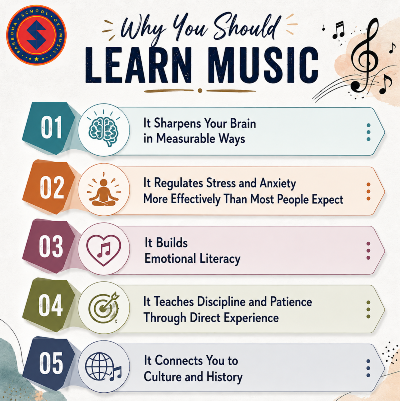
1. It Sharpens Your Brain in Measurable Ways
Learning to play an instrument or sing requires your brain to process multiple streams of information simultaneously: pitch, rhythm, dynamics, finger or breath coordination, and in many cases, reading notation while physically performing. That multi-channel cognitive demand is unusual in everyday activity, and the research consistently shows it has lasting effects.
Studies have found that music education correlates with improved mathematical reasoning and reading ability in children, and that sustained musical practice is associated with slower cognitive decline in older adults. The mechanism isn't mysterious: you're exercising the brain's capacity to integrate information across multiple systems at once, and that capacity, like any trained capability, strengthens with practice.
2. It Regulates Stress and Anxiety More Effectively Than Most People Expect
Playing music activates the parasympathetic nervous system, the one responsible for rest and recovery. It reduces cortisol levels, lowers blood pressure, and slows heart rate in various ways that have been documented across multiple studies. This isn't the same as saying music is relaxing because it's pleasant. The physiological effect is real and measurable, and not just a subjective impression.
If you're looking at how to learn music at home partly because you need a productive outlet for stress, this is a genuine reason to start rather than a marketing claim.
3. It Builds Emotional Literacy
Learning to express emotion through an instrument or voice requires a level of emotional awareness that most other activities don't develop. You have to understand what a piece of music is expressing before you can perform it expressively. That introspective work of figuring out what a phrase means, what emotional weight a particular note should carry, and how to communicate a feeling through sound rather than words develops a kind of emotional intelligence that moves into other areas of life.
This is particularly significant for children and adolescents, who are still building the emotional vocabulary and self-awareness that adult life requires.
4. It Teaches Discipline and Patience Through Direct Experience
Progress in music is slow, visible, and earned. Neither can you fake a clean scale run, nor can you shortcut the process of building finger strength or breath control. The feedback is immediate: you either hit the note or you don't, and the only path to improvement is consistent, focused practice.
For children especially, learning music provides one of the clearest demonstrations that effort produces results in a way that school subjects sometimes obscure. The lesson of difficult things becoming easier through patient repetition is more convincingly taught by a musical instrument than by almost any other medium.
5. It Connects You to Culture and History
Music isn't just a skill. It's a living record of how people have felt, celebrated, mourned, and organised their lives across centuries and across cultures:
- When you learn a raga, you're connecting to a tradition of organised sound that goes back over two thousand years.
- When you learn a Western classical piece, you're playing music that shaped how millions of people understood beauty and structure.
That connection to something larger than your own experience is not a small thing.
The Building Blocks: Understanding Basic Music Theory
You don't need to master music theory before you start learning. But a basic understanding of how music is structured helps you learn faster and understand what you're doing rather than simply following instructions.
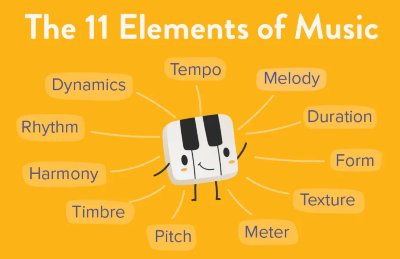
Melody is the main tune - the sequence of single notes that your ear follows as the primary line of a piece. It's what you're humming when you remember a song.
Harmony is the accompaniment - the chords and supporting notes that give the melody its emotional context. The same melody sounds completely different over a major chord versus a minor chord because the harmony changes what the melody means.
Rhythm is the organisation of sound in time. It's the beat structure that makes music feel urgent, relaxed, joyful, or mournful and that element of music that the body responds to most directly. Which is why people tap their feet before they've consciously registered what they're listening to.
Understanding how these three elements work together is the beginning of ‘how to learn music’ at a structural level rather than a purely imitative one. You're no longer just copying sounds but understanding why the sounds produce the effect they do.
What You Can Do With Music: Career Paths Worth Knowing
One of the most persistent misconceptions about music education is that it leads to one place: performing on stage. The reality is considerably more varied.
Music performer or playback singer: The most visible path is genuinely viable for committed students who develop strong technique and stage presence.
Music educator or teacher: The demand for qualified music teachers across India's growing EdTech and private education sectors is substantial and increasing. The best music learning classes in India are expanding specifically because qualified instructors are in demand.
Recording engineer or music producer: Technical and creative roles that shape the sound of recorded music. These require an understanding of music alongside technical production knowledge.
Music therapist: A growing field that uses structured music intervention for therapeutic purposes, working with patients across conditions from anxiety and depression to neurological rehabilitation.
Music journalist or critic: Writing about music at a serious level requires genuine musical understanding without enthusiasm. Publications and platforms that cover music in depth need writers who can discuss what's actually happening in a piece of music rather than simply describing their emotional response to it.
Composer or arranger: Writing original music for films, advertising, media, or concert performance. India's film music industry alone generates significant ongoing demand for composed and arranged music.
The point is that music education doesn't funnel into a single narrow career path but opens into a range of creative, technical, and educational roles that have real market demand.
Start Learning Music With Spardha
The best music learning class in India for your specific needs is taught by a certified instructor who adjusts their teaching to your level, goals, and pace. At Spardha School of Music, that's exactly what every student gets.
Our live, 1-on-1 online classes cover Hindustani vocals, Western vocals, guitar, piano, keyboard, tabla, flute, violin, and more. Whether you're a parent building your child's cognitive and emotional development through structured music education, an adult who's been wanting to start for years, or an NRI family wanting to stay connected to Indian musical traditions from abroad, our certified instructors meet you at your starting point.
No generic pre-recorded content. No large groups where you disappear. It’s real teaching, real feedback, and real progress.
Book a free trial class today at Spardha School of Music and find out what learning music feels like when it's taught well.
Conclusion
Learning music isn't a luxury or a niche interest. It's one of the most cognitively, emotionally, and culturally rich things a person can do with consistent time and attention. The benefits are real, the career paths are broader than most people assume, and the starting point is more accessible than it's ever been.
The only question is when you start.
Frequently Asked Questions
Is it too late to learn music as an adult?
No. Adults learn music successfully at every age. The process is different from childhood learning; adults develop technique and theory understanding faster, but may take longer to build certain physical habits, but there is no age at which musical learning becomes impossible.
What is the importance of music education for children specifically?
Music education builds cognitive skills, including mathematical reasoning, reading ability, and multitasking capacity. It also develops emotional literacy, discipline, and patience in ways that most other school subjects don't. Children who study music consistently tend to demonstrate these benefits across other areas of their education.
How do I learn music at home without a teacher?
Self-teaching through books and online tutorials is possible but significantly slower and more likely to build incorrect habits than structured instruction. Live, 1-on-1 online classes from a qualified instructor combine the convenience of learning at home with the quality of real-time feedback. That's the most practical approach to learning music at home effectively.
How long does it take to learn to play an instrument?
Most beginners can play simple songs within two to three months of consistent daily practice. Genuine musical competence, where you can learn new pieces independently and perform for others comfortably, typically takes one to two years. Mastery is a longer process, but meaningful progress comes much sooner than most beginners expect.
Do I need to learn music theory to play an instrument?
Not before you start, but basic theory knowledge significantly accelerates progress once you've begun. Understanding why certain notes work together, how rhythmic patterns are structured, and how to read notation opens up material that pure ear learning can't access efficiently.
What instruments are best for beginners?
Piano and keyboard are commonly recommended because the visual layout of the keys makes the relationship between notes immediately clear. Guitar is another strong beginner choice because it's physically portable and has an enormous body of learning resources available. For Indian traditions, the harmonium or tabla is a natural starting point. Ultimately, the best instrument for a beginner is the one they actually want to play.