Table of Contents
Quick Summary
The Veena and Sitar are both plucked string instruments central to Indian classical music, but their differences go far beyond that. The Veena is the foundational instrument of Carnatic classical music, associated with the goddess Saraswati and documented in Indian tradition for over two thousand years. On the contrary, the Sitar belongs to the Hindustani classical tradition of North India, shaped by Mughal court culture and made globally recognisable through Ravi Shankar's recordings and performances. Their construction, tuning systems, playing techniques, and musical functions are distinct enough that comparing them is less like comparing two guitars and more like comparing a harpsichord and a lute.
Most people who ask about Veena vs Sitar already know they're both Indian classical string instruments. What they usually don't know is how completely different they actually are; not just in sound, but in structural logic, playing technique, musical tradition, and cultural meaning.
The comparison comes up frequently because both instruments look, to the uninitiated eye, like variations on the same idea: a long neck, a gourd resonator, multiple strings, played seated. Beneath that visual similarity is a considerably more interesting story. The Sitar and Veena emerged from different geographic and cultural contexts, developed in response to different musical systems, and require different physical techniques from the player. A Sitar player picking up a Veena for the first time is not playing a familiar instrument with minor differences but starting from the beginning.
Understanding the difference between Sitar and Veena gives you a window into how two of the world's great classical music traditions developed independently and why they sound so fundamentally unlike each other.
What Is Veena?
The Veena is a traditional Indian plucked string instrument closely associated with Carnatic classical music. The Saraswati Veena, its best-known form, is also associated with Saraswati, the Hindu goddess of knowledge, music and the arts.
Its main features include:
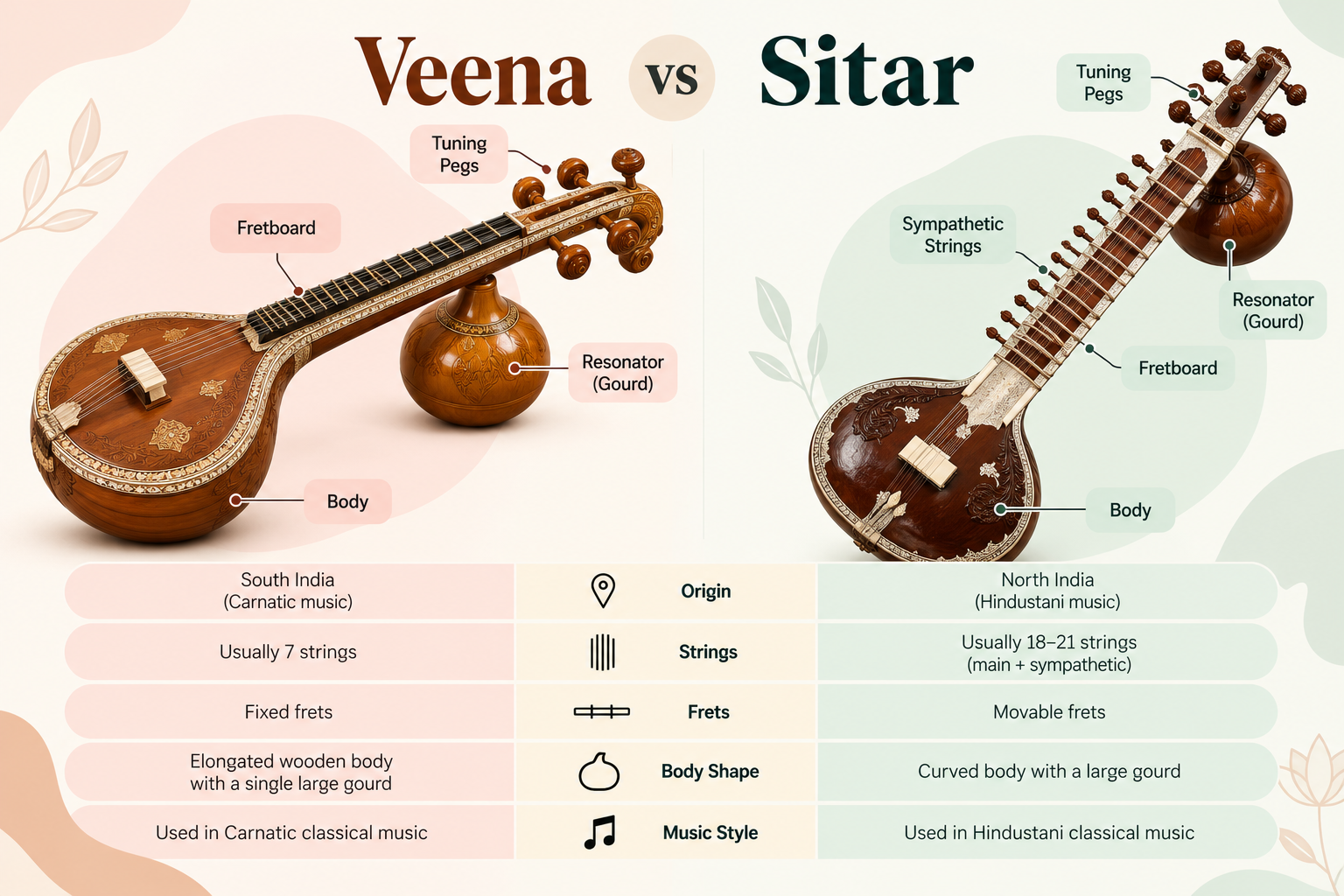
- Structure: A long neck with a large resonating body and a smaller decorative gourd.
- Strings: Four main playing strings and three additional rhythm or drone strings.
- Frets: Fixed frets set into wax.
- Playing technique: The right hand plucks the strings, while the left hand produces notes and gamakas (melodic ornaments).
- Sound: Warm, clear and resonant.
The Veena is especially suited to the melodic ornamentation and compositions central to Carnatic music.
What Is Sitar?
The Sitar is a plucked string instrument widely used in Hindustani classical music. Its development reflects a blend of Indian musical traditions and historical influences from Persian music.
Its main features include:
- Structure: A long neck, a resonating gourd and a curved fretboard.
- Strings: Main playing strings, drone strings and sympathetic strings that vibrate in response to played notes.
- Frets: Movable, curved frets that can be adjusted for different ragas.
- Playing technique: A wire plectrum called a mizrab is worn on the index finger, while the left hand controls pitch and produces slides.
- Sound: Bright, shimmering and sustained.
The Sitar's sympathetic strings contribute to its distinctive resonant sound, while techniques such as meend create expressive pitch slides.
Sitar and Veena: The Key Differences
Veena vs Sitar vs Tanpura: Understanding the Third Instrument
The Veena and Sitar perform melodies and ragas, whereas the Tanpura sustains the tonic and its harmonics to support the vocalist or instrumentalist.
Which Is Harder to Learn: Veena or Sitar?
Both instruments require serious, sustained commitment, but neither is a short-term project.
The Veena's fixed frets make initial pitch production more straightforward; you press the string to the fret and the note is there. The physical challenge is the gamaka technique, which requires independent control of finger pressure on the string to produce the oscillating pitch effects central to Carnatic expression. Developing this technique to a performance level takes years, and the technique is sufficiently unusual that prior experience with any Western string instrument provides essentially no head start.
The Sitar's movable frets and wire mizrab create their own initial challenges. Getting a clean tone with the mizrab takes practice. The meend technique, i.e. bending across the curved frets, requires specific finger strength and control. And the sympathetic strings, while not directly played, need to be tuned correctly, which requires a trained ear before the instrument can be set up properly for each performance.
Both instruments are harder than they look. Both reward serious study with one of the richest melodic and ornamental vocabularies in any musical tradition.
Which Should You Learn?
The honest answer is whichever musical tradition you're drawn to.
If Carnatic classical music is the goal, the veena is the natural choice among string instruments. It excels at rendering Tyagaraja’s compositions, building deep vocal or instrumental insight, and grounding students in South India’s classical tradition. Simply put, the instrument was built specifically for this music.
Hindustani classical music demands a specific tool for its unique expressive needs. For students focused on North Indian raga improvisation, gharana-based tradition, and extended performance structures, the sitar is the definitive choice. As a matter of fact, its construction was shaped precisely for Hindustani music.
Neither instrument crosses traditions effectively. A Veena player learning Hindustani music has the wrong instrument for the job, and vice versa. In other words, the choice of instrument and the choice of tradition are inseparable.
Learn Indian Classical Music at Spardha
The difference between Sitar and Veena is ultimately a window into the difference between two great classical traditions, both of which require informed, certified instruction to approach properly.
At Spardha School of Music, our certified instructors teach across both Hindustani and Carnatic traditions in live, 1-on-1 online sessions. Whether you're drawn to the Veena's role in Carnatic music, the Sitar's place in the Hindustani tradition, or the vocal training that underlies both, our curriculum builds genuine musical understanding alongside technical instruction.
Spardha's online format removes geographic barriers for Indian diaspora families across the UK, US, Canada, Australia, and the UAE. Parents can now connect their children directly with authentic, highly qualified instructors without compromising educational quality.
Book a free trial class at Spardha School of Music today and begin learning within the tradition you're called to.
Conclusion
The Veena vs Sitar comparison ultimately reveals two instruments that share a continent and a general family resemblance but belong to different musical worlds. The Sitar and Veena difference runs from the instrument's construction through the:
- tuning system,
- playing technique,
- acoustic character, and
- the entire musical tradition within which it functions.
Understanding the difference between Sitar and Veena and the role of the Tanpura alongside both of them gives you a clearer picture of Indian classical music's astonishing internal diversity. Two traditions, sharing ancient roots, developing for centuries in different directions, producing instruments and music that are simultaneously related and completely distinct.
Both deserve serious engagement because both reward it.
Frequently Asked Questions
What is the main difference between Veena and Sitar?
The most fundamental Sitar and Veena difference is tradition: the Veena belongs to Carnatic classical music of South India, while the Sitar belongs to Hindustani classical music of North India. They also differ significantly in construction. The Sitar features thirteen sympathetic strings that the Veena lacks, as well as movable curved frets compared to the Veena's fixed ones. Furthermore, the playing techniques for both hands are completely distinct.
What is Veena and why is it significant?
What is Veena in cultural terms: it is the sacred instrument of Saraswati, the Hindu goddess of knowledge and arts, making it the most religiously significant string instrument in the Indian tradition. Musically, it is the foundational instrument of Carnatic classical music, used to perform ragas through a highly specific technique of gamaka (ornamental pitch oscillation) unique to the instrument.
Is the Sitar related to the Veena?
Both belong to the broader family of Indian plucked string instruments and share ancient common ancestry in instruments described in Sanskrit texts. The modern sitar and veena developed in distinct geographic and cultural environments. The veena evolved in South India within temple and royal court traditions, while the sitar emerged in North India under heavy Mughal court influence. Consequently, the two instruments are not directly related in their structural evolution.
What is the difference between Veena vs Sitar vs Tanpura?
The Veena vs Sitar vs Tanpura comparison requires separating function. The Veena and Sitar are melodic instruments that play ragas, they produce pitch sequences with ornament and expression. The Tanpura is a drone instrument that plays no melody, but only sustains the tonic note and its harmonics as a continuous backdrop for melodic performance. All three typically appear in a complete classical music performance but serve entirely different roles.
Which is more difficult, Veena or Sitar?
Both instruments require years of dedicated study to reach performance level. The Veena's gamaka technique, oscillating finger pressure producing continuous pitch movement, is physically unusual and takes years to develop. Whereas, the Sitar's meend technique and mizrab playing also require specific physical development. Neither is significantly more difficult than the other overall, though the challenges are different in character.
Can I learn Sitar or Veena online?
Yes. Live, 1-on-1 online instruction works effectively for both instruments. The key requirement is a teacher who is watching and listening to you specifically in real time not a pre-recorded tutorial. For both Veena and Sitar, technique errors in the early months of learning have lasting consequences, making qualified live instruction particularly important rather than self-directed YouTube learning.