Table of Contents
Quick Summary
String instruments produce sound through vibrating strings that are plucked, bowed, or struck. This guide explains the main types of string instruments, including guitar, violin, cello, ukulele, harp, sitar, sarod, veena, santoor, sarangi, and piano, and how each one produces its distinctive sound. It also explores the differences between Western and Indian string instruments, how string length and tension affect pitch, and which instruments are easier for beginners to learn.
Pull a single string tight between two fixed points, pluck it, and it vibrates. That vibration produces a pitch. Change the tension or the length, and the pitch changes. That's the entire principle behind string instruments, and from that one simple mechanism, human beings have built thousands of years of musical tradition.
It sounds almost too simple, isn’t it? Know that the complexity resides in how different cultures, materials, and playing techniques have taken that basic idea and pulled it in completely different directions. A violin and a sitar operate on the same fundamental principle. They sound nothing alike, demand completely different techniques, and belong to musical traditions that developed independently across continents.
You can refer to this guide that covers all of it: how string instruments are classified, the major families and their defining characteristics, the most important Indian string instruments, and which instrument might actually make sense for you to start learning.
How String Musical Instruments Work
Before the categories, let’s get to physics. Understanding why string musical instruments sound the way they do makes the difference between instrument families more intuitive.
When a string vibrates, it moves the air around it. But the string itself is too thin to move enough air to produce significant volume on its own. Therefore, almost every string instrument has a resonating body comprising a hollow wooden chamber that amplifies the string's vibration by allowing a larger surface of wood to move. The shape, size, and material of that body fundamentally shape the tone of the instrument. Like, a violin's sharp, focused projection comes from its small, tightly carved body, but a guitar's warmer, rounder sound comes from its larger, deeper body.
The pitch of the string is determined by:
- Length,
- Tension, and
- Mass.
Shorter strings vibrate faster and produce higher pitches, whereas higher tension produces higher pitches. But on the other hand, thinner strings vibrate faster than thicker ones. Every string instrument's design plays with these three variables to produce its characteristic range.
Types of String Instruments: The Main Classifications
String instruments are classified by how the string is set into vibration. There are three primary methods, and understanding them makes the whole family tree easier to navigate.
Bowed String Instruments
A bow is like a horsehair stretched across a stick that’s drawn across the string, creating continuous friction that keeps the string vibrating as long as the bow is moving. This sustained vibration is what gives bowed instruments their singing and legato quality. You can hold a note for as long as your bow stroke lasts, which is something plucked instruments can't do.
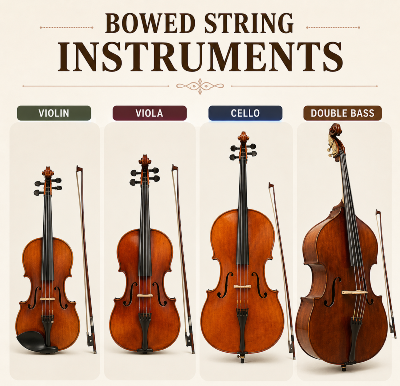
- As the highest-pitched member of the Western bowed string family, the violin remains its most widely played. Because its range extends above the human speaking voice, it carries a unique clarity and expressive power. These qualities have made it a cornerstone of classical orchestras, global folk traditions, and modern cinematic scores. The technical bar is high with an unfretted fingerboard; the left hand relies on ear training and muscle memory to hit the accurate pitch, without offering visual shortcuts for intonation.
- The viola is slightly larger than the violin and pitches a fifth lower. It occupies the middle voice in string chamber music and orchestra, a role that's harmonically essential and perpetually underappreciated.
- The cello is the lowest-pitched instrument most people encounter regularly in classical music, though the double bass sits below it. It is played upright, held between the knees, and its lower register has a warmth and vocal quality that makes it one of the more emotionally resonant instruments in the Western classical tradition. Bach's Cello Suites remain the definitive argument for what a single bowed string instrument can do all by itself.
- The double bass provides the foundation of the orchestral string section and, in a different form, the walking bass lines of jazz and the amplified electric bass of popular music.
Plucked String Instruments
Plucked string instruments get their signature sound through direct release: a finger, thumb, or plectrum sets the string in motion, triggering an instant burst of sound that immediately begins to fade. Unlike bowed instruments that can sustain a note indefinitely, plucked strings are defined by this sharp attack and rapid decay.
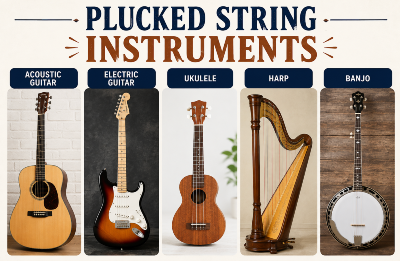
- As the most widely played string instrument on the planet, the acoustic guitar packs a full musical engine into a single wooden frame. Its six strings and hollow body effortlessly balance melody, harmony, and rhythm all at once. That sheer versatility is precisely why it serves as the ultimate gateway instrument across almost every genre, with steel-string models standing as the undisputed backbone of folk, pop, country, and singer-songwriter music.
- An electric guitar uses electromagnetic pickups to convert string vibration into an electrical signal rather than relying on a resonating body for volume. This changes everything: the guitar can be amplified to any volume, the tone can be shaped electronically, and effects can be added that would be impossible acoustically. Rock, blues, jazz, and contemporary popular music are built on the electric guitar's sonic capabilities.
- A ukulele is a four-stringed instrument with roots in Portuguese immigrant culture in Hawaii, developed from the machete, a small Portuguese guitar. Its nylon strings and small body produce a warm, bright tone that's distinctly its own. The instrument became popular as a beginner instrument partly because smaller necks and softer strings are more physically forgiving than a steel-string guitar. And partly, four strings are less initially overwhelming than six.
- A harp is one of the oldest types of string instrument documented in human history. Modern concert harps have 47 strings spanning six and a half octaves, with a pedal mechanism that allows chromatic playing. The sound is immediately distinctive: resonant, shimmering, and unlike anything else in the orchestra.
- A banjo has a drum-like resonating body covered with a membrane rather than solid wood, which gives it a sharp and bright attack. Note that this is central to American bluegrass and old-time music. However, the four- and five-string varieties demand different techniques and suit different repertoires.
Struck String Instruments
Less common as a category name, but significant. Here, the string is struck rather than plucked or bowed.
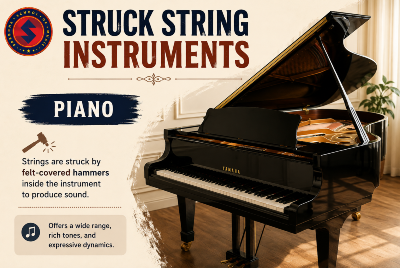
The piano is technically a string instrument, if you have noticed, which hammers strike steel strings inside the body when keys are pressed. This mechanism makes it a struck string instrument, though it's categorised separately in most practical contexts because of its keyboard interface. The dulcimer, particularly the hammered dulcimer, is the clearest pure example of this category.
Indian String Instruments: A Separate Tradition
Indian string instruments developed independently of Western traditions and operate within a completely different musical framework. Where Western classical music has been built around harmony and chord structures, Hindustani and Carnatic music are built around raga, and the instruments reflect that difference.
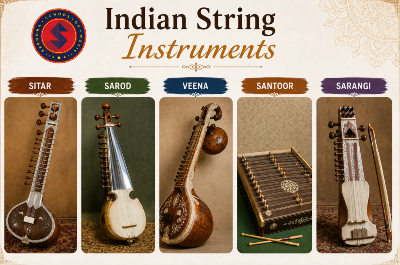
- The sitar is the most internationally recognised Indian string instrument, partly through its association with Ravi Shankar and its influence on Western rock music in the 1960s. It has a long neck, a gourd resonating body, and a unique feature: sympathetic strings that run beneath the playing strings and resonate in response to the notes played, creating the characteristic shimmering overtone quality.
- A sarod is heavier and darker-toned than the sitar. A metal fingerboard with no frets means intonation is entirely determined by finger placement and pressure, demanding exceptional ear development. It has a wider dynamic range than the sitar and is particularly valued for its lower register.
- Veena is the foundational instrument of Carnatic classical music. The Saraswati veena, most commonly encountered in South Indian tradition, has a long neck and a large resonating gourd. Its association with the goddess Saraswati places it at the symbolic centre of Indian musical tradition.
- A Santoor is a struck string instrument from Kashmir, played with light wooden mallets. It has a trapezoidal body with over 90 strings and produces a bright, layered tone that makes it immediately distinctive. Shivkumar Sharma's work with the santoor elevated it from regional folk music into the Hindustani classical tradition.
- A Sarangi is a bowed instrument with a short neck and a large number of sympathetic strings. Historically, the primary accompanying instrument for Hindustani vocal music and is one of the most technically demanding instruments in the tradition. Note that this requires the fingernails rather than fingertips to stop the strings.
String Instrument Names: A Quick Reference
Which String Instrument Should You Start With?
Honestly, the one you're actually drawn to. Motivation is the single biggest predictor of whether someone sticks with an instrument long enough to get good at it. But it’s a fact that you'll practise more consistently if you genuinely want to play what you're learning.
Having said that, a few practical notes that you can keep for future learning references:
- Acoustic guitar has the largest body of beginner resources, the widest stylistic range, and the most social utility. It is a gathering-friendly instrument if you ever have occasions to attend.
- Electric guitar demands an amp and cable but is physically easier on the fingers initially because the strings sit lower.
- Ukulele is the most physically forgiving starting point if hand size or finger strength is a concern.
- Violin is the highest technical barrier to entry of the four, requiring significant ear development before even basic melodies sound acceptable, but what you can eventually do with it is extraordinary and doesn’t come with limits.
Learn String Instruments at Spardha
At Spardha School of Music, we teach acoustic guitar, electric guitar, violin, and ukulele in live, 1-on-1 online sessions with certified instructors. Every lesson is built around your pace, your musical interests, and your specific technical starting point.
Whether starting fresh, restarting, or enrolling your child, our instructions are entirely tailored for your learning mind.
Book a free trial class at Spardha School of Music and spend thirty minutes finding out what learning a string instrument feels like with a real teacher watching.
Conclusion
String instruments span every culture and every musical tradition that humans have developed. The violin and the sitar share a physical principle and nothing else. While both are string instruments, comparing a guitar to a sarangi is like comparing a bicycle to a heavy-duty truck. What connects them is the vibrating string, but what distinguishes them is everything that a particular culture decided to do with that vibration.
Learning any one of them properly is an entry point into a tradition much larger than the instrument itself. The types of string instruments on this list are starting points, and not endpoints. Thus, pick one, learn it seriously, and see where it goes.
Frequently Asked Questions
What are string instruments and how do they produce sound?
String instruments produce sound by vibrating strings that are stretched across a resonating body. The vibration is triggered by bowing, plucking, or striking, and the resonating body amplifies the sound. Know that the length, tension, and mass of the string control the pitch.
What are the most common types of string instruments?
The most widely played types of string instruments globally include the guitar (acoustic and electric), violin, cello, piano (technically a struck string instrument), ukulele, and harp. In contrast, the Indian string instruments include the sitar, sarod, and veena, which are major instruments within their respective classical traditions.
Which string instrument is easiest for beginners?
Ukulele is the most physically accessible starting point because of its smaller size, softer nylon strings, and four-string simplicity. On the flip side, an acoustic guitar is the most practical choice for most of the beginners given its versatility and range of available learning resources. Violin is the most technically demanding of the commonly taught string musical instruments for beginners.
What are the main Indian string instruments?
The primary Indian string instruments are the sitar, sarod, veena, santoor, and sarangi. Each belongs to a specific regional or stylistic tradition within Indian classical music. The sitar and sarod are central to Hindustani classical music, whereas the veena is the foundational instrument of Carnatic classical music.
How many strings does a standard guitar have?
A standard acoustic or electric guitar has six strings; ukuleles and violins typically have four; concert harps have 47 strings. Understand that the number of strings varies significantly across different types of string instruments and is one of several factors that determine range and playing technique.
Can I learn a string instrument online?
Live, 1-on-1 online instruction works effectively for guitar, ukulele, and violin at beginner and intermediate levels. The key is live instruction from a qualified teacher rather than pre-recorded tutorials, which cannot provide the real-time feedback that physical technique development requires. Camera placement matters for instruments like the violin where bow arm position is critical and needs to be visible to the instructor.