Table of Contents
Quick Summary
The types of Indian music include Hindustani classical music, Carnatic classical music, regional folk traditions, devotional forms, Bollywood music, independent music, and modern fusion styles. Indian classical music is broadly divided into two major systems: Hindustani and Carnatic, while folk and devotional music have developed across India's different regions and communities. Modern Indian music brings many of these traditions together with contemporary production, creating styles that continue to evolve. If you want to explore these traditions through structured learning, Spardha School of Music offers live, 1-on-1 online classes in Hindustani classical, vocals, instruments, and contemporary music.
India doesn't have one musical tradition. It has several, running in parallel, occasionally intersecting, each shaped by geography, language, religion, and centuries of transmission from one generation to the next.
Indian music as a category is less a single thing than a family of related traditions that share certain foundational assumptions. It's about melody over harmony, music's relationship with time, and the purpose of performance, though expressed in radically different ways. A Hindustani classical performance and a Bihu folk song from Assam are both Indian music, but they don't sound remotely similar. Understanding what connects them, and what separates them, is what this guide is for.
The Two Classical Systems
Indian classical music sits at the formal, codified end of the tradition. Both major systems trace their theoretical lineage to the Natya Shastra. The Sanskrit treatise is attributed to Bharata Muni, and both are built around the raga framework. It’s actually a melodic structure that specifies which notes are used, how they're approached and departed from, which ornaments are appropriate, and even what time of day or season the raga is associated with.
Beyond that shared foundation, they diverged.
Hindustani Classical Music
This is the northern Indian classical tradition. Its development was shaped by the Mughal courts of the medieval period, which introduced Persian and Central Asian influences that gave birth to Hindustani music with a character distinct from its southern counterpart. The dhrupad and khayal vocal forms, the sitar and sarod as primary melodic instruments, and the tabla as the primary rhythmic accompaniment are the characteristic elements of the Hindustani tradition.
A full Hindustani classical performance develops slowly. The opening movement, aka the alaap, establishes the raga's melodic world minus rhythmic pulse. It’s just the soloist exploring the raga's character through gradually expanding melodic phrases. Only after the alap is fully established does the tabla enter and the composition begin. That patience, the willingness to spend some time before the beat starts, is fundamental to the tradition's aesthetic logic rather than incidental to it.
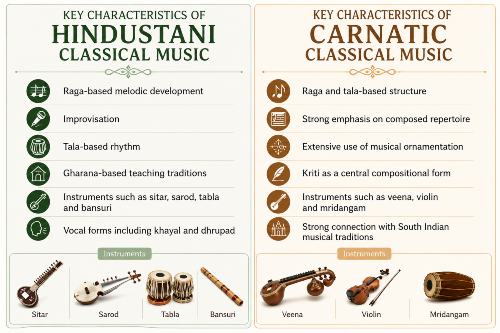
Common instruments associated with Hindustani music include the sitar, sarod, bansuri, tabla, sarangi, and harmonium.
Key characteristics of Hindustani classical music
- Raga-based melodic development
- Improvisation
- Tala-based rhythm
- Gharana-based teaching traditions
- Instruments such as sitar, sarod, tabla and bansuri
- Vocal forms including khayal and dhrupad
Carnatic Classical Music
The southern Indian classical tradition, practised primarily in Tamil Nadu, Andhra Pradesh, Telangana, Karnataka, and Kerala. While Hindustani music was shaped by Mughal court culture, Carnatic music evolved through Hindu temple traditions, staying closer to its ancient Vedic roots.
The three great composers of the Carnatic tradition, i.e. Tyagaraja, Muthuswami Dikshitar, and Syama Sastri, all of whom lived in the 18th and 19th centuries, composed the kriti form that remains central to Carnatic repertoire today. Unlike Hindustani music, which relies heavily on open raga improvisation, Carnatic music prioritises pre-composed pieces, using structure to anchor its solos.
- The veena is the foundational instrument of Carnatic music,
- The violin, adopted from Western tradition, has been thoroughly Indianised and is now as central to Carnatic ensemble performance as any native instrument,
- The mridangam is the primary rhythmic instrument.
Types of Indian classical music essentially resolve into these two systems at the formal level, though scholars identify additional traditions within and between them.
Key characteristics of Carnatic classical music
- Raga and tala-based structure
- Strong emphasis on composed repertoire
- Extensive use of musical ornamentation
- Kriti as a central compositional form
- Instruments such as veena, violin and mridangam
- Strong connection with South Indian musical traditions
Hindustani vs Carnatic Music: What’s the Difference?
Although both belong to Indian classical music, Hindustani and Carnatic music differ in their repertoire, historical development, performance styles, and musical vocabulary.
Indian Folk Music
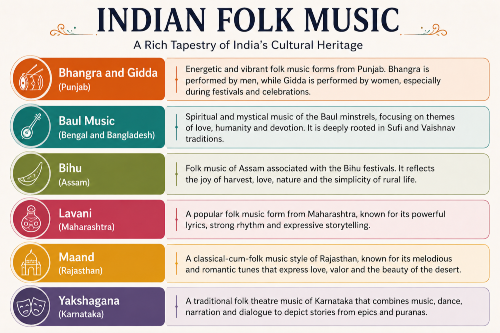
If classical music provides the formal grammar, folk music is the living dialect, i.e. the soundtrack to daily life, seasonal harvests, and community rituals. Every region of India has its own folk musical tradition, and in most cases several overlapping ones. A few of the most significant:
Bhangra and Gidda (Punjab): The most internationally recognised Indian folk music style. Bhangra developed as a harvest celebration, built around the dhol's driving beat and a physical exuberance that the music demands rather than merely permits. Gidda, its female equivalent, emphasises lyrical boli verses alongside the dance. Both were absorbed into Bollywood and contemporary pop, launching their rhythmic styles onto the global stage.
Baul Music (Bengal and Bangladesh): The Bauls are a community of wandering mystics whose music expresses a philosophy of spiritual seeking through simple melody. Their ektara (single-stringed instrument) and lyrics are simultaneously devotional and subversive of formal religion. As a matter of fact, Rabindranath Tagore drew deeply from Baul music, and its influence runs through Bengali folk and literary music. However, UNESCO has recognised Baul music as an Intangible Cultural Heritage.
Bihu (Assam): Associated with the Bihu festivals that mark the Assamese agricultural calendar, particularly the spring Bohag Bihu. The music is energetic; the instruments include the pepa (a horn made from buffalo horn) and the dhol, and the songs describe seasonal life, love, and the natural landscape of the Brahmaputra valley with specificity that makes them as much poetry as music.
Lavani (Maharashtra): A powerful combination of song and dance performed to the dhol, historically associated with entertainment for soldiers and known for its rhythmic intensity and direct emotional content. Contemporary Lavani has moved from its traditional context to theatre stages and film, but the driving rhythm and expressive vocal style remain central.
Maand (Rajasthan): The desert has its own sound, and Maand is its most refined expression. The style is a semi-classical folk associated with the royal courts of Rajasthan, performed in a manner that sits between the formality of classical music and the immediacy of folk. For this, Kesarbai Kerkar’s vocal rendition of Maand remains a definitive standard, though this rich tradition reaches far beyond any single artist.
Yakshagana (Karnataka): A traditional theatre form combining music, dance, dialogue, and costume in all-night performances that draw from the Mahabharata and Ramayana. The music is inseparable from the theatrical form, making Yakshagana a performance tradition as much as a musical one.
Devotional Music
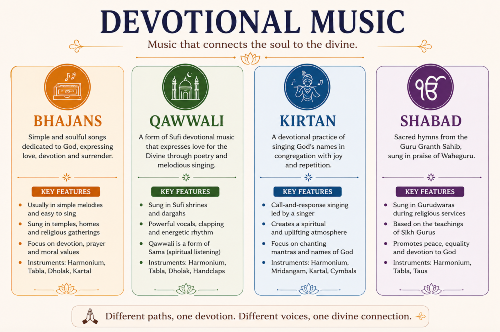
Devotional music exists across both the classical and folk frameworks in Indian tradition, and the distinction matters: devotional music is defined by its purpose rather than its form.
Bhajans are devotional songs in the bhakti tradition, addressed to a specific deity and meant for communal singing. Meera’s devotion to Krishna, Kabir’s verses to the formless divine, and Tukaram’s Marathi abhangas stand as peak achievements in Indian poetry and song. Built for collective participation rather than formal performance, the bhajan tradition remains intentionally accessible to all.
Qawwali is the devotional music of the Sufi Islamic tradition. In India and Pakistan, Qawwali developed into a highly sophisticated performance form practised by hereditary musician families called qawwals. The late Nusrat Fateh Ali Khan's recordings brought Qawwali to global audiences and demonstrated that its emotional and spiritual power translates across cultural contexts.
Kirtan is specifically associated with the Vaishnavite devotional tradition, a congregational singing of Krishna's names and stories. Furthermore, the ISKCON movement has made kirtan globally familiar, but the tradition within Indian music predates it by centuries.
Shabad is the sacred music of the Sikh tradition, drawn from the hymns of the Guru Granth Sahib and performed in Gurdwaras. Raagi, aka professional musicians trained in Sikh devotional music, maintain the tradition of kirtan performance as part of daily Gurdwara practice.
Modern Indian Music
Modern Indian music has become increasingly diverse, particularly with the growth of streaming platforms and independent artists.
Bollywood and Indian Film Music
Indian film music is one of the country’s most widely consumed forms of popular music. It has traditionally borrowed from classical music, folk traditions, Western orchestration, electronic production, and global pop.
Composers such as S.D. Burman, R.D. Burman, Ilaiyaraaja, A.R. Rahman, Vishal-Shekhar, Pritam, and Amit Trivedi represent different stages in the evolution of Indian film music.
Regional film industries have developed their own strong musical identities as well. Tamil, Telugu, Malayalam, Kannada, Punjabi, Bengali, and Marathi cinema regularly produce songs that reach audiences beyond their original language markets.
Independent Indian Music
Streaming has also created more opportunities for musicians to release music without depending entirely on films or traditional record labels.
Artists working across Hindi, English, Punjabi, Tamil, Telugu, Malayalam, Bengali, and other languages now have direct access to audiences through digital platforms.
The independent scene includes pop, indie rock, electronic music, hip-hop, folk fusion, singer-songwriter music, and many other styles.
Indian Fusion Music
Fusion music brings Indian musical traditions together with influences from jazz, rock, electronic music, Western classical music, and other global genres.
For example, a musician may combine a Hindustani raga with electronic production or use Indian classical instruments within a jazz arrangement.
This doesn’t mean that traditional music is disappearing. Instead, it shows how musicians continue to reinterpret older musical ideas for contemporary audiences.
Learn Indian Music at Spardha
If you want to learn Indian music through singing, Spardha School of Music offers structured online vocal courses for different musical traditions and learning goals. Students can choose from Hindustani Vocals, Carnatic Vocals, Bollywood Vocals, and regional film music courses.
The Hindustani Vocals course focuses on building a strong foundation in concepts such as sur, swar, raga, tala, voice culture, and vocal techniques. Students interested in South Indian classical singing can explore Carnatic Vocals, which introduces foundational concepts and traditional compositions.
For those who enjoy film music, Spardha also offers Bollywood Vocals along with dedicated courses for Tamil, Telugu, Kannada, and Malayalam film music. These courses help students develop their singing technique while learning songs they enjoy.The classes are conducted live and online, allowing students to learn with a dedicated instructor and receive personalised feedback. They are suitable for beginners as well as learners looking to develop their existing vocal skills.
If you want to learn Indian music through singing, you can book a free trial with Spardha and explore the course that suits your musical interests.
Conclusion
Exploring the types of Indian music reveals a civilisation's deep relationship with sound. Classical systems offer the formal structure, folk styles provide the living context, and devotional music carries the spiritual core. On the flip side, today's modern sound is simply an ongoing dialogue between all three traditions and the contemporary world.
None of these traditions is static. Indian classical music was itself shaped by folk and devotional influence across centuries, whereas Bollywood absorbed everything and reflected it to audiences who recognised themselves in the synthesis. That tells us that the tradition keeps moving because the people who carry it keep listening and responding to what they hear.
That responsiveness is the oldest thing about it.
Frequently Asked Questions
What are the main types of Indian music?
Indian music comprises several major traditions. It ranges from Hindustani and Carnatic classical systems to diverse regional folk styles. At the same time, it encompasses devotional forms like bhajans, Qawwali, kirtan, and shabad, alongside contemporary popular genres spanning Bollywood cinema tracks and independent streaming-era releases.
What is the difference between Hindustani and Carnatic classical music?
Both are raga-based traditions comprising ancient theoretical foundations, but they diverged through different historical and cultural influences. Hindustani music was shaped by Mughal court culture and emphasises extended improvisation within a raga framework, while Carnatic music developed primarily in temple contexts. It emphasises composed material and uses a different set of instruments and vocal ornament styles.
Is Bollywood music considered classical Indian music?
No, though the best Bollywood compositions draw on classical foundations. Bollywood film music is a popular form that synthesises classical, folk, devotional, and Western influences. It's separate from either classical tradition as a formal category, though the boundary between them is frequently and productively crossed by individual composers.
What is the importance of raga in Indian classical music?
The raga is the fundamental organising principle of Indian classical music. It specifies a set of notes, the rules for their usage, the characteristic melodic phrases that define the raga's identity, and often the time of day or emotional context it's associated with. Understand that a raga performance is an exploration of that melodic world rather than the execution of a fixed composition, which is why two performances of the same raga by the same artist can sound significantly different.
Can I learn Indian classical music online?
Live, 1-on-1 online instruction works effectively for Hindustani vocal and instrumental training at beginner and intermediate levels at Spardha School of Music. Historically, the guru-shishya tradition relied on close, personalised instruction to teach Indian classical music. Spardha preserves that core element in its live online classes, giving you a dedicated teacher who listens and corrects you in real time.