Table of Contents
Quick Summary
The flute is one of the oldest instruments in human history. Bone flutes discovered in Europe date back over 40,000 years, predating most other known instruments by a significant margin. Today, the flute family encompasses hundreds of distinct instruments across every musical culture on earth. From the Western concert flute taught in schools and orchestras to the Indian bansuri played in Hindustani classical music, the Japanese shakuhachi, and the pan flute of the Andes. Each type is physically different, requires a different embouchure, and belongs to a distinct musical tradition. Choosing between them involves knowing what each one actually demands.
No instrument travels as lightly through human history as the flute.
Every culture that has ever been documented has some version of it. The mechanism doesn't require much: a tube, an opening for the breath, and some way to change pitch. Yet the sonic range that different cultures have extracted from that simple idea is extraordinary. A Hindustani bansuri and a Western concert flute share the same fundamental physics but sound like they belong to different planets.
Understanding the types of flutes across world musical traditions isn't just interesting as cultural history. It's practically useful if you're trying to decide what to learn, because the commitment required by each instrument is genuinely different. The concert flute and the bansuri aren't two versions of the same learning experience but different instruments that happen to share an air column.
Here's delving a bit deep.
Quick Comparison of Different Types of Flutes
Types of Flutes: The Western Family
The Western flute tradition is the most codified and widely taught across the globe, which makes it the default reference point for most beginners encountering the instrument for the first time.
Concert Flute
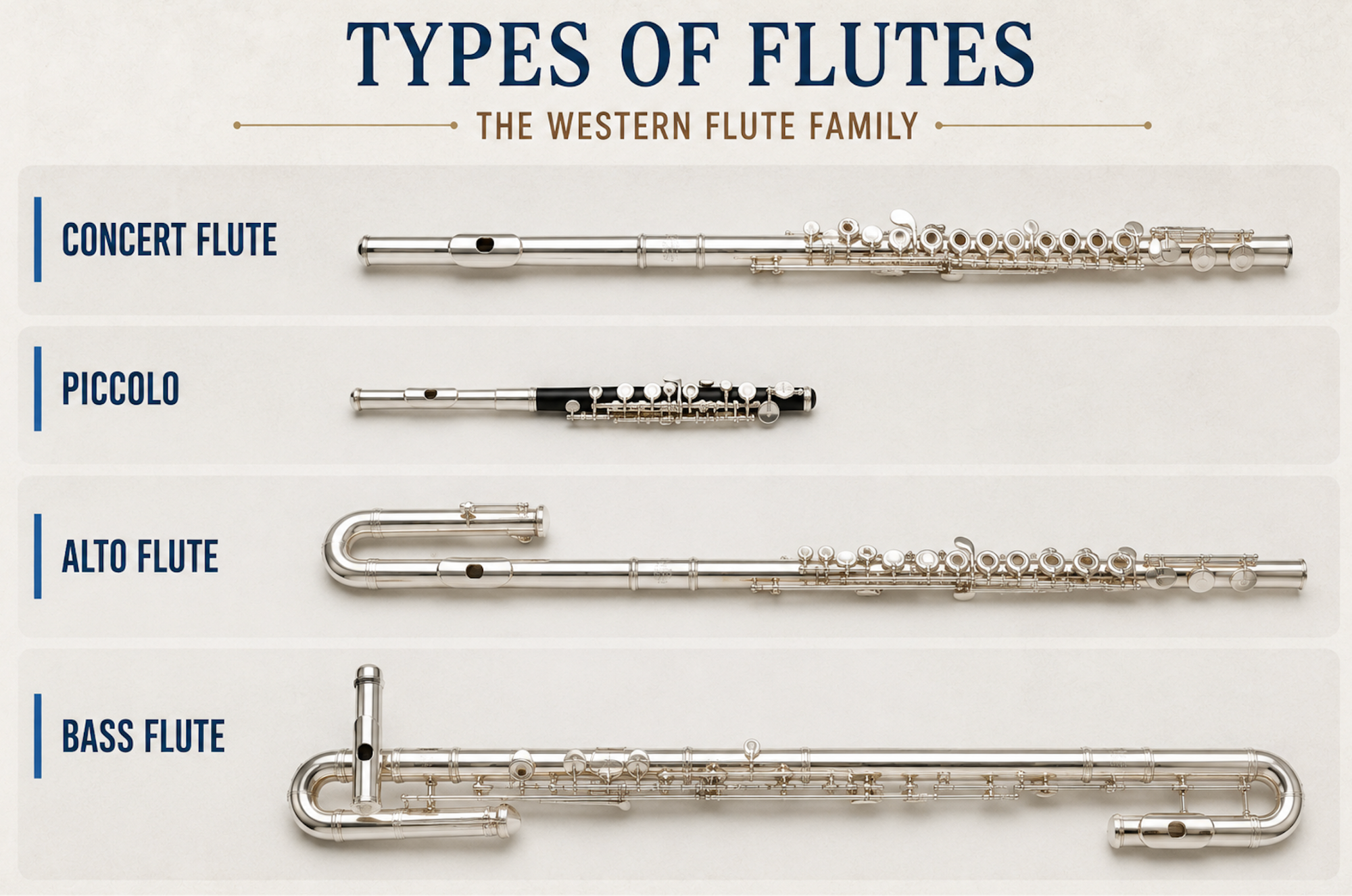
This is the standard orchestral flute that’s silver or silver-plated, approximately 67 centimetres long, held horizontally to the right. The Boehm system keywork, developed in the 19th century by Theobald Boehm, gives it a technically sophisticated mechanism. It allows chromatic playing across three octaves with relative ease once the foundational technique is established.
It's the instrument most people picture when they say the word "flute," and the one most school music programmes use as an entry point into classical music education. The tone quality ranges from bright and piercing in the upper register to warm and round in the lower. Its adaptability across classical, jazz, folk, and modern styles makes it one of the instruments you can spend time mastering, which is high-yielding at the same time.
The open embouchure hole requires precise lip placement and takes weeks of consistent practice to stabilise, as the initial difficulty is moderate to high.
Piccolo
At half the length of a concert flute and pitched a full octave higher, the piccolo is the orchestra’s highest-register instrument. Its piercing brightness easily cuts through a hundred-piece ensemble without amplification. This is because it demands micro-fine embouchure control; most players adopt it as a secondary instrument only after mastering basic flute technique.
Alto Flute
Larger than the concert flute and pitched a fourth lower, the alto flute has a darker, more mellow tone that the concert flute can't replicate. It's used in chamber music and contemporary composition rather than standard orchestral repertoire. Interestingly, the weight and size make it physically demanding for players with smaller hands.
Bass Flute
Pitched an octave below the concert flute, the bass flute is rare outside specialist contemporary music ensembles. Its curved headjoint is a practical necessity given its length. The sound is deep and breathy in a way that's immediately distinctive but has limited application in most musical contexts.
Types of Flutes in India
Types of flute in India represent a completely different development from the Western tradition, shaped by the requirements of raga-based music rather than harmonic Western composition.
Bansuri
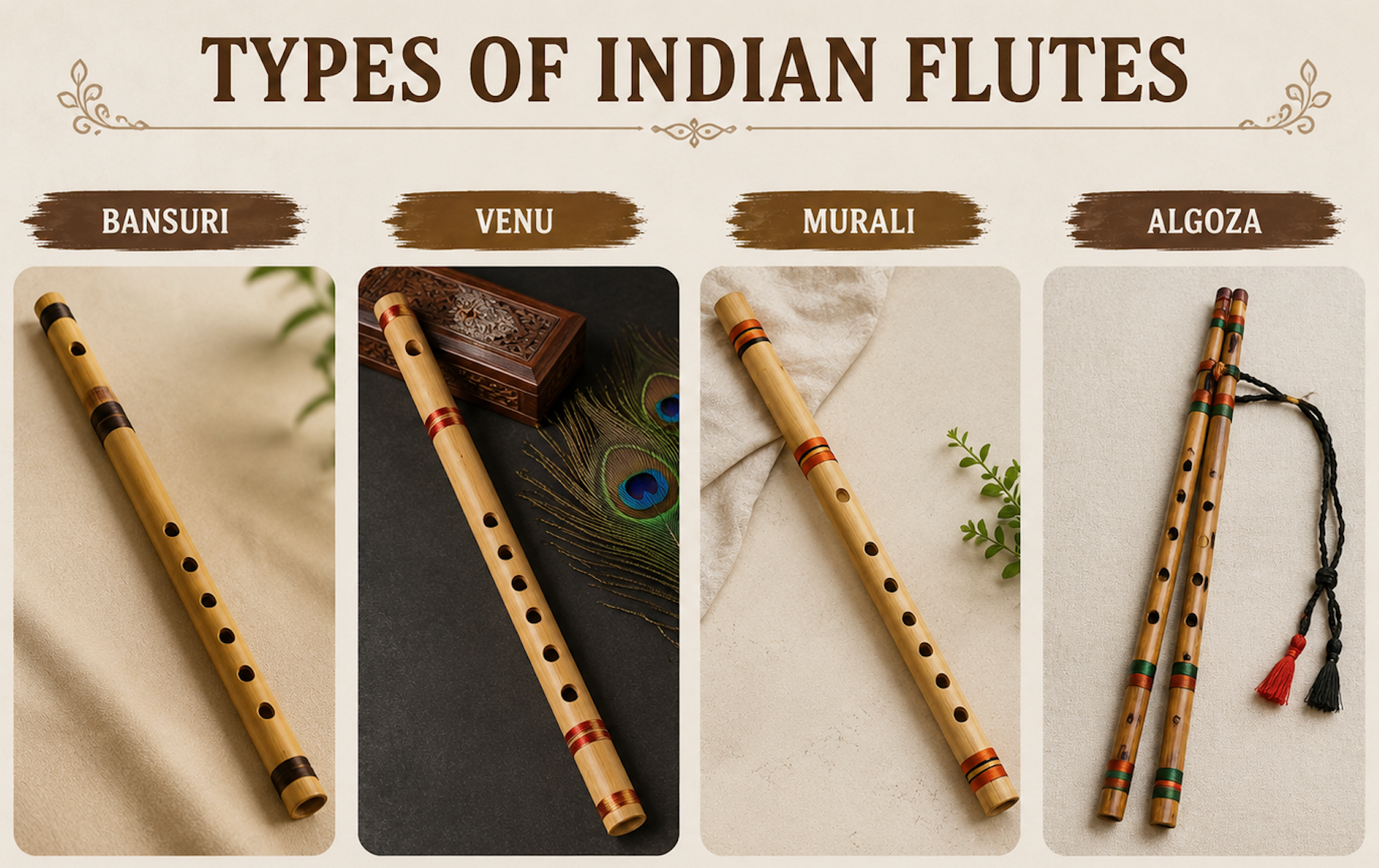
The bansuri is the foundational flute of North Indian Hindustani classical music, and its association with Lord Krishna gives it a devotional significance that goes beyond music. Hariprasad Chaurasia, the instrument's most internationally recognised practitioner, spent decades bringing the bansuri from folk and devotional contexts into the formal Hindustani classical concert tradition.
It's made from a single piece of bamboo with six or seven holes, having no keys or mechanism. Pitch is controlled entirely by the angle of the breath and the degree to which holes are covered or partially uncovered. The latter technique, called half-holing, is essential for producing the microtonal inflexions that raga requires and that a Western concert flute cannot produce at all.
From the deep, meditative resonance of a bass bansuri, essential for unhurried alap movements, to the nimble, high-pitched flutes built for rapid taans, size dictates function. Because different keys and registers serve distinct emotional and technical roles in a performance, serious players inevitably build a collection and master them all.
Without keys or frets, the instrument offers zero mechanical assistance for pitch, leaving intonation entirely to your muscle memory and ear. Mastering that microtonal flexibility requires years of dedicated ear training, making the learning curve exceptionally steep.
Venu
The venu is the flute of Carnatic classical music, smaller and higher-pitched than the bansuri. While the bansuri typically relies on six or seven finger holes, the Carnatic venu utilises eight. This helps unlock greater pitch control and the fluid movement required to execute gamakas, the complex sliding embellishments that form the bedrock of Carnatic music.
T.R. Mahalingam—famously known as "Mali"—and his legendary contemporary N. Ramani stand as the central figures who brought the venu to the modern Carnatic concert stage, while Pandit Hariprasad Chaurasia redefined its North Indian counterpart, the bansuri.
Murali
While "murali" often overlaps with the venu in South Indian terminology, the name also encompasses a broader family of simpler folk flutes central to India's rural and devotional traditions. Naturally, their build reflects their purpose, spanning everything from crude, hand-carved bamboo pipes to meticulously tuned concert instruments.
Algoza
Two flutes played simultaneously, one in each hand, with circular breathing to maintain continuous sound. The algoza is a Punjabi and Sindhi folk instrument with a distinctive double-tone character. It's not a beginner instrument and thus, circular breathing alone requires significant practice. But as an example of how Indian folk traditions have extended the basic flute concept in unusual directions, it's worth knowing.
Different Types of Flutes From Around the World
The different types of flutes that exist outside Western and Indian traditions reveal how widely the same basic acoustic principle has been adapted to suit different musical needs.
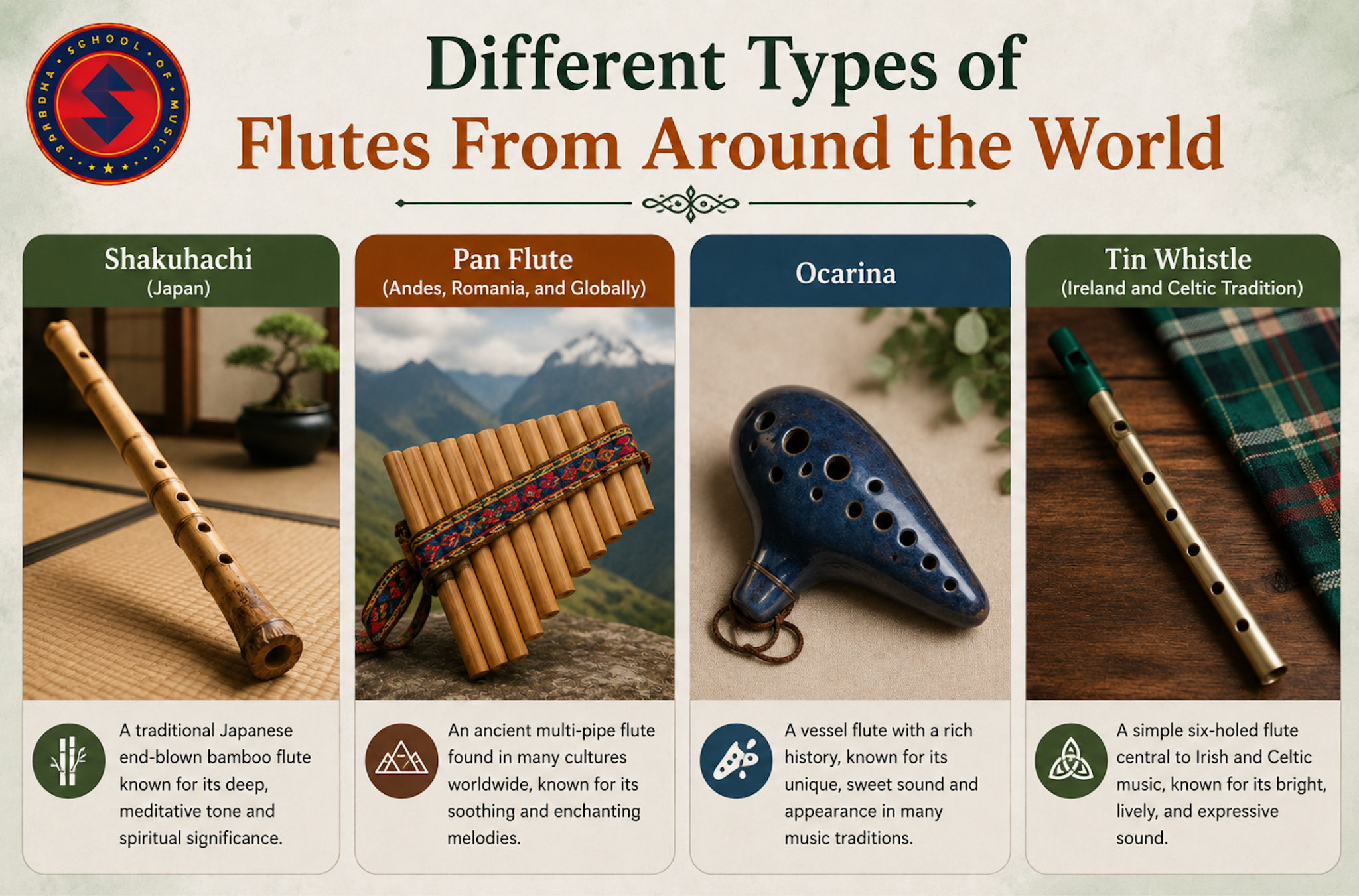
Shakuhachi (Japan)
An end-blown bamboo flute with five holes, the Shakuhachi was historically associated with Zen Buddhist monks who used it for meditation. The breath is directed across the top of the instrument rather than across a side hole, giving the player more control over tone colour and microtonal inflexion. A skilled Shakuhachi player can produce a range of sounds ranging from breathy and diffuse to focused and piercing; this is wider than most Western flutes allow.
The Shakuhachi has built a strong modern presence in jazz and world music, drawn to its vast tonal palette and dynamic flexibility for fluid improvisation. In ensemble settings, its signature breathy, meditative voice stands apart, offering an instantly recognisable sound that cuts through mixed instrumentation.
Pan Flute (Andes, Romania, and Globally)
Multiple tubes of different lengths bound together, each producing a single pitch when blown across the top. The player moves the instrument horizontally to access different pitches. Across the globe, the core mechanics remain identical while local traditions shape the craft, from the Andean zampoña and Romanian nai to distinct variations found throughout Africa and the Pacific Islands.
It produces a haunting, breathy tone that's immediately recognisable. As a starting point for someone with no prior wind instrument experience, the pan flute is relatively forgiving because embouchure demands are simpler than those of the concert flute or bansuri.
Ocarina
Unlike traditional tube flutes, the ocarina is a vessel flute, meaning its pitch is governed by the volume of air trapped in its ceramic chamber rather than the length of a pipe. Small, durable, and capable of a remarkably pure tone, it may sit outside the standard Western orchestra, but it holds a dedicated global following across folk, world, and contemporary music.
Tin Whistle (Ireland and Celtic Tradition)
Six holes, a fipple mouthpiece that directs the airstream without requiring precise lip placement, and a bright, penetrating tone that sits at the centre of Irish traditional music. The tin whistle is probably the most accessible starting point for any beginner interested in wind instruments. Because the fipple mechanism eliminates the embouchure hurdle, requiring you to simply blow through a mouthpiece rather than direct an airstream across an open hole. However, you can easily play basic melodies in your very first session.
How Flutes Actually Work
All flutes are aerophones, implying sound is produced by a vibrating column of air rather than a vibrating string or membrane. The player blows across or into an opening, creating turbulence that sets the air inside the tube vibrating. Here, the pitch changes based on the length of the vibrating air column, which is altered by opening and closing tone holes.
That’s the exact moment where most people quit.
The mechanism is simple, but the execution is brutal. On an open-hole instrument, you aren't just blowing into a pipe; you are the reed. The margin for error in your embouchure is measured in millimetres, and your mouth has to memorise a physical shape that feels completely unnatural at first.
When beginners can’t get a clear note on day three, they assume they "don't have the lungs for it" or lack natural talent. In reality, they’re just blowing past the strike edge by a fraction of a degree. Crossing that gap from a thin, airy hiss to a warm, resonant tone isn't about effort; it's about micro-adjustments, patience, and surviving the frustration of those first few weeks.
Having said that, some types of flutes are considerably more forgiving than others at the beginning. Knowing which ones will shape your early experience significantly is the key to smart learning.
How to Choose the Right Flute
Choosing between different types of flutes depends on three practical questions: what music do you actually want to play, what level of initial difficulty is realistic for your patience and practice time, and what access do you have to qualified instruction?
If Western classical music, orchestral repertoire, or structured music education are the goals, the concert flute is the obvious choice. The teaching infrastructure around it: method books, certified teachers, grades and examinations - is more developed than for any other flute type.
If Hindustani classical or Indian devotional music draws you to the meditative voice of bamboo, the bansuri is your instrument, provided you are honest about the discipline it demands. With zero keys to anchor your pitch, intonation depends entirely on your ear and embouchure. Without live feedback from a teacher to catch bad habits early, minor pitch flaws quickly harden into permanent errors.
If immediate accessibility matters most, the tin whistle delivers recognisable melodies faster than any other flute. That low barrier to entry isn't a mark against its depth; high-level Irish traditional music demands serious technical dexterity, but it eliminates the initial embouchure hurdle that stalls beginners on transverse instruments.
If your focus is Indian classical music, the bansuri (Hindustani) and venu (Carnatic) are the definitive choices. Whichever path you take, prioritise learning from an active practitioner of that specific tradition rather than a generalist wind instructor.
Learn Flute Online at Spardha
The gap between owning a flute and actually learning to play one well is where qualified instruction matters most. Embouchure development, tone production, and correct hand position are all things a teacher needs to see in real time to correct before they become fixed habits.
At Spardha School of Music, our online flute classes are taught in live, 1-on-1 online sessions with certified instructors. Whether you're starting from scratch or returning to the instrument after a gap, the curriculum is built around your specific starting point rather than a generic syllabus applied to every student.
Book a free trial flute class at Spardha School of Music and spend thirty minutes finding out what learning with a real teacher watching actually produces.
Conclusion
The types of flutes that exist across world musical traditions are a study in how far a simple acoustic principle can travel when different cultures get hold of it. The concert flute and the bansuri share an air column; that's approximately where the similarity ends. On the other hand, the shakuhachi, pan flute, venu, and tin whistle all make the same point from different directions: the flute isn't just one instrument. It's an idea that every musical culture in history has adapted to its own purposes.
Select the flute that matches your musical goals, then commit to learning it under guidance that can hear your mistakes and fix them live. The tone that takes weeks of frustration to uncover is worth every second - ask any seasoned flautist, and they'll tell you they still remember the exact moment their instrument first spoke with a pure, clean voice.
Frequently Asked Questions
What are the main types of flutes played around the world?
The primary types of flutes include the Western concert flute, piccolo, alto and bass flute, Indian bansuri and venu, Japanese shakuhachi, Andean pan flute, Irish tin whistle, and ocarina. Each belongs to a distinct musical tradition and requires different embouchure technique and playing approach.
What are the main types of flute in India?
The principal types of flute in India are the bansuri, used in Hindustani classical music and associated with Lord Krishna; the venu, the equivalent instrument in Carnatic classical music; the murali, associated with devotional and folk traditions; and the algoza, a double-flute from Punjab played with circular breathing.
Which type of flute is easiest for beginners?
The tin whistle is the most accessible starting point because its fipple mouthpiece removes the embouchure challenge that makes other flutes difficult in the initial days. Among the more classical options, the concert flute has more systematic resources available for a beginner. The bansuri is the most demanding for beginners because its keyless design requires entirely self-generated intonation.
Can I take flute classes online?
Live, 1-on-1 flute classes online are effective for both concert flute and bansuri instruction at beginner and intermediate levels. The critical requirement is live instruction rather than pre-recorded tutorials: a teacher needs to hear your tone production and embouchure in real time to give useful feedback. Camera and microphone quality matter more for wind instrument lessons than for most other online music instruction contexts.
How long does it take to produce a clean tone on the concert flute?
Most beginners stabilise their embouchure enough to produce a consistently clean tone within three to six weeks of daily practice. The quality of that tone continues developing for years. Well, the first weeks are the most technically challenging because there's no fipple mechanism to guide the airstream, as the player must find the correct angle entirely by feel and auditory feedback.
Is the bansuri harder to learn than the concert flute?
Yes, generally. The bansuri has no keys, which means pitch is controlled entirely by the player's finger placement and breath angle. The microtonal inflexions required for raga-based music add a layer of ear-training that the Western concert flute tradition doesn't demand at the same level. Both instruments require significant commitment, but the bansuri front-loads more of that difficulty into the early stages.