Table of Contents
Quick Summary
A time signature in music tells musicians how beats are organized within each measure and which note value is used as the beat unit. 4/4 time contains four quarter-note beats and is widely used in popular music. 3/4 time contains three quarter-note beats and is commonly associated with the waltz. 6/8 time is a compound meter that is typically felt as two groups of three eighth notes. Understanding time signature in music helps musicians read sheet music, count rhythms, identify meter and develop a stronger sense of rhythm.
If you've ever looked at sheet music and gotten stuck on those two stacked numbers right after the clef, you're not alone. Almost every beginner musician hits this wall. You know how to read a note, maybe you can even hum the melody, but that fraction-looking symbol at the start of the staff feels like it's written in another language.
Here's the good news: once it clicks, it clicks for good. In this guide, we'll break down exactly what a time signature in music is, why it matters more than most people realize, and walk through the three time signatures you'll run into constantly, 4/4, 3/4, and 6/8 , with visuals so you can actually see and hear the difference instead of just reading about it.
So, What Is Time Signature in Music, Really?
A time signature is a set of two numbers, stacked on top of each other, that appears at the beginning of a piece of music. It tells you two things at once: how many beats are in each measure, and which type of note counts as one beat.
Think of it as the grammar of rhythm. Without it, a song would be a pile of notes with no sense of where the "downbeats" fall, nothing telling your foot when to tap or your body when to sway. The time signature is what turns a random string of notes into something that grooves, marches, waltzes, or swings.
Let's break the fraction down, because this is where most confusion happens.
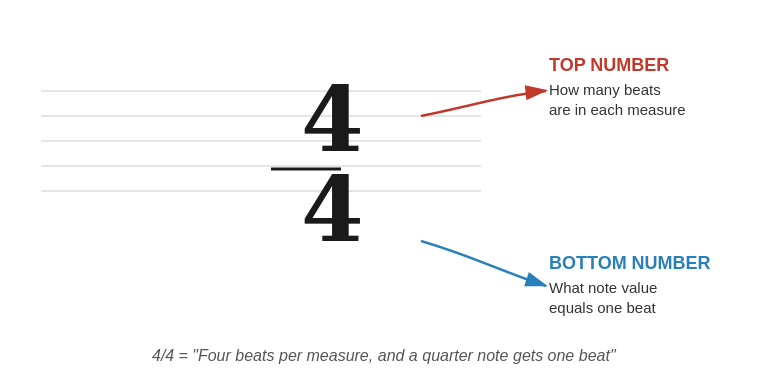
The top number tells you how many beats are in each measure ("bar").
The bottom number tells you what kind of note counts as a single beat. A 4 means a quarter note gets one beat. An 8 means an eighth note gets one beat.
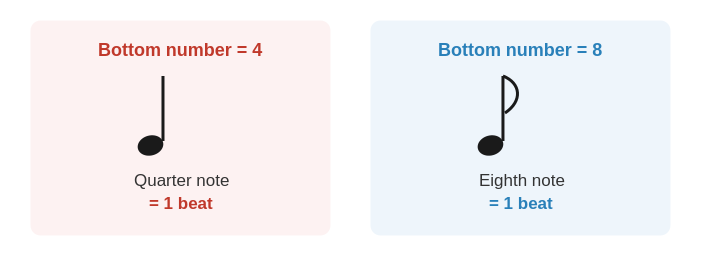
So 4/4 is telling you: "There are four beats in this measure, and a quarter note equals one beat." That simplicity is exactly why it's such a foundational piece of music theory; everything else, from syncopation to odd meters, builds on top of this basic idea.
One quick myth to clear up: a time signature is not the same as tempo. Tempo tells you how fast something goes. A time signature tells you how the beats are grouped. You can play a 4/4 song slowly as a ballad or fast as a punk track, it's still 4/4 either way.
4/4 Time Signature: The Workhorse of Popular Music
The 4/4 time signature is the most common meter in Western music, nicknamed "common time" ; you'll sometimes see it written as a large C instead of the numbers.
In 4/4, each measure contains four beats, and the quarter note is the beat unit. Count it out loud: "one, two, three, four," repeating evenly. That's it.
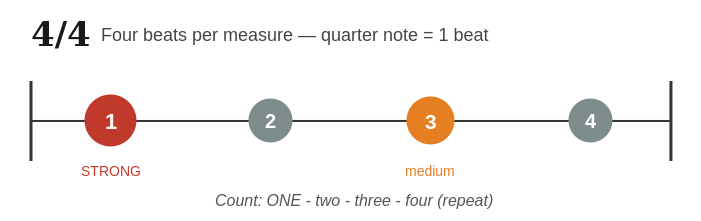
Pop, rock, hip-hop, country, most EDM , the overwhelming majority of what plays on the radio sits in 4/4. Four beats per measure divides naturally into halves and quarters, which lines up with how humans move: walking, dancing, nodding your head. A drummer typically hits the kick on beats one and three, and the snare on two and four , that snare backbeat is basically the heartbeat of modern popular music. Once you start listening to it, you'll hear it everywhere.
3/4 Time Signature: The Waltz Feel
Now for something with a completely different personality: 3/4 time.
In 3/4, each measure has three beats, again with the quarter note as the beat unit. Count it as "one, two, three, one, two, three." Where 4/4 feels grounded and even, 3/4 has a rolling, circular quality , it pulls you forward into the next measure rather than sitting flat.
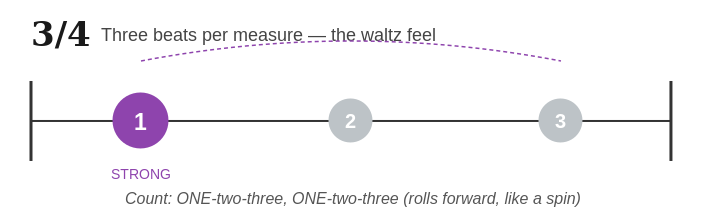
This is the meter most associated with the waltz. The classic "ONE-two-three, ONE-two-three" emphasis, with a stronger accent on beat one, is what gives waltzes their swaying, spinning sensation. But 3/4 shows up well outside the ballroom too , "My Favorite Things" from The Sound of Music is a well-known example most people can hum without realizing it's in triple meter. Plenty of lullabies lean on 3/4 as well, since that gentle three-beat rock mimics a cradling motion.
Songwriters often reach for 3/4 specifically because it stands out. In a landscape dominated by 4/4, a song written in three instantly feels a little more wistful or old-fashioned, depending on how it's used.
6/8 Time Signature: Compound Meter and the "Two Big Beats" Feel
This is the one that trips people up the most, so let's take it slow.
On paper, 6/8 looks like a cousin of 3/4 , six is just double three. But it feels completely different, because of how the beats are grouped.
In 6/8, there are six beats per measure, and the eighth note is the beat unit. If you counted it evenly, one through six, you'd be technically correct but missing the actual feel. That's because 6/8 is a compound time signature, and compound meters group beats into larger clusters of three.
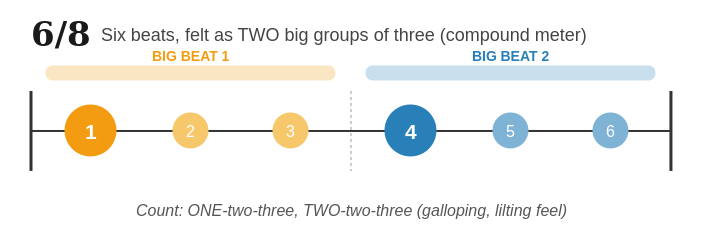
Instead of six separate beats, 6/8 is felt as two big beats, each made up of three smaller subdivisions: "ONE-two-three, TWO-two-three." Say that out loud with emphasis on the "ONE" and "TWO" and you'll feel the rolling, almost galloping quality that defines this meter.
This is why so many songs described as having a "swing," a "lilt," or a "gallop" turn out to be written in 6/8. Irish jigs are a textbook example , that bouncy, tripping rhythm is a compound meter doing exactly what it does best. On the pop side, plenty of classic ballads use 6/8 to create a slow-rocking sway rather than an even march.
The key mental shift: stop thinking of 6/8 as "six of something" and start thinking of it as "two groups of three." That reframe is genuinely the difference between confusion and clarity here.
Simple Meter vs. Compound Meter
It's worth naming the bigger concept sitting underneath all three, since this is where a lot of resources skip a step.
A simple meter is when each beat divides naturally into two equal parts. Both 4/4 and 3/4 fall here , each quarter-note beat splits into two eighth notes. That's why they feel steady and even.
Compound meter is when each beat divides naturally into three equal parts. 6/8 falls here , each of its two "big beats" is made of three eighth notes. That built-in triplet feel is baked directly into the meter, which is exactly why 6/8 has that bouncy quality simple meters don't.
This explains why 3/4 and 6/8 , despite both involving groups of three , feel so different. 3/4 has three separate beats. 6/8 has two beats that each secretly hide three subdivisions. Same numbers involved, completely different emotional texture.
How to Train Your Ear to Recognize Time Signatures?
Reading about time signatures only gets you so far. At some point you need to train your ear.
- Tap your foot and count out loud: Try counting to four on repeat. If it lines up cleanly, you're probably in 4/4.
- If counting to four feels like it "trips" or skips a beat, try counting to three instead. If that fits better, you're likely in 3/4.
- If the song has a galloping quality and counting to three feels too fast, try grouping in twos with a triplet feel underneath , "ONE-and-a, TWO-and-a." That's your 6/8 signal.
- Listen for the accents: In 4/4, it's beats one and three. In 3/4, it's beat one of every group of three. In 6/8, it's the first note of each three-note cluster.
- Clap along with a metronome app set to different time signatures and compare the accented click patterns side by side.
None of this requires reading music , it's about training your body to feel where the pulse naturally groups, which is really what a time signature is describing in the first place.
Common Mistakes Beginners Make
Confusing time signature with tempo- These are separate ideas , you can have a fast 3/4 song and a slow one; the meter stays the same, only the speed changes.
Assuming the bottom number is always 4- It's common enough to feel like a rule, but the bottom number can be 2, 8, 16, or other values, each representing a different note value getting the beat.
Treating 6/8 like "3/4 with more notes"- This is the single most common misunderstanding , the grouping is what defines compound meter, not just the raw beat count.
Assuming time signatures never change mid-song- Plenty of songs, especially in prog rock and film scores, shift time signatures for dramatic effect. Less common in mainstream radio hits, but far from rare once you start listening for it.
Bringing It All Together
At the end of the day, a time signature is a compact instruction for how to group and count beats. But its effect on how music feels is enormous. 4/4 gives you the steady, grounded pulse that powers most of what you hear on the radio. 3/4 gives you the circular, swaying waltz feel. And 6/8 gives you the rolling, compound-meter lilt that shows up everywhere from Irish jigs to slow-dance ballads.
The fastest way to internalize this isn't more reading , it's active listening. Pick three songs you already know, one in each of these time signatures, and count along out loud. Once your body feels the difference between "four even beats," "three rolling beats," and "two big beats made of three," those numbers at the start of the sheet music stop looking like a mysterious fraction and start looking like exactly what they are: a map of the rhythm you've probably been feeling instinctively all along.
Frequently Asked Questions
What is a time signature in music?
A time signature in music is a pair of numbers written at the beginning of a piece of sheet music. The top number indicates how many beats or beat groupings are in each measure, while the bottom number indicates the note value used as the beat unit.
What does 4/4 mean in music?
4/4 means that each measure contains four quarter-note beats. It is also known as common time and is frequently used in pop, rock, hip-hop, country and many other musical styles.
What is 3/4 time signature?
A 3/4 time signature contains three quarter-note beats in each measure. It is strongly associated with the waltz and is typically counted as "ONE-two-three, ONE-two-three."
What is 6/8 time signature?
A 6/8 time signature contains six eighth-note subdivisions in each measure. Because it is a compound meter, these are generally grouped into two larger beats of three eighth notes each, giving it a rolling or lilting feel.
What is the difference between 3/4 and 6/8?
Although both can involve groups of three, they organize the beats differently. 3/4 has three main beats, each normally divided into two eighth notes. 6/8 has two main beats, each divided into three eighth notes. This difference in grouping gives the two meters distinct rhythmic feels.
Is time signature the same as tempo?
No. Time signature describes how beats are organized and grouped within measures, while tempo describes how quickly the music is performed. A song can be in 4/4 at either a slow or fast tempo.
How do you identify a time signature by ear?
Listen for the recurring pulse and accents. Try counting "one-two-three-four" for 4/4, "one-two-three" for 3/4, or "ONE-and-a, TWO-and-a" for 6/8. Practising with familiar songs and a metronome can help you recognize different meters.
What are simple and compound meters?
In simple meter, each main beat naturally divides into two equal parts, as in 4/4 and 3/4. In compound meter, each main beat divides naturally into three parts, as in 6/8. This is why 6/8 is generally felt as two groups of three rather than six equal main beats.