

Table of Contents
Quick Summary
Timbre in music is the distinctive quality or colour of a sound that helps listeners distinguish between instruments and voices, even when they play or sing the same note at a similar volume. Also known as tone colour, timbre is shaped by the sound's frequency components, how it begins and fades, the instrument's construction, and the performer's technique. For example, a piano produces a struck sound that gradually fades, while a flute can sustain a smooth tone through controlled airflow. Understanding timbre helps musicians recognise sounds, describe musical expression and develop more attentive listening skills.
Have you ever heard a piano and a flute play the same note, yet known instantly which instrument was which? The pitch may be identical and the volume may be similar, but the sounds still feel different. That distinctive quality is called timbre. It helps us recognise instruments, tell one singer from another, and notice the character of a sound even when the notes themselves do not change.
Timbre is a musical idea people often understand by listening before learning its name. A trumpet may sound bright, a cello warm, or a cymbal sharp and shimmering. These descriptions point to timbre: the quality that gives each sound its identity. This guide explains the timbre meaning, how timbre works in music, and examples you can listen for at home or in class.
What Is Timbre in Music?
Timbre in music is the distinctive quality or colour of a sound that allows us to distinguish one sound source from another, even when they produce the same pitch at a similar loudness. It is sometimes described as tone colour or sound colour. A piano note and a guitar note may both be middle C, but they do not have the same timbre. Their sound-producing mechanisms and the mix of frequencies they create are different.
In simple words, timbre means what makes a sound sound like itself. Pitch tells you how high or low a note is; loudness tells you how strong it seems; timbre gives you clues about its character and source. When you hear a familiar voice over the phone, you may recognise the person before you understand every word. That recognition often depends partly on timbre.
How Does Timbre Work?
A musical sound is usually made up of more than one frequency. Along with the fundamental frequency, which largely determines the perceived pitch, many sounds contain additional frequencies called overtones. Some overtones line up as integer multiples of the fundamental and are called harmonics. The balance and strength of these components help shape the sound we hear.
The pattern differs from one instrument to another. A clarinet often has a strong odd-harmonic structure in its lower register, while bright brass sounds may contain more upper-frequency energy. Real instruments are more complex than a single rule, and technique changes the result. Each sound has its own blend of frequencies, which contributes to the timbre we hear.
Timbre is also affected by how a note begins, develops, and fades. A piano hammer strikes a string and the sound starts quickly before gradually dying away. A violinist can draw a bow across a string and sustain the note, shaping its intensity throughout. A flute player blows air across an opening, creating a tone with a different attack and a different balance of noise and harmonics. These changes over time are part of the sound’s identity.
The way a sound begins and ends is often described through its envelope: attack, decay, sustain, and release. A sharp attack can feel crisp or percussive, while a slow one can sound gentle or swelling. A long release leaves a lingering impression; a short one stops cleanly. Timbre includes how a sound behaves over time, not just how it sounds at one moment.
Examples of Timbre in Music
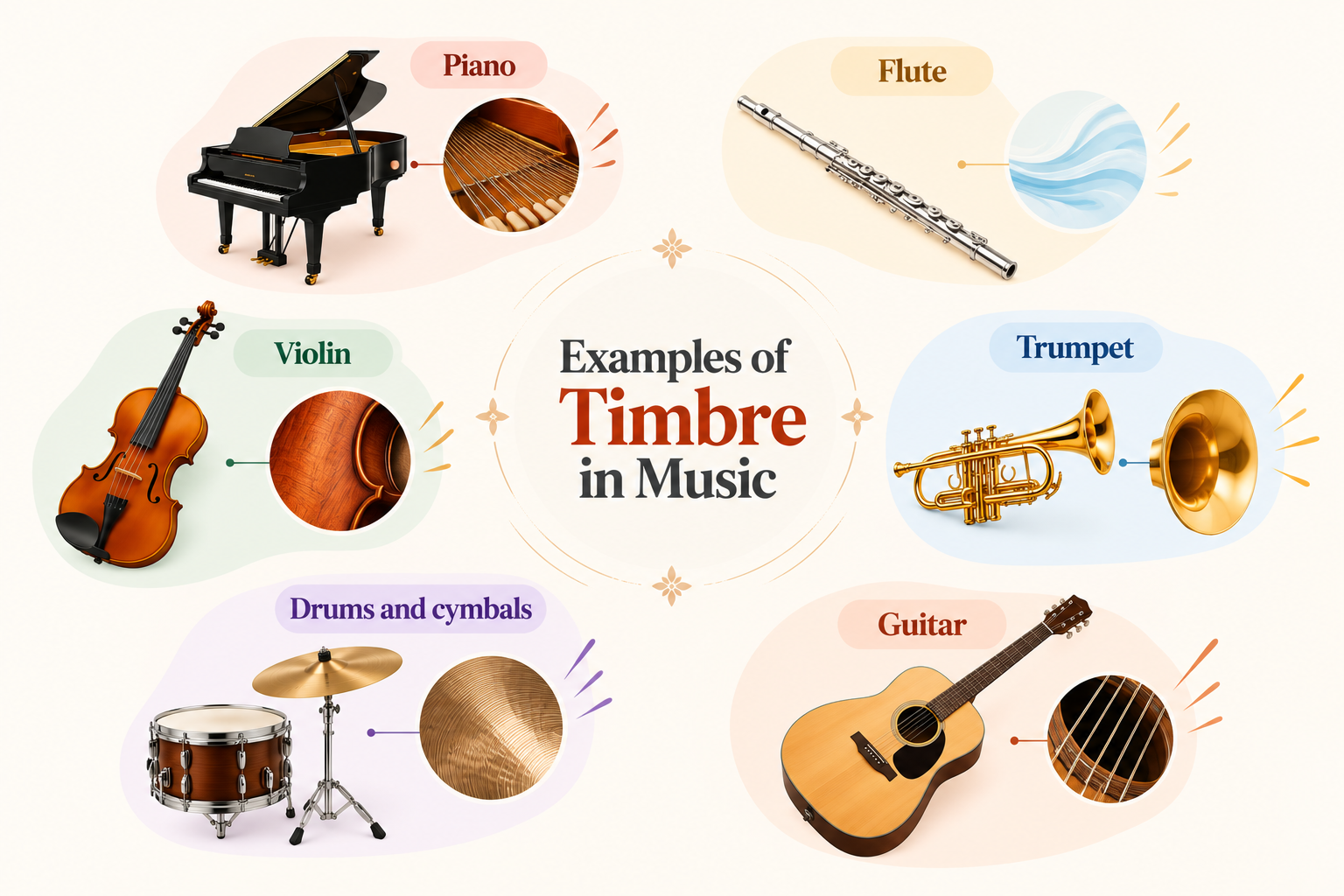
The easiest way to understand timbre is to compare instruments. Listen to a short passage played on a piano, then hear the same melody on a flute. The notes may match, but the piano sounds struck and begins to fade once the key is played, while the flute can sustain a smooth line for as long as the player controls the breath. Those differences are easy to hear, even without knowing the instruments’ technical details.
Piano
A piano can sound crisp and bright in its upper register, full in the middle, or deep and resonant in the bass. The hammer strikes strings, and the sound naturally decays after the initial attack. The player can change the character by playing softly or forcefully, using the sustain pedal, or adjusting articulation. A piano’s timbre is therefore not one fixed quality; it varies across the instrument and with the performer’s touch.
Flute
A flute often has a light, clear quality, especially in its middle and upper registers. Depending on the player and register, the sound may be soft and breathy or brilliant and penetrating. Because the tone is produced by directing air across an opening, breath noise may mix with the pitched sound. This combination helps give the flute its recognisable timbre.
Violin
A violin can produce a sweet, singing tone, a brilliant high note, or a rough, dramatic sound. The bow’s speed, pressure, and contact point affect the tone, as do vibrato and the position of the left hand. A violin playing a sustained melody can sound expressive and vocal, while short, sharply articulated notes may feel much more pointed. These are different timbral possibilities within the same instrument.
Trumpet
The trumpet is known for a sound that can cut through a large ensemble. Its timbre may be rounded and mellow when played softly, or bright and piercing in a powerful high passage. The player’s embouchure, breath support, mouthpiece, and use of a mute can all influence the result. A muted trumpet can sound noticeably different from an open trumpet, even when the same notes are played.
Drums and cymbals
Percussion instruments offer especially clear examples because many are not heard as stable pitched notes. A snare drum has a sharp attack and a noisy rattle; a bass drum produces a deeper thump; a cymbal can shimmer and ring for several seconds. The materials, shape, tension, and playing technique all influence the sound. A gentle brush stroke on a snare has a different timbre from a forceful stick hit.
Guitar
An acoustic guitar has a resonant, woody quality shaped by the strings and body. A clean electric guitar can sound smooth and focused, while distortion adds harmonic complexity and sustain, creating a more saturated tone. Picking near the bridge often gives a sharper attack than picking over the sound hole. The instrument, effects, amplifier settings, and player’s technique all contribute to the final timbre.
Timbre of the Human Voice
Human voices are a powerful reminder that timbre is not limited to instruments. Two people can sing the same note at the same volume and still sound unmistakably different. One voice may seem breathy, another clear and ringing; one may have a dark, rich quality, while another sounds bright and light. Vocal timbre is influenced by vocal-fold vibration, the shape of the vocal tract, resonance, articulation, and the singer’s technique.
Words such as warm, thin, nasal, mellow, husky, airy, metallic, dark, and bright are commonly used to describe vocal timbre. These are listening descriptions rather than precise measurements, and people may use them a little differently. The goal is not to find one perfect label; it is to notice what you hear and use language that helps another person imagine the sound.
What Factors Affect Timbre?
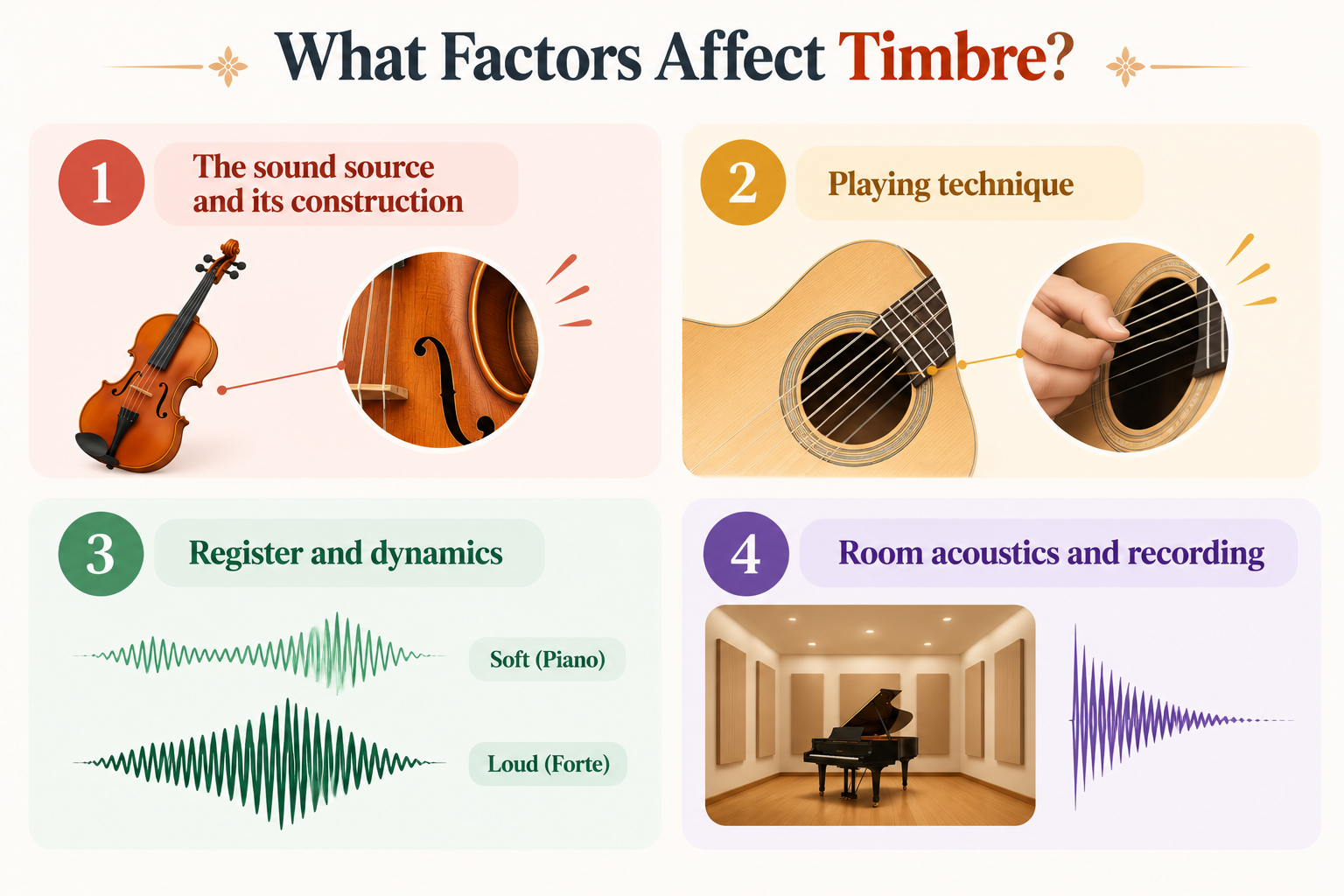
Several elements work together to shape timbre. The instrument’s material and construction matter, but the sound is also affected by the performer, playing technique, register, room, and any electronic processing used. Here are some of the main factors.
1. The sound source and its construction
A violin string, a piano string struck by a hammer, and a flute’s air column vibrate in different ways. The body of an acoustic instrument also resonates, reinforcing some frequencies more than others. Wood type, shape, string material, drumhead tension, and instrument design can all influence sound, although no single material automatically guarantees a particular tone.
2. Playing technique
The same instrument can sound surprisingly different in different hands. A guitarist can pluck gently or aggressively, a flautist can change the breath, and a violinist can use a smooth bow stroke or a short, accented one. Technique changes the balance of frequencies and the way a note starts, sustains, and ends. This is one reason a musician’s sound can become recognisable over time.
3. Register and dynamics
An instrument’s timbre can change as it moves from low notes to high notes. A piano’s bass notes may feel round and heavy, while its top notes can seem clear and delicate. Playing louder can introduce a sharper attack or stronger upper frequencies; playing softly may bring out a more delicate colour. The relationship varies by instrument, so it is useful to listen for changes rather than assume one rule applies to all sounds.
4. Room acoustics and recording
A sound heard in a dry practice room may feel different in a concert hall. Reflections and reverberation can make notes blend together or seem fuller. Microphone placement and recording equipment also affect what gets captured. Equalisation, compression, reverb, and distortion can further alter a recorded sound. The source still matters, but the listening environment becomes part of the experience.
Timbre vs Pitch, Tone, and Texture
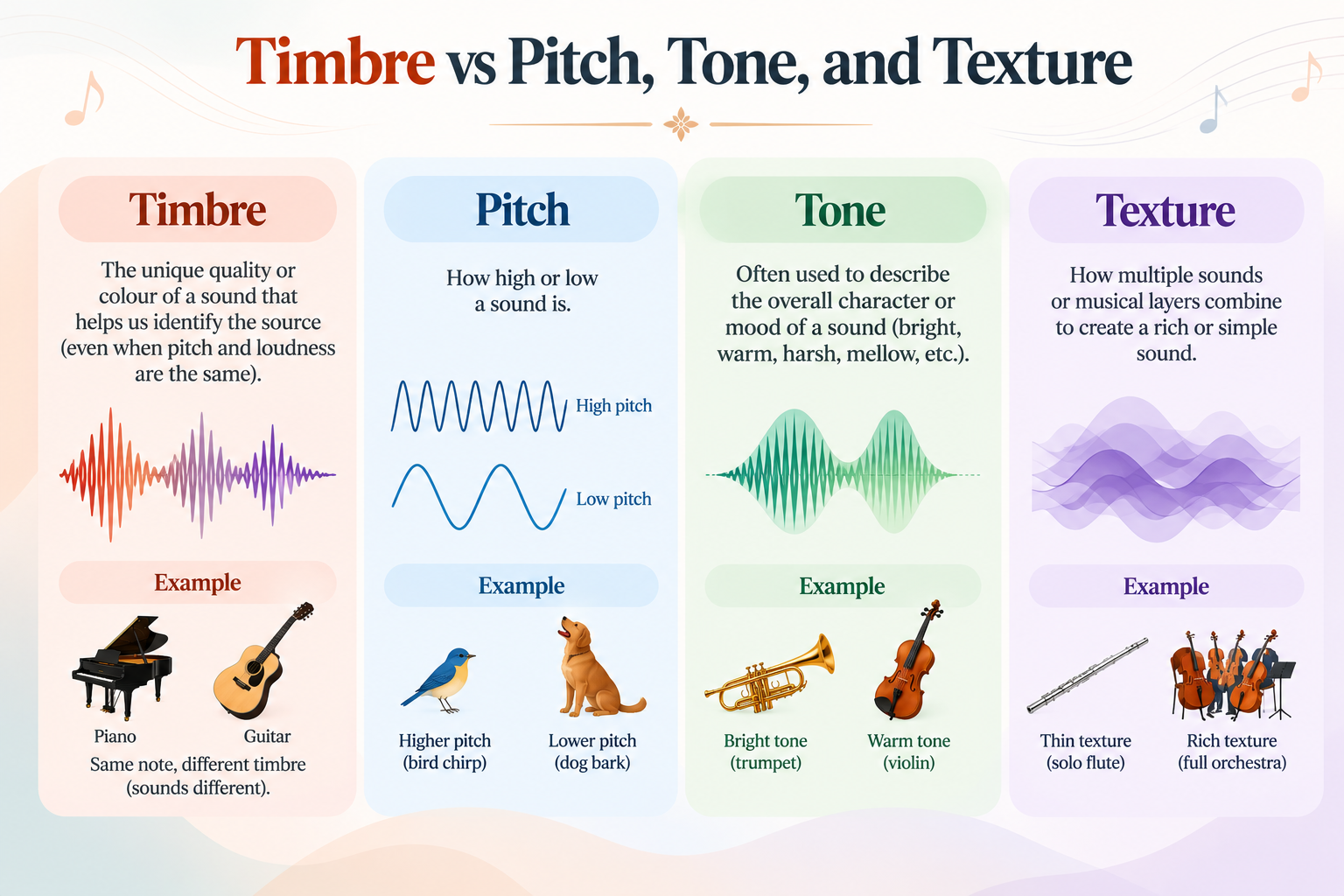
These terms are related, but they do not mean exactly the same thing. Understanding the distinctions makes it easier to talk about music clearly.
Timbre vs pitch: Pitch refers to how high or low a note sounds. Timbre describes the sound’s quality. A flute and a violin may play the same pitch but remain easy to tell apart because their timbres differ.
Timbre vs loudness: Loudness is how strong or quiet a sound seems. Timbre is its sound colour. A loud cello and a soft cello may differ in timbre as well as loudness, but those are separate aspects of what you hear.
Timbre vs tone: In everyday conversation, tone and timbre are sometimes used interchangeably. Tone may describe a performance’s sound quality, while tone colour is a more specific term for timbre. Context matters because tone can also mean a musical note or interval.
Timbre vs texture: Texture describes how musical parts fit together, such as a solo voice, a melody with accompaniment, or several independent melodic lines. Timbre describes the character of the sounds making up those parts. A piece can have a simple texture but use several contrasting timbres, or a thick texture built from instruments with similar sound colours.
Why Is Timbre Important in Music?
Timbre helps musicians create contrast, mood, and identity. A composer might give a gentle melody to a flute and a dramatic response to low strings. Film music may use metallic sounds to build tension, while a distorted guitar can make a pop chorus feel forceful. A soft keyboard pad can create space beneath a singer. The choice of sound shapes the effect as much as the notes do.
How to Train Your Ear to Recognise Timbre
You do not need specialist equipment to practise. Start with sounds you know and make comparisons; listening closely to the timbre of music helps you hear its individual colours. The key is to listen carefully to one feature at a time instead of trying to describe everything at once.
First, compare the same short melody on two instruments. Notice the beginning of each note, the fullness or brightness of the sound, and how long it continues after the player stops. Next, listen to two singers performing a similar phrase. What seems different: breathiness, resonance, edge, or smoothness? Try to describe the sound before looking at the performer or instrument if you can.
Conclusion
Timbre gives every musical sound its own character. It is the reason a flute does not sound like a trumpet, why two singers can perform the same melody differently, and how a musician can create several colours on a single instrument. The timbre musical definition may sound technical at first, but the idea is familiar: it is the quality of a sound that helps you recognise and describe it.
The best way to understand timbre is to listen actively. Compare instruments playing the same note, notice how sounds begin and fade, and experiment with different playing styles. As your ear becomes more attentive, you will hear more than pitch and rhythm. You will hear the individual colours that make music expressive, distinctive, and memorable.
Frequently Asked Questions
Is timbre the same as tone colour?
Yes. Tone colour is a common alternative term for timbre. Both refer to the distinctive quality that helps a listener tell sounds apart, even when pitch and loudness are similar.
Can two instruments have the same timbre?
Two instruments can have similar timbres, especially in a particular register or playing style, but their sounds are rarely identical in every detail. Performers, rooms, and recording choices can make the differences more or less noticeable.
Can timbre change during a song?
Yes. Timbre can change when the performer changes technique, when an instrument moves into a different register, or when effects and processing are introduced. Arrangements can also shift the overall sound colour as instruments enter, leave, or combine.
How do you describe timbre?
Try words such as bright, dark, warm, hollow, breathy, metallic, smooth, rough, mellow, or nasal. These are useful listening terms rather than strict scientific categories. Add a short explanation of the feature you noticed so the description is clear.
What does timbre in music mean for beginners?
For beginners, timbre in music means the quality that makes a sound recognisable. It explains why a piano, a guitar, a flute, and a human voice can sound different while playing the same note.