Table of Contents
Quick Summary
Tabla bols are the spoken syllables used to represent different strokes and sounds produced on the tabla. They help students understand rhythms, memorise patterns and develop coordination between their hands. Common bols include Na, Ta, Tin, Tun, Ge, Ke and Dha. Learning these basic syllables is an important first step for beginners before moving on to more complex rhythmic compositions.
The tabla is one of India's most recognised percussion instruments, known for its distinctive sounds and rhythmic versatility. Whether you listen to classical music, devotional compositions, Bollywood songs or contemporary fusion, the tabla often plays an important role in creating the rhythm.
But how do tabla players learn and remember different rhythmic patterns?
The answer lies in tabla bols.
Tabla bols are spoken syllables that represent the different sounds or strokes produced by playing the instrument. Instead of remembering every hand movement through written instructions, students learn specific syllables that help them identify and reproduce sounds.
For example, syllables such as Na, Tin, Tun and Dha represent different strokes or combinations of strokes.
These syllables form the foundation of tabla learning. Once students understand them, they can begin practising rhythmic patterns, developing speed and exploring traditional compositions.
Why Are Tabla Bols Important for Beginners?
Learning tabla is not just about striking the drum. It involves understanding rhythm, controlling hand movements and maintaining a steady beat.
Tabla bols make this learning process easier in several ways.
1. Help understand different sounds
Each bol represents a particular stroke or combination of strokes. Learning them helps students recognise the sounds produced by the instrument.
2. Make rhythm easier to remember
Spoken syllables are easier to memorise and repeat than complicated written instructions. Students can recite a rhythmic pattern before attempting to play it.
3. Improve hand coordination
Practising bols helps beginners understand which hand movements are needed to produce different sounds on the tabla.
4. Build a foundation for compositions
Basic bols are combined to create longer rhythmic patterns, compositions and variations.
5. Develop rhythm and timing
Reciting and playing bols regularly helps students maintain a consistent rhythm and become more comfortable with different beat patterns.
Understanding the Basic Tabla Bols
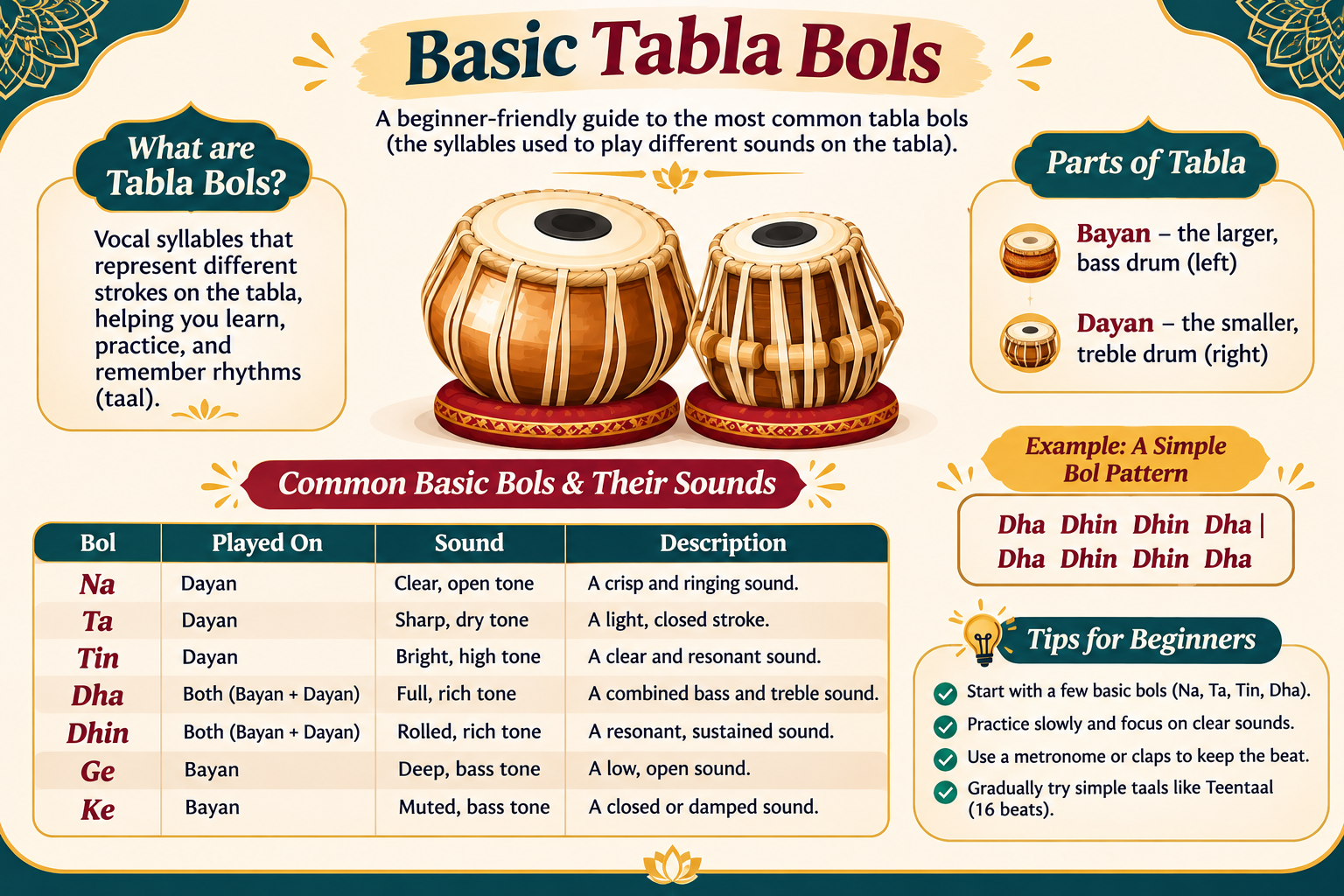
Before learning complete rhythmic compositions, beginners should become familiar with the fundamental syllables.
The tabla consists of two drums:
- Dayan: The smaller wooden drum, generally played with the dominant hand.
- Bayan: The larger metal or clay drum, generally played with the other hand.
Different strokes on these drums produce different sounds. The following table introduces some commonly taught tabla bols.
Note: The exact technique and sound associated with a bol can vary by tabla tradition, school and teaching method. Students should learn the correct hand placement from a trained teacher.
What Are the Different Types of Tabla Bols?
Once beginners understand individual syllables, they can start exploring how different bols are used in rhythmic patterns.
Here are some common categories to understand.
1. Single-Hand Bols
These are strokes generally produced using one drum at a time. For example, Na, Ta, Tin and Tun are commonly introduced as dayan bols.
Practising these strokes helps students develop finger control, clarity and consistency.
2. Bayan Bols
The bayan produces the deeper bass sounds of the tabla. Bols such as Ge and Ke are commonly introduced while learning how to control the left hand.
Beginners should practise these strokes slowly to understand how pressure and hand placement affect the sound.
3. Combined Bols
Some bols involve strokes played on both drums together.
Dha and Dhin are examples of commonly taught combined bols. They help students understand how the two drums work together to create a fuller rhythmic sound.
What Are Tabla Notes for Beginners?
When people search for tabla notes, they are often looking for a simple way to understand and practise the instrument's basic strokes.
Unlike piano or guitar, tabla does not use fixed musical notes in the same way. Its learning system is built around bols, hand techniques and rhythmic patterns.
For beginners, the best approach is to learn the spoken syllables first and then practise producing each sound on the instrument.
Here is a simple reference for tabla notes for beginners:
These are introductory learning references, not a complete notation system. The actual sound depends on the stroke technique and the tabla's tuning.
Easy Tabla Bols Patterns to Practise
Once you are comfortable with individual strokes, you can begin combining them into simple patterns.
Start slowly. Recite each pattern aloud before playing it on the instrument.
Pattern 1: Basic Repetition
Na – Na – Na – Na
This simple exercise helps beginners practise consistency and produce a clear sound with each stroke.
Pattern 2: Alternating Bols
Na – Tin – Na – Tin
Practise alternating between the two bols while maintaining equal spacing between each beat.
Pattern 3: Introducing Combined Bols
Dha – Dhin – Dha – Dhin
This pattern introduces combined strokes and encourages coordination between the two hands.
Pattern 4: A Simple Four-Beat Exercise
Dha – Ge – Na – Tin
Recite the sequence slowly and repeat it several times. Focus on producing each sound clearly instead of increasing your speed.
These exercises are starting points for practice. A teacher can help you refine the strokes and introduce appropriate rhythmic structures as you progress.
Introduction to Teentaal: A Basic Tabla Rhythm
After learning individual tabla bols, beginners can explore taal, which refers to a rhythmic cycle in Indian music.
One of the most commonly taught rhythmic cycles is Teentaal.
Teentaal consists of 16 beats divided into four sections of four beats each. Its basic theka is:
Dha Dhin Dhin Dha |
Dha Dhin Dhin Dha |
Na Tin Tin Ta |
Ta Dhin Dhin Dha
The 16 beats are organised as follows:
The first beat is called Sam, an important point of return in the rhythmic cycle. The third section begins with Khali, traditionally marked by a wave of the hand.
Teentaal is a useful example of how individual tabla bols come together to form a complete rhythmic structure.
How Can Beginners Practise Tabla Bols Effectively?
Learning the names of different strokes is only the beginning. Regular practice helps students develop the control needed to play them correctly.
Here are a few practical tips:
1. Learn a few bols at a time
Avoid trying to memorise every bol in one session. Start with basic syllables such as Na, Ta, Tin and Tun before moving on to combined strokes.
2. Recite before playing
Say the bols aloud several times before attempting the pattern on the instrument. This helps you remember the sequence and understand its rhythm.
3. Practise slowly
Speed is not the priority when starting out. Focus on producing clear, consistent sounds.
4. Maintain a regular practice routine
Even 15–20 minutes of focused practice can help beginners become more comfortable with basic strokes and patterns.
5. Listen to experienced tabla players
Listening to different performances can help you recognise rhythmic variations, understand musical expression and develop a better sense of timing.
6. Learn with proper guidance
A trained teacher can correct hand positioning, explain stroke techniques and help you avoid developing incorrect playing habits.
Learn Tabla with Spardha School of Music
Learning tabla becomes more rewarding when you understand the instrument step by step. At Spardha School of Music, we offer live, one-on-one online music classes for children and adults.
Our tabla lessons help students build a strong musical foundation, understand rhythm and develop practical playing skills through structured guidance. Whether you are completely new to the instrument or looking to improve your existing skills, you can learn at a pace that suits your progress.
With regular practice and guidance, students can gradually move from basic bols to more advanced rhythmic patterns and compositions.
Explore our online music classes at Spardha School of Music to begin your musical journey.
Conclusion
Tabla bols are the building blocks of tabla playing. They help beginners understand individual strokes, remember rhythmic patterns and develop coordination between the two hands.
Start with simple syllables such as Na, Ta, Tin and Tun, practise them regularly and gradually move towards combined bols and rhythmic cycles like Teentaal.
Remember, learning tabla is a gradual process. Focus on clarity, consistency and timing before trying to play faster. With structured practice and the right guidance, you can build a strong foundation in this beautiful percussion instrument.
Frequently Asked Questions
What are tabla bols?
Tabla bols are spoken syllables that represent different strokes or sounds produced on the tabla. They help musicians learn, remember and perform rhythmic patterns.
What are the basic bols of tabla?
Some commonly taught basic tabla bols include Na, Ta, Tin, Tun, Ge, Ke, Dha and Dhin.
How many bols are there in tabla?
There is no single fixed number of tabla bols. Different strokes, combinations and variations are used across tabla traditions and compositions.
Are tabla bols the same as tabla notes?
Not exactly. Tabla bols are spoken syllables representing strokes and sounds. Unlike melodic instruments, tabla learning primarily focuses on strokes, rhythmic patterns and techniques rather than a fixed set of musical notes.
Which tabla bols should beginners learn first?
Beginners can start with Na, Ta, Tin and Tun, followed by Ge, Ke and combined bols such as Dha and Dhin.
What is Teentaal in tabla?
Teentaal is a popular rhythmic cycle in Indian classical music consisting of 16 beats divided into four sections of four beats each.
How long does it take to learn basic tabla bols?
The time required depends on practice frequency, learning pace and guidance. With regular practice, beginners can gradually become familiar with basic bols and simple rhythmic patterns.
Can I learn tabla at home?
Yes. You can practise tabla at home with an instrument, regular exercises and structured lessons. Learning from a trained teacher is helpful for developing correct hand techniques.