Table of Contents
Quick Summary
Sur in music refers to a musical note or a pitch that is produced accurately and has a clear, tuneful quality. In Indian classical music, the seven basic sur are Sa, Re, Ga, Ma, Pa, Dha and Ni, collectively called the Sapta Swara. In the commonly used 12-pitch framework, the 12 sur in music consist of two Achal swaras (Sa and Pa), five Shuddh swaras, four Komal swaras (Komal Re, Ga, Dha and Ni) and one Tivra swara (Tivra Ma). Understanding what is sur helps singers and instrumentalists develop pitch accuracy, practise riyaz, understand ragas and perform musical phrases with greater control.
Despite cultural and linguistic barriers, music has a global language that speaks straight to the human soul. The core elements of this expressive medium are melody, emotion, and structure. You have probably heard the basic term sur if you have ever dabbled in Indian classical music, whether it is Carnatic or Hindustani. However, what is sur, why is it so important to musical education, and how does knowing the 12 sur in music transform basic sound into an enthralling melody?
Understanding sur in music is essential for vocalists, instrumentalists, and passionate listeners alike. It serves as the bedrock upon which raga structures, pitch accuracy, and tonal expression are built.
What Is Sur? Defining the Fundamental Musical Note
To understand the sur meaning, a person must look at both the definition of sur and the cultural importance of sur in music. Sur, also spelled swar or swara means a note or tone. In sound terms a sur is a particular sound frequency that has a clear pitch, sharpness and echo. A sur is not noise or a spoken tone. A sur is planned, steady and sings in harmony with a main key or tonic note.In music philosophy the word swara comes from two Sanskrit ideas: swa, which means self and ra which means to resonate or shine. Therefore a sur is a sound that shines on its own, with emotional power and pure tone.
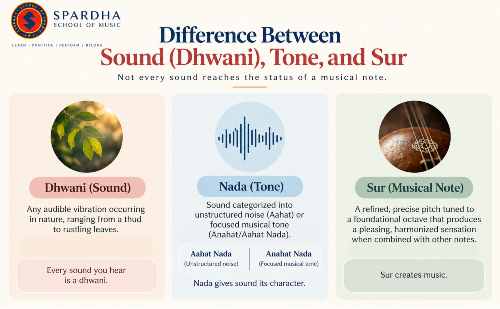
Difference Between Sound (Dhwani), Tone, and Sur
Not every sound reaches the status of a musical note:
- Dhwani (Sound): Any audible vibration occurring in nature, ranging from a thud to rustling leaves.
- Nada (Tone): Sound categorized into unstructured noise (Aahat) or focused musical tone (Anahat/Aahat Nada).
- Sur (Musical Note): A refined, precise pitch tuned to a foundational octave that produces a pleasing, harmonized sensation when combined with other notes.
The Origins and Philosophy of Sur in Indian Classical Music
The history of sur in music goes back to Vedic chants, especially the Sama Veda, where sur was first organized to sing hymns. Over centuries scholars carefully wrote down how sur, spoken by human vocal cords and played on instruments creates particular musical tones. Ancient books such as the Natya Shastra by Bharata Muni and the Sangeeta Ratnakara by Sarangadeva turned sound into 22 microtonal intervals called Shrutis. From these 22 Shrutis seven main sur were selected for their sound and harmonious spacing forming the basic musical octave known as Saptak. In philosophy each sur is thought to vibrate with emotions called Rasas with natural elements and even, with animal sounds tying sur made by humans to the world around us.
The 7 Primary Notes: Sapta Swara
In both vocal and instrumental traditions, the foundational octave consists of seven primary notes, collectively known as the Sapta Swara. These seven notes form the bedrock of Indian musical scales:
Together, these seven notes create the basic scale: Sa – Re – Ga – Ma – Pa – Dha – Ni.
The 12 Sur in Music: Achal and Vikrit Swaras
In classical music Swar means a specific theoretical musical note (for example Sa, Re, Ga, Ma). Sur is the resonant and tuneful way that note is played or sung in a real performance. In short a swar is the note that you see on paper or, in a scale. Sur is how accurately and melodiously you sing or play that note.
1. Achal Swaras (Fixed Notes - 2 Notes)
These are immutable anchor notes that never change their frequency or pitch level within a scale:
- Shadja (Sa): The fundamental tonic note (the base pitch of the artist).
- Pancham (Pa): The perfect fifth note.
Because Sa and Pa remain fixed, they provide constant stability for the singer or instrumentalist.
2. Shuddh Swaras (Pure/Natural Notes - 5 Notes)
These are the standard, un-flattened versions of the remaining five notes:
- Shuddh Rishabh (Re)
- Shuddh Gandhara (Ga)
- Shuddh Madhyam (Ma)
- Shuddh Dhaivata (Dha)
- Shuddh Nishad (Ni)
3. Vikrit Swaras (Altered/Modified Notes - 5 Notes)
The remaining five notes are created by lowering (flattening) or raising (sharpening) the natural pitches:
- Komal Swaras (4 Flat Notes): Notes that are pitched half a step lower than their natural position.
- Komal Re (Re♭)
- Komal Ga (Ga♭)
- Komal Dha (Dha♭)
- Komal Ni (Ni♭)
- Tivra Swara (1 Sharp Note): A note pitched half a step higher than its natural position.
- Tivra Ma (Ma♯)
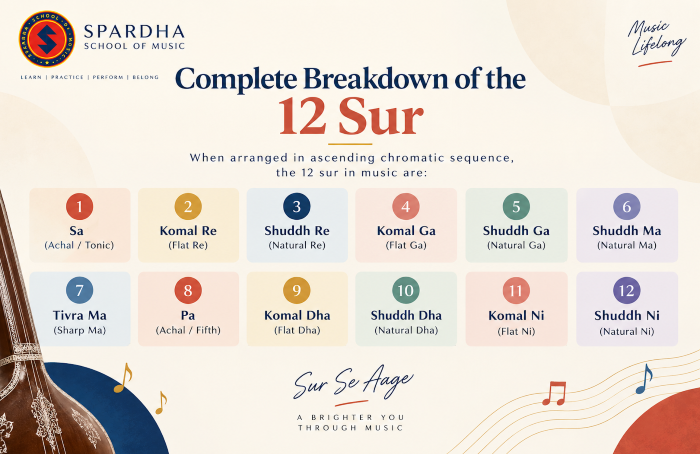
Complete Breakdown of the 12 Sur
When arranged in ascending chromatic sequence, the 12 sur in music are:
- Sa (Achal / Tonic)
- Komal Re (Flat Re)
- Shuddh Re (Natural Re)
- Komal Ga (Flat Ga)
- Shuddh Ga (Natural Ga)
- Shuddh Ma (Natural Ma)
- Tivra Ma (Sharp Ma)
- Pa (Achal / Fifth)
- Komal Dha (Flat Dha)
- Shuddh Dha (Natural Dha)
- Komal Ni (Flat Ni)
- Shuddh Ni (Natural Ni)
Microtones (Shrutis) vs. Sur
To understand what is sur, feel Sur needs to be set apart from Shruti.
• Shruti (Microtone): I think Shruti is a audible pitch variation. Indian music theory says there are 22 Shrutis in one octave.
• Sur (Note): I think Sur is a chosen, Shruti that serves as a main functional frequency in a musical scale.
I think picture Shrutis as a rainbow of colors. I think picture Sur, as the named secondary colors that are chosen to color a musical canvas.
Sur across Different Music Traditions: Hindustani, Carnatic & Western
While pitch is a universal physical phenomenon, different global traditions categorize and utilize surs in unique ways:
Despite notation variations, a musician maintaining absolute pitch precision in any tradition is practicing what Indian classical music calls Sur Lagana (striking the pure note).
Why Sur Matters in Music Performance
Knowing sur in music is much more than just learning theory. The way you hit your pitch determines if a musical performance grabs the heart of the audience or just sounds bad and out of tune.
1. Emotional Expression (Rasa Creation)
Every raga depends on combinations of surs to make people feel things - like devotion (Bhakti) sorrow (Karuna) joy (Haasya) or peace (Shanta). If you hit a note a little bit flat or sharp you change the entire feeling of the musical performance.
2. Tonal Harmony and Resonance
When a singer hits the sur while a drone instrument like the Tanpura plays something special happens. The sounds vibrate together to create a rich feeling that makes the music much better to listen to.
3. Foundation for Melodic Improvisation
Parts of music like Meend (glissando/slur) Gamak (oscillation) and Taan (rapid melodic passages) need perfect pitch to work. If you do not have a hold on your basic surs those fancy musical decorations will just sound shaky.
4. Cohesion in Ensemble Playing
It does not matter if you are playing in a classical jugalbandi or a modern fusion band. Staying in sur makes sure that every singer and every instrument stays perfectly in tune, with each other..
What Happens When a Musician Is "Besura"?
In musical terminology, being “besura” means singing or playing off-pitch (out of tune).
- Physical Cause: Lack of vocal cord muscle memory, poor auditory feedback, or incorrect breath support.
- Aesthetic Result: The natural harmony between the performer, background drone (Tanpura), and accompaniment is broken, creating auditory strain for listeners.
- The Solution: Focused daily pitch alignment exercise, known as Riyaz or Swar Sadhana.
The Role of Modern Technology in Training Sur
- It has been observed that traditional Guru‑Shishya learning remains unmatched. Yet modern digital tools help modern students to perfect their sur.
- Tanpura Apps: Mobile applications such as iTanpura give background reference pitches anywhere.
- Tuner Apps & Visualizers: Real‑time pitch detection software shows pitch graphs. The graphs let singers see instantly if their sur is sharp, flat or exactly, on target.
- Digital Keyboards: These keyboards let vocalists check pitch accuracy away. They compare the singer’s sur with fixed frequencies.
Key Takeaways on Sur in Music
- Core Definition: Sur refers to a pure, melodious pitch or musical note tuned to a stable sound frequency.
- The 7 Base Notes: Sa, Re, Ga, Ma, Pa, Dha, Ni make up the Sapta Swara.
- The 12-Sur Spectrum: An octave contains 12 sur in music- 2 Achal (fixed: Sa, Pa), 5 Shuddh (natural), 4 Komal (flat), and 1 Tivra (sharp).
- Core Practice: Daily Swar Sadhana, lower octave practice (Kharaj), and ear training are the primary methods for achieving pitch perfection.
Frequently Asked Questions
What does "Sur" mean in music?
In music, sur (सुर) means a musical note, tone, or exact pitch. It is a core idea in Indian classical music. It is the specific sound frequency that sounds pleasant to the ear.
What is 7 Sur?
The 7 sur (or Sapta Swaras) are the seven basic musical notes in Indian classical music: Sa, Re (Ri), Ga, Ma, Pa, Dha, and Ni. Together, they form the octave (called the Saptak) and serve as the foundation for all melodies, scales, and ragas.
What is the sur of the song?
In Indian music, the "Sa" (often spelled "sur" or root note) of a song is the primary home base, anchor pitch, or fundamental tonic note (equivalent to the root or key in Western music) upon which the entire melody, scale, and raga are dependent.
What is the difference between sur and swar?
In Indian classical music, Swar refers to the specific, theoretical musical note (such as Sa, Re, Ga, Ma), while Sur is the precise, resonant, and tuneful execution of that pitch in actual performance. In short, a swar is the note on paper or scale, and sur is how accurately and melodiously you sing or play it.