

Table of Contents
Quick Summary
Strumming patterns are combinations of downstrokes and upstrokes that create the rhythm of a song. Beginners can start with simple patterns such as D-D-D-D and D-U-D-U before moving to more advanced combinations. Learning guitar strumming patterns helps develop steady timing, chord coordination and rhythm, while many of the same techniques can be used for ukulele strumming patterns. Regular practice with a metronome, simple chords and slow tempos can make guitar strumming more consistent and comfortable.
Learning a few basic strumming patterns is one of the fastest ways to turn simple guitar or ukulele chords into recognisable music. You don't need advanced technique to get started. If you can hold a chord and keep a steady beat, you can begin practising strumming.
For beginners, the most useful patterns start with simple downstrokes and upstrokes, such as D-D-D-D and D-U-D-U. As your timing improves, you can move to patterns such as D-D-U-U-D-U, which are commonly used in pop, acoustic and contemporary songs.
This guide explains the strumming meaning, basic guitar strumming techniques, easy guitar strumming patterns, beginner-friendly ukulele strumming patterns, and how to practise them without losing the beat.
What Does Strumming Mean?
The strumming meaning is simple: strumming is the action of moving your fingers, thumb or a pick across multiple strings to produce a rhythmic sound.
On a guitar or ukulele, chords provide the notes that make up the harmony. Strumming determines how those chords are played rhythmically.
For example, imagine you are playing:
C – G – Am – F
You could play one downstroke for every chord, or you could use a repeated pattern of downstrokes and upstrokes. The chords remain the same, but the rhythm changes.
That rhythmic movement is what we call a strumming pattern.
Strumming vs Picking
Strumming usually involves playing several strings together, while picking involves playing individual strings or specific notes.
If you're just starting, focus on basic guitar exercise before worrying about complicated picking techniques.
Understanding Downstrokes and Upstrokes
Before learning different guitar strumming patterns, you need to understand two basic movements: downstrokes and upstrokes.
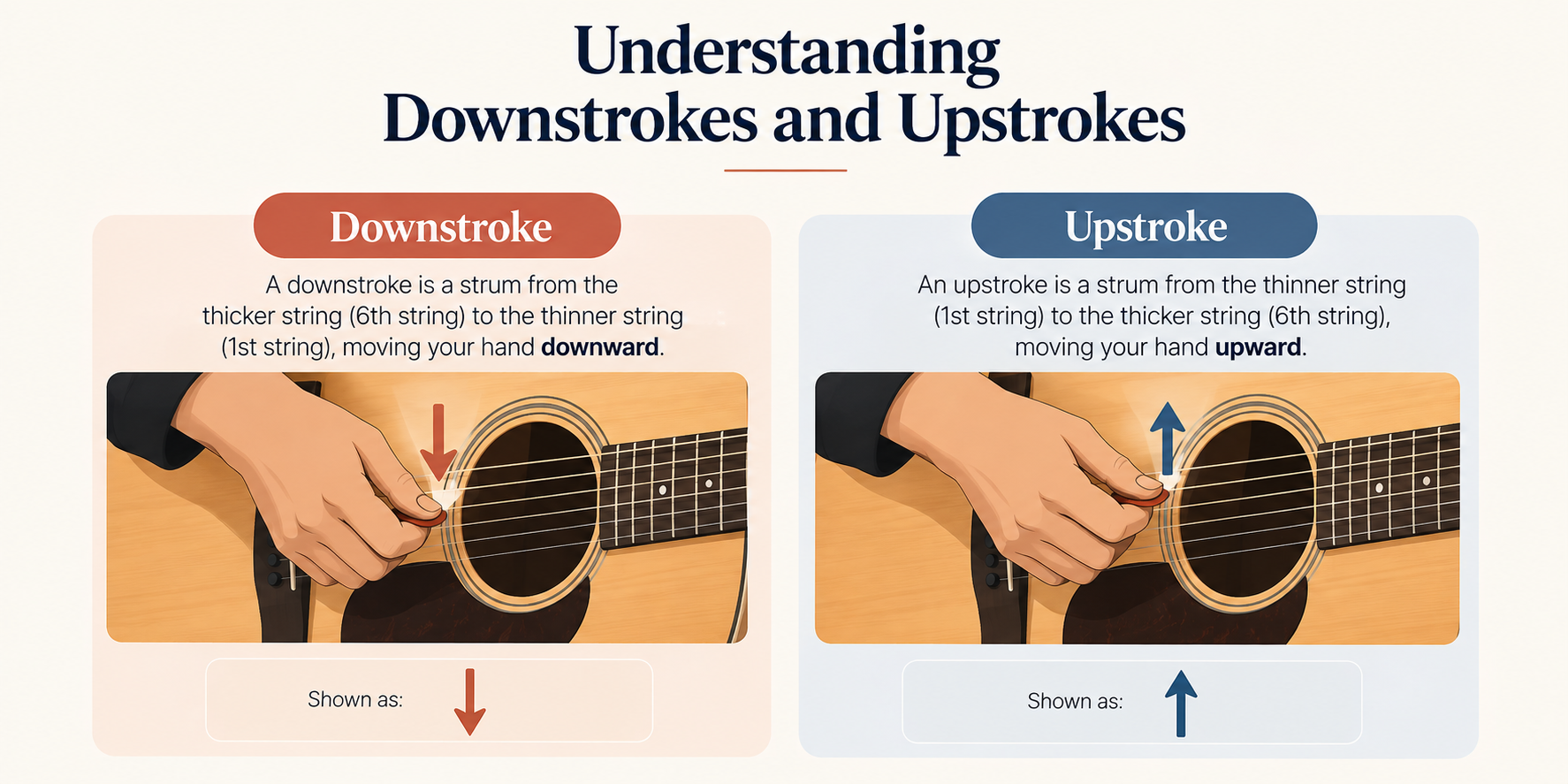
What Is a Downstroke?
A downstroke is a movement from the thicker strings towards the thinner strings.
It is usually written as:
D
or
↓
Start by counting:
1 – 2 – 3 – 4
Play one downstroke on each count:
D – D – D – D
Don't worry about speed. The goal is to make every stroke evenly spaced.
What Is an Upstroke?
An upstroke moves from the thinner strings towards the thicker strings.
It is usually written as:
U
or
↑
Now combine the two:
D – U – D – U
Count:
1 & 2 & 3 & 4 &
The downstrokes fall on the numbers and the upstrokes fall on the "&".
This simple movement forms the foundation of many guitar strumming patterns.
How to Strum a Guitar: A Beginner's Step-by-Step Guide
If you're searching for how to strum guitar keys, start with rhythm rather than speed.
1. Hold the guitar comfortably
Your strumming arm should be relaxed enough to move freely. Avoid locking your wrist or shoulder.
2. Start with muted strings
Place your fretting hand lightly over the strings without pressing them against the fretboard.
Now practise your strumming pattern.
This lets you focus entirely on rhythm without worrying about chord changes.
3. Practise four downstrokes
Play:
D – D – D – D
Count:
1 – 2 – 3 – 4
Try to make every stroke sound evenly spaced.
4. Add upstrokes
Once four downstrokes feel comfortable, try:
D – U – D – U
Count:
1 & 2 & 3 & 4 &
Keep your hand moving continuously.
5. Add two chords
Choose two beginner-friendly chords, such as C and G.
Play the pattern four times on C, then four times on G.
The goal is to change chords without stopping the rhythm.
7 Beginner Strumming Patterns to Practise
The following strumming patterns move from very easy to slightly more challenging. Start with the first pattern and only move on when you can maintain a steady beat.
1. Four Downstrokes
Pattern:
D – D – D – D
Count:
1 – 2 – 3 – 4
This is the simplest starting point for guitar strumming.
Play one downstroke on every beat. Once you can do this comfortably with one chord, practise changing between two chords.
Difficulty: Beginner
Best for: First-time players and chord-change practice.
2. Alternating Down and Up
Pattern:
D – U – D – U
Count:
1 & 2 & 3 & 4 &
This is one of the most useful beginner guitar strumming patterns.
Keep your strumming hand moving steadily down and up rather than treating each stroke as a separate movement.
Difficulty: Beginner
Best for: Pop, acoustic and simple accompaniment.
3. Downstrokes with a Final Upstroke
Pattern:
D – D – D – D – U
You can count it as:
1 – 2 – 3 – 4 &
This introduces an upstroke without requiring a complicated rhythm.
Difficulty: Beginner
Best for: Building coordination.
4. D-D-U-U-D-U
Pattern:
D – D – U – U – D – U
This is a very useful pattern once you are comfortable with alternating down and upstrokes.
Start slowly. You don't need to play it at song speed immediately.
Practise the movement with muted strings first, then add a chord.
Difficulty: Beginner to intermediate
Best for: Pop and acoustic songs.
5. D-DU-UDU
Pattern:
D – D U – U D U
Count:
1 – 2 & – & 4 &
This pattern introduces more rhythmic variation.
The important part is keeping your hand movement consistent even when you don't strike the strings on every movement.
Difficulty: Beginner to intermediate
Best for: Contemporary acoustic and pop rhythms.
6. Down-Up with a Rest
Pattern:
D – U – D – (U) – D – U
The bracketed stroke represents a movement that you can practise without necessarily striking the strings.
This introduces the idea of rests and missed strokes, which are important in more advanced guitar strumming.
Difficulty: Intermediate beginner
Best for: Developing rhythmic control.
7. Continuous Eighth-Note Strumming
Pattern:
D – U – D – U – D – U – D – U
Count:
1 & 2 & 3 & 4 &
Start slowly and keep the movement even.
Once comfortable, practise changing chords every four or eight counts.
Difficulty: Beginner
Best for: Building consistency and timing.
Beginner Ukulele Strumming Patterns
The same basic rhythm concepts can be used when learning ukulele strumming patterns.
The ukulele has four strings rather than the six strings found on a standard guitar, but the basic downstroke and upstroke movements remain similar.
Start with:
D – D – D – D
Then try:
D – U – D – U
Once these feel natural, move to:
D – D – U – U – D – U
Easy Ukulele Strumming Patterns
For ukulele beginners, don't worry about hitting all four strings with every stroke. Focus first on creating a consistent rhythm.
Guitar vs Ukulele Strumming Patterns
Many basic strumming patterns can be used on both instruments, but the playing experience is different
The rhythm doesn't have to change just because you switch instruments. Once you understand the underlying pattern, you can adapt it to either guitar or ukulele.

How to Keep Your Strumming Hand Moving
One of the biggest breakthroughs for beginners is understanding that your hand doesn't always have to hit the strings.
Imagine your hand moving like a pendulum:
Down → Up → Down → Up → Down → Up
Even when a particular stroke is silent, the hand can continue moving.
This makes more complicated strumming patterns easier because your rhythm is based on continuous movement rather than trying to memorise every individual stroke.
For example, instead of thinking:
Down... down-up... up-down-up
think:
1 & 2 & 3 & 4 &
and decide which movements actually touch the strings.
This approach makes guitar strumming more consistent.
Common Strumming Mistakes Beginners Make
1. Playing too fast
Speed isn't the goal when learning strumming patterns.
Start slowly enough to play the entire pattern without losing the beat.
A slow, steady pattern is more useful than a fast pattern that constantly breaks.
2. Stopping between every stroke
If your hand completely stops after every downstroke, more complicated patterns will become difficult.
Practise continuous movement instead.
3. Holding the pick too tightly
If you're using a pick, avoid gripping it with excessive pressure. A relaxed grip makes it easier to move across the strings.
4. Looking at your strumming hand constantly
Once the basic movement is comfortable, try looking away from your hand occasionally.
You want the rhythm to become a physical habit rather than something you have to consciously monitor.
5. Changing chords before the rhythm is stable
Beginners often try to learn chord changes and complicated strumming simultaneously.
Start with one chord.
Then practise two chords.
Then introduce more chords.
6. Increasing the tempo too quickly
Use a metronome and increase the speed gradually.
If you cannot play the pattern cleanly at a particular tempo, slow it down.
How to Practise Strumming Patterns
You don't need an hour-long practice session to improve.
Try this simple 10-minute strumming routine.
The important thing is consistency.
Five to ten focused minutes every day can be more useful for a beginner than one long session once a week.
How to Practise with a Metronome
A metronome gives you a steady pulse to play against.
Start at a comfortable speed, such as 60 BPM, and play one downstroke for every click.
Then try:
D – U – D – U
with the downstroke on the click and the upstroke between clicks.
Once the pattern is comfortable, increase the tempo gradually.
This helps develop internal timing and makes it easier to stay in rhythm when you eventually play with other musicians.
What Are the Best Strumming Patterns for Beginners?
There isn't one best strumming pattern for every player.
The most useful patterns are the ones that help you develop three basic skills:
- Steady timing
- Consistent hand movement
- Smooth chord changes
A practical learning progression is:
D – D – D – D
↓
D – U – D – U
↓
D – D – D – D – U
↓
D – D – U – U – D – U
↓
D – D U – U D U
Don't move to the next pattern simply because you've memorised it. Move forward when you can play the current pattern consistently without losing the beat.
When Should You Learn More Advanced Strumming?
Once basic guitar strumming feels natural, you can start exploring:
- Accents
- Muted strums
- Syncopation
- Rests
- Swing rhythms
- Sixteenth-note patterns
- Percussive strumming
- Fingerstyle combinations
These techniques give you more control over dynamics and groove, but they are easier to learn once your basic downstroke and upstroke movements are comfortable.
Final Thoughts
Good strumming isn't about playing the most complicated pattern. It's about keeping a steady rhythm while your chords change.
Start with simple strumming patterns such as D-D-D-D and D-U-D-U. Practise them slowly, keep your hand relaxed and use a metronome when you need help maintaining a steady pulse.
The same principles apply to ukulele strumming patterns. Once you understand how downstrokes, upstrokes, rests and continuous hand movement work, you can adapt those ideas to hundreds of songs.
The goal is simple: make the rhythm feel natural enough that you no longer have to think about every stroke.
Frequently Asked Questions
What is the easiest strumming pattern for beginners?
D-D-D-D is one of the easiest patterns to start with. Play one downstroke on each beat while counting 1-2-3-4.
How do I learn how to strum a guitar?
Start with muted strings and practise four steady downstrokes. Then introduce alternating downstrokes and upstrokes with D-U-D-U. Once your rhythm is stable, add simple chord changes.
What are the best strumming patterns for beginners?
Start with D-D-D-D and D-U-D-U. Once these are comfortable, try D-D-U-U-D-U and D-DU-UDU. These patterns help build timing, coordination and consistent hand movement.
Are guitar and ukulele strumming patterns the same?
Many basic patterns can be used on both instruments. D-D-D-D and D-U-D-U, for example, work on both guitar and ukulele. The main difference comes from the instruments' string arrangements, tuning and tone.
What does D and U mean in strumming?
D means downstroke and U means upstroke. So D-D-U-U-D-U means two downstrokes, two upstrokes, one downstroke and one upstroke.
Should beginners use a pick or their fingers?
Either works. Guitar beginners can experiment with both a pick and finger strumming to find what feels comfortable. Ukulele players commonly use their fingers or thumb for basic strumming.
How long does it take to learn strumming?
Basic strumming can be introduced within the first few practice sessions, but consistent timing takes regular practice. The exact time depends on how often you practise and how comfortable you are with chord changes.
Why does my strumming sound uneven?
Uneven strumming usually comes from inconsistent hand movement, changing tempo or difficulty coordinating chord changes with the rhythm. Slow the pattern down, practise with muted strings and use a metronome until the movement becomes more consistent.
Can I learn guitar strumming without knowing many chords?
Yes. You can practise guitar strumming using muted strings or a single chord. Learning the rhythm separately can actually make it easier to combine strumming with chord changes later.
Can I use these patterns for songs?
Yes. Once you can play a pattern consistently, you can try applying it to songs that use a compatible rhythm. Start slowly and adjust the pattern to match the song rather than forcing every song into the same rhythm.