Table of Contents
Quick Summary
The saxophone is a single-reed wind instrument invented by Belgian instrument maker Adolphe Sax in the 1840s, designed to bridge the tonal gap between woodwind and brass instruments in military bands. Although made of brass, it is classified as a woodwind because it's the vibrating reed rather than the player's lips that produces the sound. The saxophone family spans from tiny soprano to enormous contrabass, with alto and tenor being the most widely played. It found its true home in jazz, became central to blues, soul, and rock, and remains one of the most emotionally expressive instruments in any musical tradition.
There are instruments people appreciate. Then there's the saxophone, which people feel different about.
Something about the saxophone instrument gets under the skin in a way that most instruments don't manage. It can sound like a human voice in its most expressive moments, without mimicking speech, but carrying emotional information the way a voice does, through timbre and phrasing and the subtle gradations between notes that bypass rational processing entirely. Jazz musicians understood this early. So did the blues players and every music composer who needed a single instrument to carry the weight of a scene.
Understanding the saxophone properly - what it is, how it works, which type does what - requires knowing a bit of history alongside the mechanics. The history is good, the mechanics are interesting, and the music the instrument has produced is extraordinary.
Who Invented the Saxophone and Why
The saxophone was invented by Adolphe Sax, a Belgian-born instrument maker who worked in Paris during the 1840s.
Sax was interested in improving wind instruments and wanted to create an instrument that combined some of the projection of brass instruments with the flexibility and expressive qualities of reed instruments.
He developed the saxophone as a family of instruments rather than as a single instrument. The original family included instruments in different sizes and pitch ranges.
Adolphe Sax received a French patent for his saxophone designs in 1846.
Saxophone History at a Glance
The instrument’s history is relatively young compared with instruments such as the violin, flute and tabla. Yet its impact on modern music has been considerable.
How the Saxophone Instrument Works
The basic principle behind a saxophone is relatively simple.
When a player blows into the mouthpiece, the reed vibrates against the mouthpiece. That vibration creates pressure changes in the air inside the saxophone’s body.
The player then uses the keys to open and close tone holes. This changes the effective length of the air column and therefore changes the pitch.
The process is:
Player blows → reed vibrates → air column vibrates → keys change air-column length → different notes are produced
The saxophone has a conical bore, meaning its internal tube gradually becomes wider towards the bell. This is different from the largely cylindrical bore of instruments such as the clarinet.
The saxophone also has an octave key, which allows the player to access higher registers more easily.
Also Read: Easy Musical Instruments to Learn at Any Age: Your Complete Guide
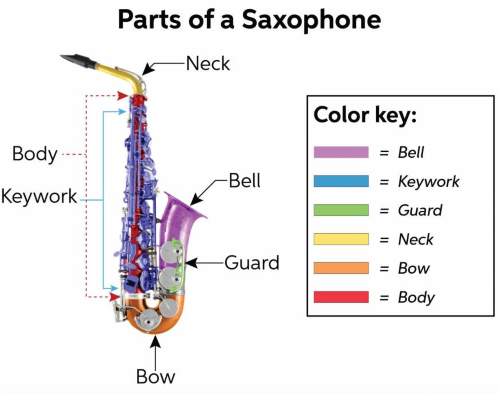
Parts of the Saxophone: For a Quick Reference
Mouthpiece: The piece the player puts in their mouth. It comes in different materials (hard rubber, metal, crystal) and different internal dimensions that significantly affect tone character.
Reed: A thin slice of cane that vibrates to produce sound. Reeds come in different hardnesses (typically rated 1.5 to 4) that affect resistance and tone. However, beginners generally start with softer reeds.
Ligature: The clamp that holds the reed against the mouthpiece. Note that small differences in ligature design affect tone and response more than seems reasonable for a piece of metal.
Neck: The curved section connecting mouthpiece to body, whose construction affects the instrument's tone and intonation.
Body: The main conical tube with the key mechanism. On most saxophones, this curves back on itself for practical length management.
Bell: The flared opening at the base of the instrument that projects sound outward.
Keys and Pads: The mechanism the player's fingers operate, each key closing a padded cup over a tone hole when pressed.
Types of Saxophones: The Main Family Members
The types of saxophones span a range of nearly four octaves from the highest soprano to the lowest contrabass. Inventor Adolphe Sax designed the family in both Bb/Eb transposing and C/F concert pitch configurations, though only the transposing versions survived into common use.
Alto Saxophone
The most widely taught and most commonly encountered type of saxophone in school music programmes. It sits in the middle of the family's pitch range, making it accessible for beginners. This is because the size is manageable and the register sits comfortably in the range where tone is easiest to develop. The key placement hits a middle ground, which is less cramped than the soprano, but easier to reach than the tenor.
Charlie Parker made the alto saxophone the instrument of bebop, whereas Ornette Coleman used it to dismantle bebop's harmonic conventions. It's also the saxophone most associated with the melodic, singing quality of saxophone instrumental music in jazz and film soundtrack contexts.
Tenor Saxophone
Larger and lower than the alto, it matches the natural register of a human male voice. The tenor is the saxophone of John Coltrane, Sonny Rollins, and Coleman Hawkins; the instrument at the centre of jazz's greatest individual statements.
It's also the saxophone most associated with rock and roll and soul music. The honking, driving sound of early rock and roll highlights one side of the tenor saxophone's personality. Its smoky, lyrical tone in soul ballads reveals another. When you hear a memorable saxophone song in soul or R&B, the chances are high it's a tenor.
Soprano Saxophone
Straight or slightly curved, the soprano is the highest of the commonly played types of saxophones. Its intonation is notoriously demanding, implying the instrument is less forgiving of embouchure inconsistency than the alto or tenor, and beginners rarely start here. John Coltrane’s 1960 recording of My Favourite Things brought the soprano saxophone back into the jazz spotlight. Decades later, Kenny G pushed the instrument into mainstream pop, earning widespread commercial success along with mixed reactions from jazz purists.
Baritone Saxophone
The lowest of the commonly played types of saxophones, the baritone anchors saxophone sections in big bands and provides the harmonic foundation that allows the alto and tenor voices above it to move freely. The baritone is a physically large instrument requiring hands big enough to reach its keys. In return, it produces a sound of extraordinary depth and warmth that no other saxophone in the family can replicate.
Gerry Mulligan's work as a baritone saxophone leader in the 1950s is the definitive argument for what the instrument can do as a solo voice rather than just a section anchor.
Soprano and Sopranino / Bass and Contrabass
Beyond the four main types of saxophones, the family extends upward to the sopranino and downward through the bass and contrabass. These instruments exist primarily in specialist contemporary music and saxophone ensemble contexts. The contrabass saxophone, standing nearly two metres tall, requires the player to sit and support the instrument on a stand. Interestingly, beyond hearing its sound, you will actually feel it.
Saxophone Types at a Glance
Also read: Guide To Types of String Instruments
Famous Saxophone Songs That Defined the Instrument
No guide to the saxophone instrument is complete without acknowledging the recordings that demonstrated what it could do at its best. These aren't just famous tracks featuring the saxophone but the songs where the saxophone steals the entire show.
Giant Steps by John Coltrane (1960): The most harmonically sophisticated saxophone improvisation ever recorded, and the most studied.
Take Five by Paul Desmond (Dave Brubeck Quartet, 1959): The best-selling jazz single in history. Paul Desmond's alto saxophone melody over Dave Brubeck's 5/4 piano accompaniment made jazz rhythmically adventurous accessible to a mainstream audience.
Baker Street by Gerry Rafferty (1978): Raphael Ravenscroft's tenor saxophone riff is one of the most immediately recognisable eight bars in pop music history. This is that saxophone song that non-musicians can identify from a single bar.
Careless Whisper by George Michael (1984): Steve Gregory's alto saxophone intro is the defining example of saxophone in contemporary pop. In other words, atmospheric, immediately emotional, and inseparable from the song it opens.
Yakety Sax by Boots Randolph (1963): This track proves the saxophone can be comedic without being a cheap gimmick. It treats musical humour as a legitimate art form, blending absurd speed with genuine technical skill.
Great saxophone music reaches far beyond traditional jazz. From Evan Parker’s radical free improvisation to Harry Carney’s deep baritone in Ellington's orchestra, and even the soprano sax shaping Carnatic fusion. In short, these styles prove the instrument's expressive range is limitless.
Learn Music With Spardha
The saxophone sits within a broader family of wind and reed instruments, and the ear development, breath control, and musical understanding that a serious music education builds translate across instruments and musical traditions.
At Spardha School of Music, our certified instructors teach vocal and instrumental music in live, 1-on-1 online sessions across classical, contemporary, and film music traditions. Whether the saxophone has sparked a broader interest in how music works, or whether you're already learning an instrument and want to deepen your musical knowledge, our curriculum is built around genuine development rather than surface familiarity.
Book a free trial class at Spardha School of Music today and start learning with a teacher who understands the music you want to make.
Conclusion
The saxophone instrument is barely 180 years old, which makes it young by the standards of most instruments in serious musical use. Ages back, it found its way into military bands, minstrel ensembles, jazz orchestras, rock and roll recording sessions, film soundtracks, and contemporary saxophone instrumental music of every description. No other instrument invented in the modern era has had a more significant cultural impact than the saxophone.
Its expressive range, from the sweetest lyrical melody to the most aggressive honk a brass-bodied instrument can produce, is what kept it relevant across every musical era since its invention. That range doesn't come from the instrument alone. It comes from the players who found in it something capable of saying whatever needed to be expressed.
Frequently Asked Questions
What type of instrument is a saxophone?
The saxophone instrument is classified as a woodwind instrument despite being constructed from brass. Its classification is based on how sound is produced: a vibrating reed rather than the player's lips vibrating against a mouthpiece, which is the defining characteristic of woodwind instruments.
What are the main types of saxophones?
The most commonly played types of saxophones are the soprano, alto, tenor, and baritone, out of which alto and tenor are the most widely taught. The family extends to the sopranino at the high end and bass and contrabass saxophones at the low end, though these are specialist ones.
Which saxophone is best for beginners?
The alto saxophone is the standard recommendation for beginners. Its size is manageable, register is comfortable for tone development, and the largest body of beginner teaching material is written for it. The tenor is a reasonable alternative for players with larger hands or a specific preference for its deeper sound.
What is the most famous saxophone song?
Baker Street by Gerry Rafferty (1978) and Careless Whisper by George Michael (1984) are the most widely recognised saxophone songs in popular music. Whereas in jazz, Take Five by Paul Desmond and Giant Steps by John Coltrane are the standard reference points.
How long does it take to learn saxophone?
With consistent daily practice and qualified instruction, most beginners can play simple melodies within two to three months. But developing real musical control over tone, intonation, and phrasing takes considerably longer. Note that the saxophone is considered moderately accessible at the beginner level but demands serious technical investment to play well.
What is saxophone instrumental music used in today?
Saxophone instrumental music appears across jazz, soul, R&B, rock, film scoring, contemporary classical composition, and world music fusion contexts. It remains active in all of these areas rather than being confined to a historical period, which reflects the instrument's genuine versatility rather than nostalgic continuation.