Table of Contents
Rabindra Sangeet represents one of India's most profound musical treasures, created by Nobel laureate Rabindranath Tagore over six decades. "Music fills the infinite between two souls," Tagore once said, and his Rabindra Sangeet embodies this philosophy. When people discuss Tagore, they often focus on his poetry and Nobel Prize, but the most intimate part of his legacy lives through his music.
Rabindra Sangeet isn't merely a genre you listen to, it's an emotional language you experience. For Bengalis and art lovers worldwide, Tagore's spirit feels alive through these songs. With over 2,200 compositions spanning love, nature, devotion, and patriotism, Rabindra Sangeet continues touching hearts across generations. This tradition offers a gentle way of understanding the world, always searching for the sacred in everyday life.
Origins of Rabindra Sangeet
Rabindra Sangeet originated in the culturally rich environment of Jorasanko Thakurbari in Kolkata, the ancestral home where young Tagore absorbed diverse global influences from music, literature, theatre, art, and philosophy. This vibrant intellectual atmosphere, combined with his family's progressive outlook, shaped Tagore's revolutionary approach to music composition. What makes Rabindra Sangeet truly unique is Tagore's fearless refusal to confine himself to a single musical tradition or rigid classical framework.
Musical Influences and Fusion
Tagore was a musical polymath who borrowed freely and creatively from multiple sources:
This extraordinary fusion created Rabindranath Tagore songs that are simultaneously simple yet profound, accessible yet deeply meaningful, traditional yet innovative. Tagore believed music should welcome everyone regardless of training or background, not intimidate them with complexity. This democratic, humanistic spirit fundamentally defines the essence of Rabindra Sangeet and explains its enduring universal appeal.
Complete Rabindra Sangeet List
A comprehensive Rabindra Sangeet list reveals the full spectrum of Tagore's inner world, his spiritual searching, profound love for nature, philosophical depth, and emotional vulnerabilities. The songs are traditionally organized into six main thematic categories, each reflecting different facets of human experience.
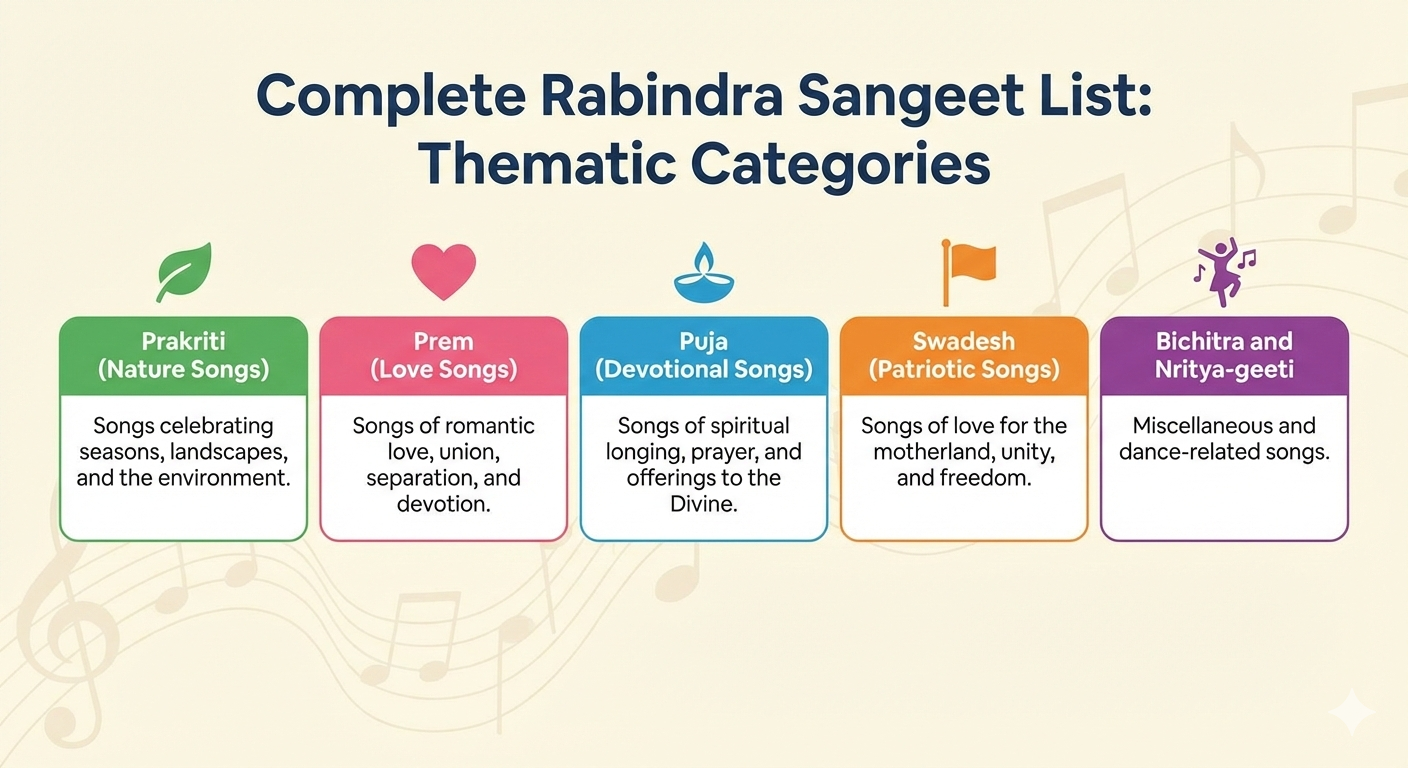
Prakriti (Nature Songs)
For Tagore, nature wasn't merely decorative scenery but an intimate companion, teacher, and friend. His nature songs beautifully capture seasonal changes: Basant (spring's renewal), Barsha (monsoon's abundance), Sharad (autumn's reflection), Hemanta (winter's contemplation), reflecting life's eternal cycles of birth, growth, and transformation.
Popular Nature Songs:
Akash Bhora Surjo Tara (sky full of stars)
Aaji Dokhin Duwar Khola (southern door opens)
Esho Shyamolo Sundoro (beautiful green one)
Amra Shobai Raja (we are all kings in spring's kingdom)
Prem (Love Songs)
Rabindra Sangeet love songs feel remarkably gentle and honest, never ostentatious or melodramatic. They explore love's awakening, the sweet ache of yearning, patient waiting, and complete surrender with dignified restraint. These songs speak of love as transformation rather than possession.
Beloved Love Songs
Amaro Porano Jaha Chay (what my heart desires)
Tumi Robe Nirobe (you remain silently in my heart)
Bhalobashi Bhalobashi (I love you)
Tomarei Koriyachi (you are my guiding star)
Puja (Devotional Songs)
Rabindranath Tagore songs in the devotional category draw deep inspiration from Upanishadic philosophy and Vaishnava mysticism. Rather than commanding or instructing, these songs gently invite listeners inward, whispering spiritual truths that resonate in the soul.
Sacred Devotional Songs:
Anondoloke Mongolaloke (world of joy and auspiciousness)
Aguner Parashmoni (touchstone of fire, purify my heart)
Tomar Khola Hawa (your open breeze calls me to freedom)
Jodi Tor Dak Shune (if no one responds, walk alone - the famous Ekla Cholo Re)
Swadesh (Patriotic Songs)
Rabindra Sangeet patriotic compositions, many written during India's freedom struggle, embody courage, compassion, hope, and unwavering dignity. Remarkably, Tagore's patriotism never descended into narrow nationalism or divisiveness, he always emphasized human dignity over political boundaries.
Bichitra and Nritya-geeti
Miscellaneous songs (Bichitra) and dance compositions (Nritya-geeti) complete the Rabindra Sangeet list. Dance songs include Anondodhara Bohiche (streams of joy flowing), Phule Phule Dhole Dhole (flowers swaying in breeze), and the hauntingly beautiful Shyama Sangita (songs of devotion and dance).
Akash Bhora Surjo Tara (The sky full of sun and stars)
Aaji Bangladesher Hridoy Hote (From the heart of Bengal today)
Aaji E Probhate Rabi (This morning the sun awakens me)
Musical Structure and Composition Style
Rabindra Sangeet borrowed liberally from classical ragas but never adhered rigidly to traditional rules or conventions. Tagore fearlessly modified ragas to perfectly suit his lyrical needs and emotional intentions, creating a distinctive style that trained musicians now recognize and call Rabindrik Anga.
Distinctive Musical Characteristics
What sets Rabindra Sangeet apart from other Indian classical traditions:
- Melodic Simplicity: Uncluttered, accessible tunes that anyone can learn and sing
- Emotional Clarity: Direct, unambiguous emotional expression without artifice
- Minimal Ornamentation: No excessive flourishes or complex vocal acrobatics
- Smooth Flow: Natural, conversational rhythm that mimics speech patterns
- Word-Tune Integration: Lyrics and melody bound so tightly they're inseparable
- Poetic Primacy: Music always serves the poetry, never overshadowing it
- Universal Accessibility: Designed for everyone, not just trained classical musicians
This unique approach makes Rabindra Sangeet feel like intimate heart-to-heart communication rather than distant performance art. The simplicity is deceptive, beneath the surface lies profound musical and emotional sophistication.
Tagore as a Revolutionary Composer
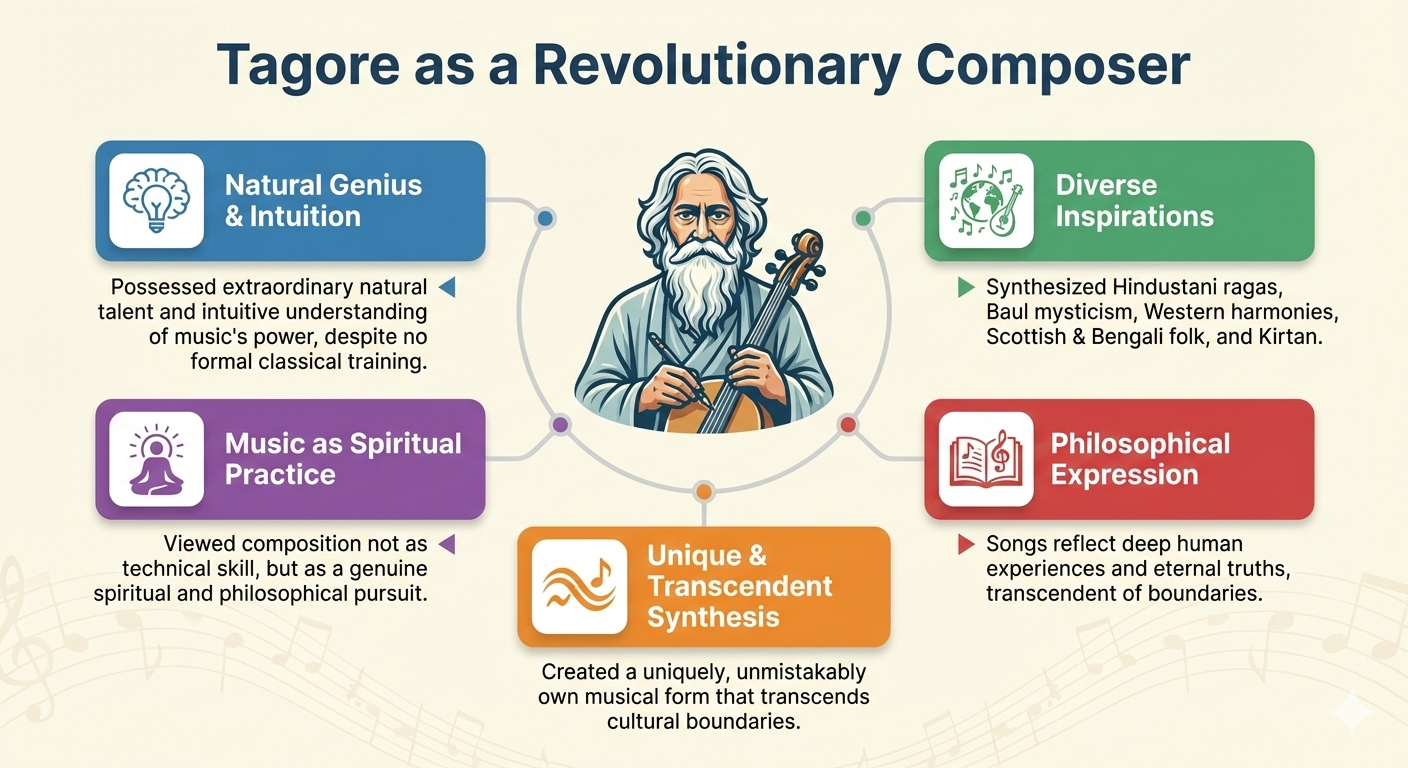
Though Tagore never underwent formal training as a classical musician in the traditional gurukul system, he possessed extraordinary natural genius and an intuitive understanding of music's emotional power and philosophical depth. He drew inspiration from incredibly diverse sources like Hindustani ragas (Bhairavi, Kafi, Khamaj, Todi), Baul mysticism, Western harmonies, Scottish folk tunes, Bengali folk traditions, kirtan devotional traditions, and synthesized them into something uniquely, unmistakably his own creation that transcended all boundaries.
Tagore famously declared, "Music is the purest form of art...and it is also the most direct means to the soul." For him, musical composition wasn't merely technical skill or entertainment but genuine spiritual practice and philosophical expression. His Rabindranath Tagore songs reflect this deep philosophy, each composition carries meaning far beyond its melodic beauty, speaking to fundamental human experiences and eternal truths that resonate across cultures.
Rabindra Sangeet at Shantiniketan
Tagore founded Visva-Bharati at Shantiniketan, creating a space where creativity, nature, and culture coexisted. Music formed the institution's heartbeat.
At Shantiniketan, students lived Rabindra Sangeet daily. Music permeated festivals and rituals. Today, festivals like Basant Utsav still burst with Tagore's songs, performed by students and visitors worldwide.
This institutional embedding transformed Rabindra Sangeet into a living tradition passed through generations.
Bangla Rabindra Sangeet
Bangla Rabindra Sangeet represents Bengali culture's heartbeat. For Bengali people, these songs appear everywhere: homes, schools, temples, festivals. Bangla Rabindra Sangeet carries Bengal's essence, its monsoons, rivers, and seasonal rhythms.
Bangla Rabindra Sangeet is Bengal's soul, always present, always alive.
Hindi Rabindra Sangeet
Though rooted in Bengali culture, Rabindra Sangeet transcends all boundaries universally. Hindi Rabindra Sangeet has grown popular nationwide, allowing non-Bengali speakers to connect with Tagore's emotional depth profoundly.
Rabindranath Tagore songs in Hindi make his poetry accessible to wider audiences. While some Bengali subtlety may be lost in translation, core emotions remain powerfully intact.
- Pagli Hawa Badraya Din (Suresh Wadkar)
- Tum Kya Ho Ek Chhabi (Manna Dey)
- Maine Tere Saath (Manna Dey)
- Oho Nadiya Ki Begdhar (Usha Mangeshkar)
- Jane Pyaar Kise Kehte Hain (Antara Mitra)
Hindi Rabindra Sangeet successfully preserves the original's heart while reaching millions beyond Bengal's traditional boundaries.
Rabindra Sangeet in Cinema and Popular Culture
Rabindra Sangeet has shaped Bengali cinema through filmmakers like Satyajit Ray and Tapan Sinha. Recently, Rabindra Sangeet found new life through fusion music, streaming platforms, and contemporary reinterpretations.
Artists like Hemanta Mukherjee, Debabrata Biswas, Kanika Banerjee, Suchitra Mitra, and Rezwana Choudhury Bannya have kept the tradition alive.
Learning Singing at Spardha School of Music
If you want to explore your love for music, and learn singing, Spardha School of Music offers 1:1 live and personalised classes under the guidance of professional and supportive teachers that ensure the student keeps learning at their own pace and stays motivated. We also offer multiple performance opportunities to ensure you gain the confidence of performing while learning. Book a free trial now and experience the magic of learning music online.
Relevance of Rabindranath Tagore Songs
A century has passed, yet Rabindra Sangeet continues moving hearts worldwide. These songs speak to the soul comforting in sadness, celebrating in joy, guiding when lost.
Why It Still Matters
- Universal emotions transcending time
- Gentle approach to profound topics
- Connects Bengali diaspora to homeland
- Provides guidance through life's journey
Conclusion
Rabindra Sangeet lives vibrantly in gatherings, classrooms, stages, and quiet moments. This tradition pulses as cultural heartbeat and emotional mirror.
Whether in Bangla Rabindra Sangeet's original form, Hindi Rabindra Sangeet adaptations, or global interpretations, Tagore's music inspires and uplifts. The Rabindra Sangeet list spanning love, nature, devotion, and patriotism offers something for every soul.
Rabindranath Tagore songs remind us that beauty can be simple, truth lives in feeling, and the sacred inhabits everyday moments. As long as people search for meaning, Rabindra Sangeet will remain living, shining, profoundly human.
Each Rabindra Sangeet song carries Tagore's gift: permission to feel deeply, think freely, and love completely. His legacy proves art's greatest power lies in touching hearts with simple truth.
Frequently Asked Questions
1. What is the most famous Rabindra Sangeet?
"Ekla Cholo Re" (Walk Alone) is arguably the most famous, with the exception of the national anthems "Jana Gana Mana" (India) and "Amar Shonar Bangla" (Bangladesh), all composed by Tagore.
2. What is special about Rabindra Sangeet?
Rabindra Sangeet uniquely blends Indian classical ragas, folk melodies, Western harmonies, and profound poetry, creating emotionally rich yet accessible music that speaks directly to the human soul.
3. Who introduced Rabindra Sangeet?
Rabindranath Tagore himself created and introduced Rabindra Sangeet through his 2,200+ compositions spanning six decades, establishing it at Shantiniketan and through his literary works.
4. How many Tagore Songs are there?
Rabindranath Tagore composed over 2,200 songs (some sources cite 2,232) spanning various themes including love, nature, devotion, patriotism, and seasons throughout his lifetime.