Table of Contents
If you've been thinking about learning music or signing your kid up, the first real decision you'll face isn't which instrument. It's where you'll learn.
Online music lessons have exploded over the last few years. And no, it's not just a pandemic-era workaround. Parents in Kolkata, London, Toronto, and Dubai are all choosing them on purpose. But in-person lessons are still very much alive and well, and for some learners, they're genuinely the better fit.
So which one actually works better for beginners?
Let's get into it honestly, without the sales pitch.
What Are Online Music Lessons, Really?
It's not just a YouTube video or a pre-recorded tutorial you passively watch. Real online music lessons are live, interactive sessions with you and a trained instructor, face-to-face over a video call, in real time.
You play. They listen. They correct your finger placement, your breathing, your rhythm. You ask questions, they answer. It's a lesson just without the commute.
Platforms like Spardha School of Music run these as structured 1-on-1 or smaller group classes with proper syllabi, progress tracking, and certified instructors. It's closer to a proper music school than most people expect.
Online vs In-Person Music Lessons: The Real Differences
Let's be straight! Neither format is perfect. Both have genuine trade-offs. Here's where they actually differ.
Flexibility and Scheduling
In-person lessons mean you're locked to someone's studio hours, their location, and your ability to physically get there. If you're a working professional or a parent managing school pickups and after-school chaos, that's a real constraint.
Online music lessons let you book slots that fit your actual life. Early morning before work. Saturday afternoons. Late evenings. Your kid doesn't miss football practice because of a music class anymore.
For NRI families, especially parents in the UK or Canada who want their kids to learn Indian classical music or a specific instrument, in-person access to quality teachers is often just not available. Online isn't a compromise. It's the only real option.
Quality of Instruction
This one's usually where people push back. "But how can a teacher really hear you or correct you online?"
Fair concern. But here's what most people don't factor in: with in-person lessons, you're limited to whoever is available near you. That could be an excellent teacher, or it could be someone decent who happens to live nearby.
With online music lessons for kids and adults, you're choosing from a much larger pool. You can specifically find a certified Hindustani classical vocalist, a trained guitarist with a Berklee degree, or a tabla player from Banaras, regardless of where you're sitting.
Better access to better teachers often means better outcomes.
Accountability and Consistency
In-person lessons have a built-in accountability loop. You walk into a physical space, the teacher is in front of you, and there's a certain social pressure to show up and practise.
Online lessons require a bit more self-discipline, especially for older beginners. But this is less of a problem with kids who have parents supervising, and it's less of a problem when the platform itself builds in engagement tools. Spardha, for instance, uses gamification and progress milestones that keep young learners motivated between sessions.
Honestly? For most kids aged 6–16, parental involvement matters far more than the format. If a parent is present and engaged, an online lesson works just as well as an in-person one, sometimes better.
Cost and Value
In-person lessons in a good music school can be expensive. You're paying for the teacher's time, the studio rental, and sometimes travel. In major metros or abroad, that cost adds up quickly.
Online music lessons cut a lot of that overhead. The same level of instruction, sometimes better, often comes at a lower price point. With subscription-based platforms like Spardha, you also get more predictable monthly costs that are easier to plan around.
The Physical Touch Gap
Here's where in-person lessons have a real, undeniable advantage. For certain instruments, especially early-stage beginners on something like the violin, or young kids learning to hold a drumstick, a teacher physically adjusting your posture or hand position does make a difference that a camera can't fully replicate.
It's not a dealbreaker. But it's real. Good online teachers learn to compensate in music lessons online by using angles, mirrors, and verbal cues. And as a learner, you get used to it quickly. But if you have the option for in-person early on with a complex instrument, there's value there.
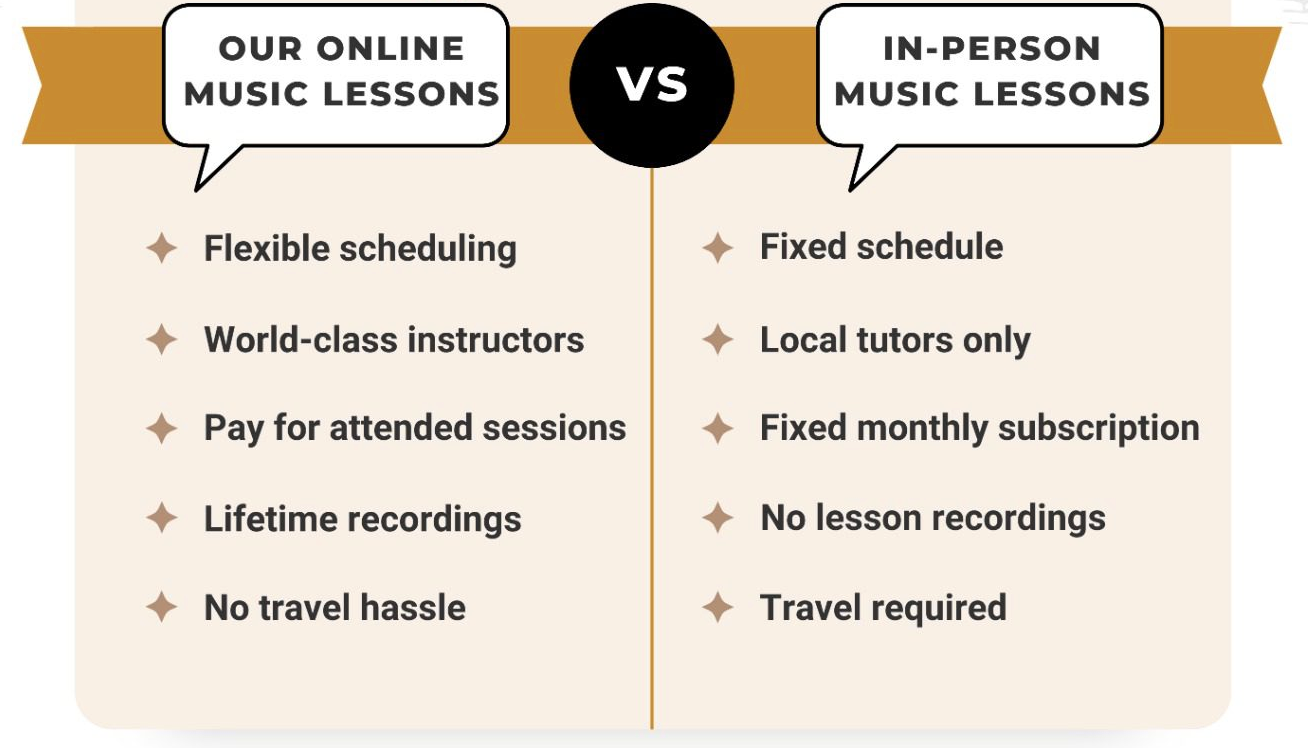
Let’s Quickly Summarise The Distinctions:
Factor |
Music Lessons Online |
Music Lessons In-Person |
Flexibility |
Learn from anywhere and choose convenient time slots. |
Fixed schedules and travel required. |
Teacher Access |
Access to expert teachers from across the world. |
Limited to teachers available in your local area. |
Convenience |
No commuting; classes happen from home. |
Requires travelling to a studio or the teacher's location. |
Scheduling for Families |
Easier to fit around school, work, and extracurricular activities. |
Often requires adjusting family schedules. |
Availability for NRIs |
Easy access to Indian music teachers regardless of location. |
Quality Indian music teachers may be difficult to find abroad. |
Accountability |
Requires self-discipline, though platforms and parents can help maintain consistency. |
Stronger built-in accountability through physical attendance. |
Learning Experience |
Interactive and effective with modern teaching tools. |
More traditional face-to-face interaction. |
Cost |
Generally, more affordable due to lower overhead costs. |
Often more expensive because of studio and travel costs. |
Posture & Technique Correction |
Teachers guide using camera angles and verbal cues. |
Teachers can physically demonstrate and correct posture. |
Best For |
Busy families, working professionals, NRIs, and learners seeking specialist teachers. |
Learners who prefer face-to-face interaction or need hands-on guidance in the early stages. |
Who Should Choose Online Music Lessons?
Online music lessons are probably right for you if:
You live in a city or country where good local teachers aren't easy to access. You or your child has a tight weekly schedule. You want Indian classical training, specifically Hindustani or Carnatic, taught by native practitioners. You're an adult hobbyist who wants to learn at a steady, pressure-free pace from home. You're an NRI family wanting your kids to stay connected to Indian music heritage. You want structured learning with certifications, not just casual tutorials.
In-person might suit you better if:
You're a very young child (under 6) just starting on a physical instrument. You live close to a genuinely excellent teacher whom you've vetted. You or your child struggles significantly with screen-based learning or attention in front of a device.
Online Music Lessons for Kids: What Parents Should Know
The fear most parents have is that their child won't engage through a screen. It's a valid concern, and it's not unfounded. We've all seen kids zone out on a video call.
But online music lessons for kids work differently from Zoom school. The ratio matters. A 1-on-1 lesson means the teacher's full attention is on your child for the entire session. There's no "unmute yourself" chaos. The child is in the class.
Spardha's platform adds gamified elements to the music lessons online, such as practice streaks, achievement badges, and level progression, that make the experience feel more like a game than a chore. For kids between 6 and 16, that framing changes everything.
Parents should plan to sit nearby for the first few sessions, especially with younger kids. Not to micro-manage, but to help the child get comfortable with the format. After that, most kids settle in on their own.
Why Spardha School of Music Works for Beginners
Spardha is built specifically around what beginners actually need: structure, patience, and the right teacher for their goals.
Whether you're a parent looking for online music lessons for kids in keyboard, guitar, tabla, or Indian classical vocals, or you're an adult who's always wanted to learn and never had the time, Spardha matches you with certified instructors who teach at your pace.
No pre-recorded content you sit through alone - live classes, real feedback, real progress. The platform tracks your child’s progress with the syllabus, flags practice gaps, and keeps parents in the loop without being intrusive.
And for the global Indian diaspora, this is exactly the kind of structured access to quality Indian music education that's been hard to find abroad. You don't have to compromise.
Conclusion: Online Music Lessons Are the Smarter Start for Most Beginners
The format debate is mostly settled at this point. Online music lessons aren't inferior to in-person ones; they're a genuinely strong option that offers better flexibility, wider access to great teachers, and lower costs. For kids, diaspora families, busy adults, and anyone who doesn't have a great local teacher nearby, they're the practical and often better choice.
The only thing that really determines whether you'll succeed isn't the format. It's consistency. Show up to your lessons. Practise between sessions. Give it three months.
If you're ready to start, book a free trial class with Spardha School of Music and see for yourself. The first session is on us, and it takes about 20 minutes to know whether it's the right fit.
Frequently Asked Questions
Can a complete beginner start with online music lessons?
Yes, and in many ways it's ideal. You don't need any prior experience. Certified instructors on platforms like Spardha start from absolute basics and build up systematically.
What equipment do I need for online music lessons?
A stable internet connection, a laptop or tablet with a working camera and microphone, and your instrument (or access to one). Most instructors will advise on what setup works best for your specific instrument.
Are online music lessons effective for young children?
Yes, particularly in a 1-on-1 format. The key is parental involvement in the first few weeks and a platform designed with young learners in mind, equipped with engagement tools like gamification and structured progress tracking.
How long should online music lessons be for a beginner?
30 to 45 minutes is the standard recommendation for beginners. Longer sessions can lead to fatigue, especially for kids. As skill and focus improve, you can extend the session length.
Can I get a music certification through online classes?
Yes. Platforms like Spardha offer structured courses aligned with recognised certifications in Indian classical music and other disciplines. Check the specific course page for certification details.
What instruments can I learn online?
Most instruments translate well to online lessons like the ones with guitar, keyboard, piano, violin, flute, tabla, sitar, harmonium, and vocals (both Hindustani and Carnatic). Percussion instruments with strong physical technique demands may benefit from at least a few in-person sessions early on.