Table of Contents
Quick Summary
YouTube contains an extraordinary volume of free music content, from beginner chord tutorials to advanced theory breakdowns. Structured online music courses, on the other hand, offer a curriculum, instructor feedback, and accountability. Both have genuine value, and significant limitations that their advocates rarely acknowledge. The right choice depends on where you are as a learner, what instrument you're working on, how much time you have, and whether you're learning for enjoyment or genuine technical development. For some learners, YouTube is sufficient, but for most, it isn't, and the reasons why are more specific than "you get what you pay for."
People often frame the comparison between YouTube and structured music courses as a choice between cost and quality. People treat it as if the only variable is what you are willing to spend. That framing misses the actual difference. The real question isn't about money; it's about what kind of learner you are, what stage you're at, and whether the feedback loop you're working within is capable of producing genuine improvement.
YouTube has made music education more accessible than any institution in history. That's real and worth acknowledging. It's also true that a significant portion of people who try to learn music through YouTube alone plateau within six months and can't explain why. Understanding the specific mechanisms behind that plateau is the most useful thing this article can offer.
What YouTube Actually Is (and Isn't)
YouTube is a content platform, and not a teaching platform. That distinction sounds semantic, but it matters practically.
When a guitarist with two million subscribers makes a tutorial, they're creating content for the median viewer at the median skill level. The camera angle shows what the instructor wants you to see, but the pace moves as per the instructor. The troubleshooting addresses the problems the instructor anticipates, not the specific problem your left hand is currently developing.
This produces a specific learning experience: you watch, you attempt to replicate, you mostly manage, and you move on. What you can't do is ask the video why the chord transition keeps catching on your third finger. This is because you can't get a response when the technique you've been using for six weeks is subtly wrong, limiting you for years. Do remember that the video doesn't know you're there.
That's not a criticism, but rather a description of the medium's honest limitations. Learning music online through YouTube works best as a supplement to something that provides feedback, not as the primary learning mechanism.
YouTube genuinely excels in four specific areas. It works well for introducing a concept before your next lesson. It provides quick visual references for chord shapes and techniques. It offers inspiration through performance videos. Finally, it delivers clear theory explainers before a formal curriculum introduces them. These are real uses, and musicians who use YouTube this way, as a supplement rather than a replacement, tend to do well with it.
What Structured Online Music Courses Actually Offer
The category of "structured online music classes" covers a significant range, from pre-recorded course libraries to live one-to-one instruction, and the difference between these two sub-types is almost as significant as the difference between YouTube and a proper course.
A pre-recorded course on a platform like Udemy or Coursera is structured version of YouTube with better organisation and an optional certificate. The content is curated, the progression makes sense, and the curriculum has been designed by someone who thought about what order things should be taught in. But the fundamental limitation remains, it doesn't know you're there. You can get stuck on bar 12 of an exercise, and there's no one to ask.
Live instruction, whether one-to-one or in small groups, is categorically a different product. A teacher who can hear and see you practice in real time changes the information available in the session entirely. Great teachers catch physical tension and subtle intonation errors before you notice them. They track your progress, spot where intellectual understanding falls short of physical execution, and adapt the lesson on the spot.
For music lessons for beginners specifically, this distinction matters more than at any other stage. The first six months of learning an instrument are when technical habits form. Getting those habits right, or getting them wrong, has consequences that compound over years. A teacher watching you in real time in those early months is not a luxury. For most instruments, it's the difference between a foundation you can build on and one you'll have to partially demolish later.
The Key Comparisons
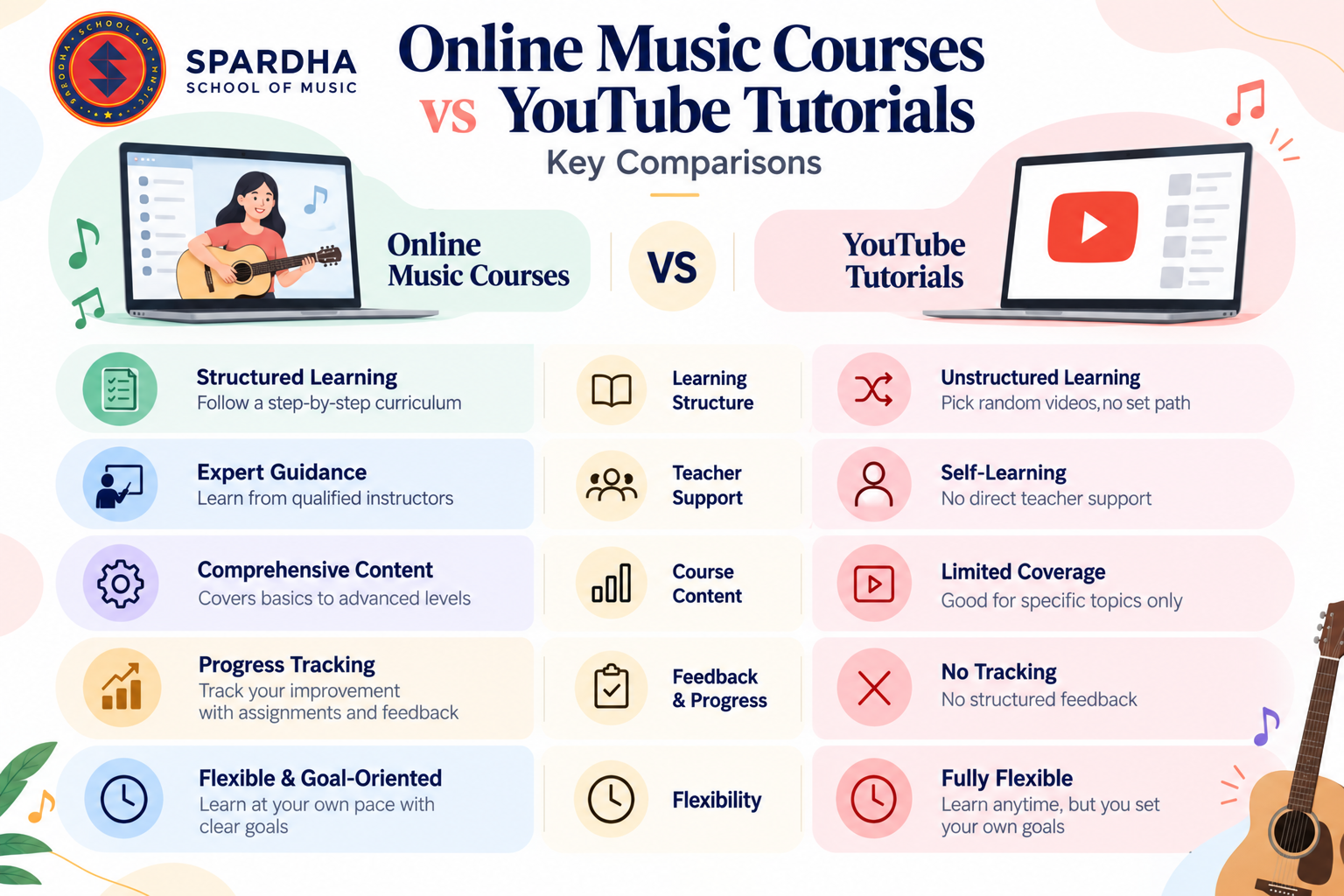
Speed of Progress
YouTube learners and structured course students often start at a similar pace. The divergence becomes visible around the three to six-month mark.
Naturally gifted, highly disciplined learners with strong self-diagnosis skills can reach an intermediate level using YouTube alone. They are the minority. Most YouTube-primary learners build a mix of correct and flawed techniques. This stalls their progress, leaving them able to play songs that sound approximately right but feel mysteriously difficult to improve.
Structured online music classes with a real instructor typically produce more linear progress because errors get corrected before they compound. The plateau hits later and at a higher level.
Technique Correction
This is where the comparison is least close. YouTube cannot correct your technique, neither can any recorded video. This doesn't mean YouTube technique advice is wrong as much of it is accurate and useful. It just means that the advice cannot account for what your specific body, hands, and habits are doing in this specific moment.
Technique errors that feel fine to the player often look immediately obvious to an instructor:
- Bow arm collapse on violin.
- Thumb tension in a guitar chord.
- Breath support dropping in the upper register on vocals.
These are things a camera pointed at a tutorial subject cannot see in you, and they're things that a live teacher spots within minutes.
For instruments with highly physical mechanics and stubborn error patterns, such as violin, classical guitar, brass, and voice, this feedback gap represents the most critical difference between YouTube and live instruction.
Accountability
YouTube has none, but structured music learning does, to varying degrees.
The accountability argument is sometimes dismissed as a soft benefit, but it has measurable practical effects. Students with a weekly lesson scheduled practise between sessions at significantly higher rates than students working entirely self-directed. The social contract of showing up to a session having not done the work is a genuine motivator, and its absence is one of the most common reasons YouTube learners drift away from consistent practice.
Cost
This is where YouTube wins without argument. Free, versus whatever a structured online music classes platform charges. For learners who aren't sure whether they'll stick with an instrument, or who want to explore before committing to paid instruction, YouTube's cost point is a real advantage.
The calculation changes when you factor in the cost of sustained inefficiency. If YouTube-based learning takes eighteen months to reach a level that a structured course would reach in nine, the cost of the "free" option includes nine months of wasted practice time. Whether that cost is worth the monetary saving depends entirely on how seriously you intend to pursue the instrument.
Depth
YouTube can go genuinely deep on theory, music history, and conceptual content. Where it struggles with depth is technique, because that is personal. A twelve-part theory series on YouTube about modal harmony can be as rigorous and comprehensive as anything in a paid course. Similarly, a twelve-part series on violin bow technique cannot deliver the same depth of individual application that six weeks of live instruction provides.
Who Each Option Actually Suits
YouTube-primary learning works for:
- Adult hobbyists with modest goals who want to play songs they enjoy at a level they find satisfying, without needing formal certification or serious technical development.
- Experienced musicians learning a secondary instrument who can self-diagnose their own errors because they already understand how instrument technique works.
- Theory students who want supplementary resources beyond what their structured course covers.
Structured online music courses work for:
- Children at any stage of learning. Beginners on any instrument who haven't yet developed the self-diagnostic ability to identify their own errors.
- Learners with specific, serious goals like examinations, performance, professional development.
- Anyone who has tried YouTube and stalled, which is a significant number of people who assume the stall is a talent problem when it's actually a feedback problem.
The Honest Answer
The most common trajectory for serious learners isn't either/or. It's structured instruction as the primary learning mechanism, with YouTube as a supplementary resource. The live lesson provides the feedback loop and the correct technical development. Simultaneously. YouTube provides the surrounding content that makes the learning richer with additional theory explanations, repertoire inspiration, historical context, and quick visual references between sessions.
Using YouTube to replace live instruction saves money in the short term and costs progress in the medium term. On the contrary, using it to supplement structured learning costs nothing and adds genuine value. That's the relationship between the two formats that produces the best outcomes.
Learn Music Online at Spardha
Spardha School of Music builds its curriculum around the model that yields the best results. Every class features live, one-to-one instruction with a certified teacher who sees and hears your performance. They respond in real time to your actual technique rather than catering to an average student.
Whether you are a parent seeking structured lessons for your child, an adult who stalled on YouTube, or an NRI family wanting authentic Indian classical training, the format remains identical. You get a real instructor who watches, listens, and adapts every session to your specific needs.
Book a free trial class at Spardha today and spend thirty minutes finding out what learning with someone watching actually produces.
Conclusion
Learning music online via YouTube and learning through structured courses are not the same activity dressed differently. They're different products with different mechanisms, different limitations, and different appropriate uses. Note that YouTube is an extraordinary resource used well and an inefficient primary learning mechanism used as a replacement for instruction.
The fastest, most technically sound path to genuine musical ability runs through structured online music classes with a live instructor, supplemented by whatever YouTube has to offer on the side. That combination beats either option alone.
Frequently Asked Questions
Can you actually learn music from YouTube?
Yes, to a point. YouTube works well for theory concepts, song tutorials at casual levels, and supplementing live instruction. But it works poorly as a primary learning mechanism for beginners, for technically demanding instruments, and for anyone with serious progression goals, because it provides no individual feedback.
What is the biggest difference between online music courses and YouTube?
Feedback. A structured online music class with a live instructor can observe your technique and correct it in real time. Having said that, YouTube cannot see you and cannot correct the specific errors your hands, breath or bow arm are making. That gap is the primary practical difference between the two approaches.
Are paid online music courses worth it compared to free YouTube tutorials?
For serious learners and for children, yes. The feedback and accountability that paid live instruction provides produce measurably faster and more technically accurate development than self-directed YouTube learning for most learner types. For adult hobbyists with modest goals, YouTube may be sufficient.
How long does it take to learn music from YouTube alone?
Progress varies enormously by instrument, natural aptitude, and practice consistency. Many YouTube-primary learners reach a functional beginner level within three to six months and then plateau in a way that's difficult to diagnose or progress past without external feedback. Know that plateau is the most common outcome, not a reflection of talent.
What should I look for in an online music course?
Live, one-to-one instruction is the most important factor. A structured curriculum that progresses logically, certified and vetted instructors, a trial session before committing, and scheduling flexibility that matches your actual life. Pre-recorded course libraries without human instruction are a separate category that should be evaluated by different criteria.
Is it better to learn music through structured courses or apps?
Structured courses with live instruction produce better technical outcomes than apps for most instruments and most learner types. Apps like Yousician serve well as engagement tools to sustain early motivation. However, their microphone-based feedback only checks pitch and rhythm accuracy. They cannot evaluate posture, hand position, embouchure, or any mechanical technique that requires a human observer.