Table of Contents
What Should You Practice? It is a big question, and the answer looks different for everyone. Every instrument comes with its basics, how to hold a guitar pick, finger positions on a saxophone, getting your hands and feet working independently on the drums. You need a foundation before you can make music. That part is non-negotiable.
But once you have the basics, what you practice should be shaped by where you are headed. What is coming up for you musically? A gig, a recital, a jam session with a friend? Maybe you play at church, perform at an open mic, or sit in the school band. Whatever it is, that is your target, and your music practice routine should be built around it. So, let’s discuss some of the most important tips you can implement in your routine.
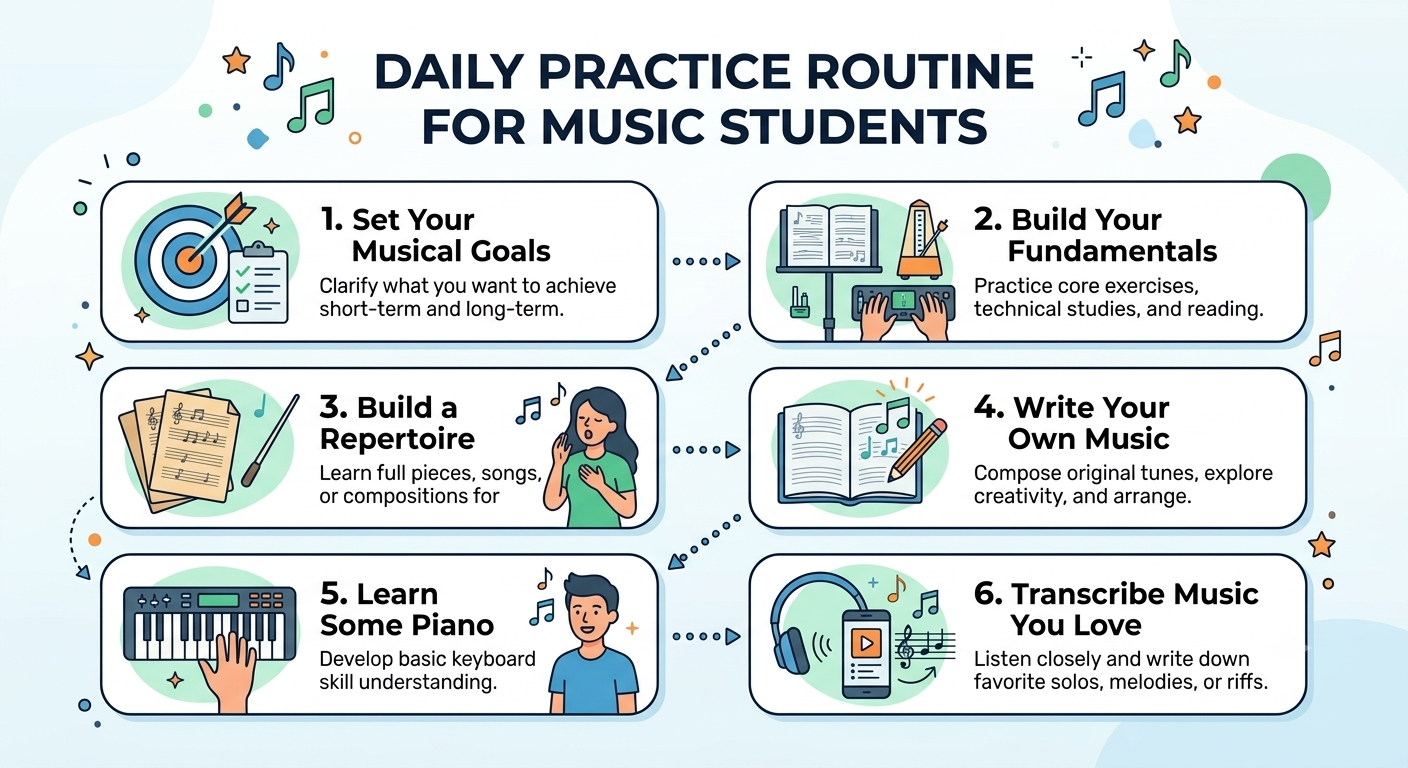
1. Set Your Musical Goals
"Get better at guitar" is not a goal, it is a wish. Without something specific to aim for, music practice routine becomes aimless. Set short, medium, and long-term goals, and wherever possible, tie them to a performance of some kind.
That does not have to mean a stage. It could be a jam at a friend's place, playing a song for your family, or just sitting in with other musicians. Playing with others is one of the most rewarding parts of music, leave the ego at the door, make mistakes, and learn from them. As Pat Metheny puts it: be the worst player in your band. That is where growth happens fastest.
Keep your goals realistic but stretching. A short-term goal might be learning the notes on one string or nailing a few bars of a song you love. Medium-term could be learning the full track, solo included. Long-term might be an open mic, a recital, or simply playing confidently in front of people.
2. Build Your Fundamentals
Every great musician, regardless of instrument, has one thing in common, a solid command of the basics. Ear training, rhythm, scales, chords, improvisation, sight reading, music theory, these are not optional extras. Some time in every music practice routine should go toward them.
Start simple. If you play guitar, begin with the open chords you actually need, C, G, D, Am. Once those feel natural, work on new voicings. Learn your triads, then your pentatonic scales in one position, then all five. Build toward the major and minor scales across all 12 keys.
There are no shortcuts here. Mastery comes from repetition, and as Malcolm Gladwell notes in Outliers, it takes roughly 10,000 hours. Short, medium, long-term goals, keep coming back to them.
3. Build a Repertoire
Technique and theory are tools. The point of those tools is to play music you actually love.
Build a collection of songs you enjoy playing and can pull off confidently. These are your go-to tracks for jam music practice routine, the ones other musicians are likely to know. Learning some blues is a smart move, the 12-bar form is straightforward, leaves room for improvisation, and most musicians are comfortable with it.
Beyond your confident tracks, keep a few songs in progress, pieces you are working toward but not quite there yet. And then keep one or two that are genuinely beyond your current level. That last category is what stops your playing from going flat.
4. Write Your Own Music
At some point, give yourself permission to create without rules. And this is one of the most important practice tips for music students.
Writing music is a music practice routine in itself, but unlike scales or theory, there is no fixed method. What comes out is entirely yours. Set aside some time in each session to play freely, follow what feels right, experiment, and see where it goes. You do not need an audience or a commercial goal. The freedom of creating something with no strings attached is what makes it worth doing. You might surprise yourself.
5. Learn Some Piano
If you already play piano, move on. But if your instrument is guitar or anything else, picking up even basic keyboard skills will change how you understand music. This is where practice tips for music students can help you.
The piano lays harmony out visually in a way no other instrument does. Bass, harmony, and melody are all in front of you at once. It is one of the best songwriting tools available, and it makes theory, chord construction, inversions, voice leading, far easier to grasp. There is a reason music students are required to study piano regardless of their primary instrument. A working knowledge of basic chords and scales on the keyboard will strengthen everything else you play.
6. Transcribe Music You Love
One of the most valuable things you can do as a musician is figure out songs by ear, chords, progressions, solos, harmonic ideas, without looking them up.
When you learn music through your own listening and reasoning, the understanding goes deeper. You start to hear how an artist thinks, and over time that shapes your own voice. Avoid reaching for a tutorial the moment something gets difficult. The musicians worth admiring did not have that option, and working through it yourself is where the real learning happens.
A useful music practice routine to carry forward: imitate, assimilate, then innovate.
The Bottom Line
There is no single practice routine that works for everyone. But there is a principle that holds across every instrument and every level, practice with purpose. Know what you are working toward, build your fundamentals consistently, grow your repertoire, and give yourself space to create. Do that regularly, and progress is not a matter of talent. It is a matter of time.
At Spardha School of Music, these are not just music practice routine, they are the foundation of how students are taught. Whether you are picking up an instrument for the first time or looking to sharpen skills you already have, Spardha's structured approach to goals, fundamentals, and creative development gives your practice real direction.
Come learn with people who take music seriously.
Frequently Asked Questions
How long should a daily music practice session be?
Quality matters more than duration. Even 30 focused minutes a day, spent on goals, fundamentals, and repertoire, will produce more progress than two hours of unfocused playing.
What is the most important thing to practice as a beginner?
Fundamentals, basic chords, scales, rhythm, and ear training. Everything else is built on top of them. Start simple, stay consistent, and expand from there.
How do goals help with music practice?
A goal gives your practice direction. Without one, sessions drift. With one, a jam, a recital, a song you want to nail, every minute of practice has a reason behind it.
Do music students really need to learn piano even if they play another instrument?
It helps significantly. The piano makes harmony, theory, and chord construction far easier to visualise, which strengthens your understanding of any instrument you play.