Table of Contents
Quick Summary
The mridangam is a double-headed barrel drum and the primary rhythmic instrument of Carnatic classical music. Its origins are ancient, with representations appearing in temple sculptures, Sanskrit treatises, and Sangam-era Tamil poetry. Its role in South Indian classical performance has remained structurally central for over two thousand years. Unlike simple timekeeping percussion instruments, the mridangam delivers melodic and rhythmic information simultaneously. It tunes directly to the performance tonic pitch and produces distinct tonal syllables using its own notation system. It is one of the most sophisticated percussion instruments in any musical tradition.
There are instruments that accompany a performance. Then there's the mridangam instrument, which converses with it. The mridangam does not merely keep time in the background of a Carnatic classical concert. It engages in an active dialogue with the vocalist or soloist by responding, elaborating, challenging, and resolving phrases. When a vocalist lands on a lower-register note, the mridangam player anticipates the move and places their response precisely. When the tempo accelerates toward a composition's climax, the mridangam drives it there as much as it follows.
Understanding what the mridangam is and how it works changes how you hear the entire Carnatic tradition. The instrument is the rhythmic architecture that makes everything else possible.
Mridangam Meaning: What the Name Actually Tells You
The mridangam meaning is embedded in the Sanskrit compound from which the name derives.
- Mrid means earth or clay, and
- anga means body.
- It's, etymologically, the instrument with a body of clay.
That etymology is historically accurate. The earliest versions of the instrument were constructed from hardened clay rather than wood, and the name survived the transition to wooden construction that characterises the modern instrument. The word appears in ancient Sanskrit texts, including the Natya Shastra. Attributed to Bharata Muni and dated between 200 BCE and 200 CE, this foundational work remains a cornerstone of Indian performing arts.
The Natya Shastra classifies musical instruments into four categories: tata (stringed), sushira (wind), avanaddha (membranophone/covered), and ghana (solid percussion). The mridangam is the avanaddha, an instrument whose sound is produced by a membrane stretched over a body. That classification is still accurate even though it is two thousand years old.
In Tamil, the instrument is sometimes called tannumai in ancient Sangam literature, and the physical object described in those texts is recognisably the ancestor of what Carnatic musicians play today.
History of the Mridangam Instrument
The mridangam belongs to a long tradition of percussion in South Indian music. References to drums and percussion instruments appear in ancient Sanskrit texts and Tamil literature, while temple sculptures provide visual evidence of historical musical practices.
Over time, the instrument developed into the form associated with modern Carnatic music. Its construction, tuning techniques and playing methods have been refined across generations of musicians and instrument makers.
Today, the mridangam remains a defining instrument in Carnatic concerts, devotional performances and traditional music education.
Let’s Understand Mrudanga vs Mridangam
Structure of the Mridangam Musical Instrument
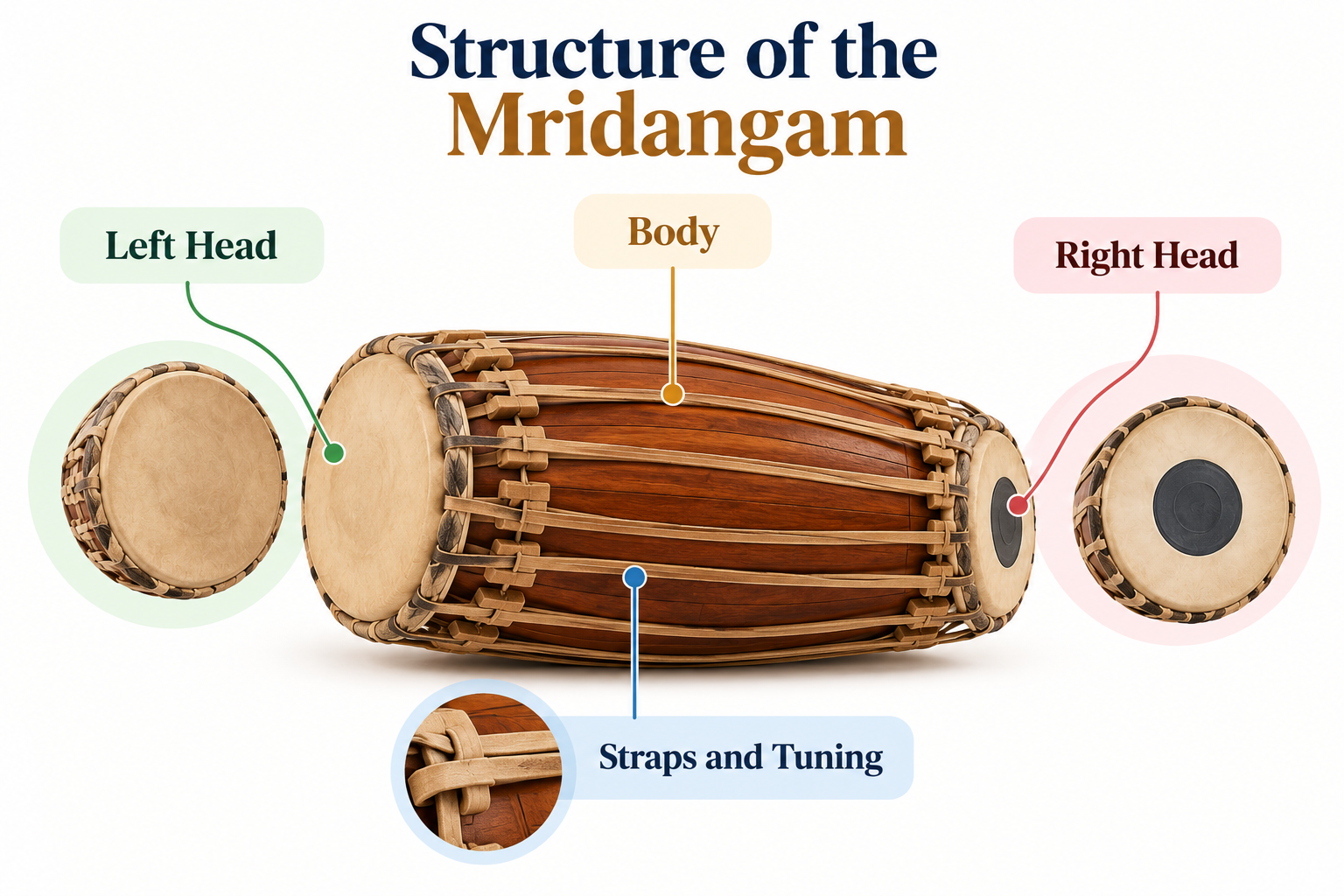
The mridangam musical instrument is a barrel-shaped drum with two heads of different sizes, connected by leather straps that run the length of the instrument and allow both heads to be tuned by adjusting tension.
The Body
- The traditional body is carved from a single piece of jackfruit wood, hollowed out to create a resonating chamber.
- The barrel shape is wider at the centre and narrower toward both ends, with the right end (the main playing surface) significantly narrower than the left.
This asymmetry is acoustically deliberate; the different diameters produce the different tonal registers that the two heads are designed to occupy.
The wood's density and the quality of the hollowing directly affect the instrument's resonance. Instrument makers treat mridangam construction as a specialised craft with its own distinct lineage. They spend years learning how different pieces of hollowed jackfruit wood respond once strung.
The Right Head: Valanthalai
The right head (valanthalai in Tamil, also called thoppi) is the primary playing surface and the acoustically dominant face of the instrument. It is significantly smaller in diameter than the left and produces higher-pitched tones.
The most distinctive feature of the right head is the black circular application at its centre, made from a mixture of rice flour, ferrous metal shavings, and other materials that differ slightly between makers and traditions. The karanai or soru, i.e. the permanent application, is what gives the mridangam its characteristic tonal richness and the ability to produce distinct melodic pitches rather than simply percussive attack.
The right head is tuned to the tonic pitch (Sa) of the performance, which means the mridangam is retuned for every concert depending on the vocalist's or lead instrumentalist's key. This tuning is done by hammering the leather straps to increase or decrease tension before the concert begins.
The Left Head: Thoppi or Idanthalai
The left head is larger in diameter and produces a low, bass-register sound. Before each performance, a player applies a wet paste of semolina and water to the left head. This temporarily dampens the skin and lowers its pitch. The paste dries during the performance, and the player removes it afterwards.
This temporary application stands as one of the most unusual features of the mridangam. The left head gradually alters its sonic character during a concert as the paste dries. Experienced players explicitly account for this shift throughout different points in a performance.
The Straps and Tuning Rings
Leather straps run lengthwise across the body, connecting the two heads and maintaining the tension that keeps both membranes taut. Small cylindrical wooden or leather pieces are inserted between the straps and the body at various points to adjust tension; moving these pieces up or down changes the pitch of the head they affect.
Tuning the mridangam is done with a wooden hammer before a performance. The process requires a trained ear; the instrument must be tuned not to a fixed standard pitch but to the specific tonic of whatever is being performed.
The Sound: What Makes the Mridangam Different
Most percussion instruments produce one type of sound per stroke. The mridangam produces a vocabulary of distinct tonal syllables, each given a specific name in the Carnatic tradition, each requiring a different combination of fingers, position, and pressure.
The wet paste application gives the mridangam a truly unique feature. As the paste dries during a concert, the left head gradually shifts its sonic character, and experienced players intentionally adapt their technique to account for this change throughout the performance.
The most commonly referenced syllables include ta, di, thom, na, ka, and thi, each representing a specific stroke technique with a specific tonal result. Carnatic percussion students spend years learning to produce each syllable cleanly before combining them into the rhythmic cycles that form the basis of performance vocabulary.
This syllabic approach to percussion is the most important structural difference between the mridangam and most Western percussion instruments. A snare drummer plays the drum. A mridangam player plays a language.
Famous Mridangam Players Who Shaped the Tradition
The mridangam players who defined the instrument's modern tradition span several generations of the Carnatic classical period.
- Palghat Mani Iyer (1912–1981) is considered by most serious listeners and practitioners to be the defining figure in 20th-century mridangam playing. His technical range and razor-sharp responsiveness to the soloist set an unprecedented benchmark. The sheer intelligence of his improvisation established a standard that subsequent mridangam players continue to measure themselves against. The recordings with M.S. Subbalakshmi and other Carnatic legends of the mid-20th century are considered essential listening for anyone studying the instrument.
- Umayalpuram K. Sivaraman brought a different aesthetic to the same tradition, a precision and clarity that suited his frequent collaborations with more technically demanding contemporary Carnatic artists. His playing is characterised by a restraint that allows the melodic content to lead without competition.
- Karaikudi Mani developed a distinctive approach to percussion solos (tani avartanam) that emphasised mathematical rhythmic construction, influencing a generation of students who trained under him at his institution in Chennai.
- T.V. Gopalakrishnan excelled as both a vocalist and a percussionist. He brought a deep understanding of melodic structure to his mridangam playing. This enabled a conversational style that aligned directly with the lead vocalist instead of merely running parallel to them.
Contemporary mridangam players like Srimushnam V. Raja Rao and a generation of younger artists trained under these masters continue to develop the tradition while maintaining its structural relationship to Carnatic performance.
The Mridangam's Role in Carnatic Performance
A standard Carnatic concert performance has several structural sections. The mridangam enters differently in each.
- During the alapana, the raga exploration that opens a major composition, improvised without rhythmic pulse, the mridangam is silent. The melodic instrument or vocalist develops the raga's character unaccompanied. Having said that, the mridangam's entry, when the composition's rhythmic cycle (tala) begins, marks a structural shift in the performance.
- During niraval and kalpana svaras, the mridangam player improvises live in response to the lead artist. This creates an unscripted rhythmic dialogue that changes with every performance, making it the most demanding aspect of the accompanist's role.
- The tani avartanam is the mridangam player's dedicated solo section, usually toward the end of a major composition, where they demonstrate the instrument's full range independent of melodic support. A well-played tani avartanam is its own complete musical experience.
Learn Carnatic Music at Spardha
The mridangam doesn't exist in isolation. It functions within the Carnatic classical tradition's complete rhythmic and melodic framework, understanding tala cycles, recognising raga structures, and hearing how melodic and rhythmic improvisation interact in performance. That contextual understanding is what separates informed listening from passive appreciation.
At Spardha School of Music, our Carnatic vocal and instrumental instructors teach with exactly this depth of context alongside technical instruction. Our live, 1-on-1 online classes offer structured, progressive instruction instead of generic content. They cater to beginners in Carnatic music, students building on an existing foundation, and children connecting to South India's classical tradition from anywhere in the world.
Book a free trial class at Spardha School of Music today and start learning within the tradition that the mridangam has anchored for two thousand years.
Conclusion
The mridangam instrument is not a drum in the sense that most people use the word. The mridangam is a pitched, multi-tonal percussion instrument with a documented history spanning over two millennia. Its construction methodology has undergone centuries of refinement. In Carnatic classical music, its role is structurally irreplaceable rather than decorative.
‘Mridangam’ meaning goes beyond the etymology of clay and body. It describes an instrument that is simultaneously the timekeeper, the conversational partner, and the rhythmic foundation of one of the world's oldest continuous musical traditions. The greatest mridangam players understood this not as a constraint but as the richest possible creative context.
Listen to a concert recording featuring a skilled mridangam player and a great vocalist during a full tani avartanam. It will completely transform how you hear percussion.
Frequently Asked Questions
What is the mridangam instrument and where is it from?
The mridangam instrument is a double-headed barrel drum originating in South India, serving as the primary rhythmic instrument of Carnatic classical music. It has been in continuous use for over two thousand years and is documented in ancient Sanskrit texts, Sangam-era Tamil poetry, and temple sculpture across South India.
What does mridangam mean?
The 'mridangam' meaning comes from Sanskrit: mrid (earth or clay) plus anga (body), giving "instrument with a body of clay." Basically, the name dates from when the instrument was made from hardened clay rather than wood, and survived the transition to jackfruit wood construction.
What makes the mridangam different from other drums?
The mridangam musical instrument produces a vocabulary of distinct tonal syllables rather than a single percussive sound. The right head is tuned directly to the performance tonic pitch. Permanent and temporary tonal applications on both heads shape its sound. Mastering the playing technique requires years of training to produce the specific sounds that Carnatic rhythm demands.
Who are the most famous mridangam players?
Palghat Mani Iyer stands as the defining figure of 20th-century mridangam playing. Other celebrated masters in the modern tradition include Umayalpuram K. Sivaraman, Karaikudi Mani, and T.V. Gopalakrishnan. Their recordings from the mid-20th century remain the standard reference for students and practitioners.
How long does it take to learn the mridangam?
The mridangam is among the most technically demanding percussion instruments in any tradition. Students typically spend the first one to two years learning the basic syllabic vocabulary and fundamental tala cycles before beginning to accompany other musicians. Concert-level proficiency takes a decade or more of consistent, structured instruction under a qualified teacher.
Is the mridangam used only in Carnatic music?
The mridangam is primarily associated with Carnatic classical music, where it holds the most central role. It appears in some Hindustani classical and fusion contexts as well, and is used in temple ritual music and devotional contexts across South India. The pakhawaj, a related North Indian drum, shares common ancestry but belongs to a distinct tradition.