

Table of Contents
Quick Summary
A metronome is a tool that produces a steady beat at a selected tempo, measured in beats per minute (BPM). Musicians use it to develop accurate timing, maintain a consistent tempo, practise difficult passages, and stay in sync with other performers. To use one effectively, start at a comfortable BPM, play along with the beat, and gradually increase the tempo as your accuracy improves. An online metronome makes this practice easy without needing a physical device. Spardha School of Music also offers a free online metronome with tempo, beats-per-measure, and volume controls.
Most musicians own one but fewer actually use it. And a significant number of them are using it wrong.
The metronome is one of those tools that gets recommended constantly and explained rarely. Teachers tell students to "practise with the metronome" without specifying what that means in practice. Then, the students end up either ignoring the advice or switching it on and playing through their piece at performance tempo while the click ticks uselessly in the background.
That's not using a metronome. That's using a metronome as furniture.
Used properly, it's the most honest and most useful tool in a musician's practice kit. Here's everything you need to know about what it is, what it actually does, and how to make it work for you.
Metronome Meaning: What It Is and What It Does
If you had to define metronome in one sentence:
“A metronome is a device or digital tool that produces a steady beat at a selected tempo to help musicians maintain accurate timing.”
The important part is not the clicking sound itself. The purpose is to give you an external pulse against which you can check your own timing.
Without a metronome, a musician may unknowingly speed up during an easy section or slow down while playing something technically difficult. With a metronome, those changes become easier to hear and correct.
This is why metronome practice is useful for beginners as well as experienced musicians.
What Is Metronome in Music: Understanding Beats Per Minute
Metronome beats are measured in BPM or beats per minute.
- A metronome set to 60 BPM produces one click per second.
- Set to 120 BPM, it clicks twice per second.
- Set to 80 BPM, and you're somewhere between the two, a comfortable walking pace that suits a lot of moderate-tempo music.
Most metronomes allow you to set an accent on the first beat of each bar, which makes it easier to track where you are within a rhythmic cycle rather than just counting individual clicks. This small detail carries more weight than you might think. Running a flat, unaccented click forces your brain to manually map out where the bar line starts while you're playing, an extra layer of mental heavy lifting that only gets in the way when you're still building basic hand mechanics.
Common BPM reference points that are worth internalising:
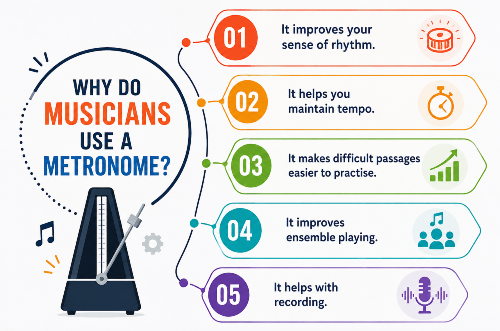
Why Do Musicians Use a Metronome?
A metronome is not simply a device for checking whether you can play fast. Its bigger purpose is to develop consistent internal timing.
1. It improves your sense of rhythm
Playing along with a steady pulse helps you understand where each note, chord, or syllable falls in relation to the beat.
2. It helps you maintain tempo
Musicians can naturally rush or drag without noticing it. A metronome provides an objective reference.
3. It makes difficult passages easier to practise
Instead of repeatedly playing a difficult section at full speed, you can slow the tempo down and focus on accuracy first.
4. It improves ensemble playing
When multiple musicians perform together, everyone needs a common sense of tempo. A metronome can help musicians practise independently at the same speed before rehearsing together.
5. It helps with recording
A consistent tempo is particularly useful during recording because musicians and producers often need different parts to stay rhythmically aligned.
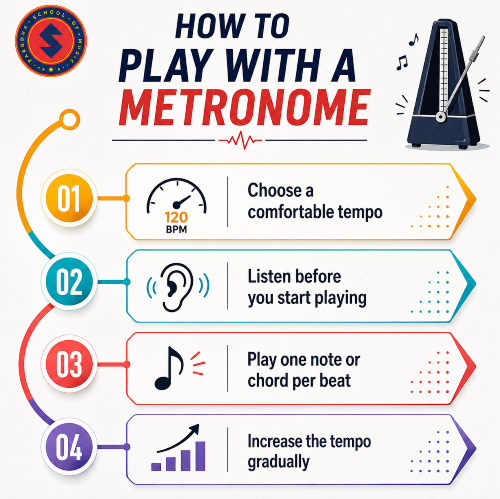
How to Play With a Metronome
Learning how to play with a metronome is easier when you treat the click as a guide rather than something you have to chase.
Step 1: Choose a comfortable tempo
Start slower than your target tempo. If a piece is supposed to be played at 120 BPM but you struggle to play it accurately, try 70 or 80 BPM first.
The aim is to play correctly and consistently before increasing speed.
Step 2: Listen before you start playing
Let the metronome play for a few seconds. Tap your foot, clap, or simply count along with the beats.
This helps you establish the pulse before adding your instrument or voice.
Step 3: Play one note or chord per beat
For beginners, start by matching one note, chord, or syllable to every click.
Once that feels comfortable, experiment with two notes per beat, four notes per beat, or different rhythmic patterns.
Step 4: Increase the tempo gradually
Once you can play accurately, increase the BPM in small steps.
For example:
80 BPM → 85 BPM → 90 BPM → 95 BPM → 100 BPM
If your accuracy starts falling apart, reduce the tempo and practise again.
Common Mistakes to Avoid
Playing through mistakes. If you miss a note or lose the beat, stopping and restarting is more productive than completing the passage. Well, but completing it incorrectly trains the incorrect version.
Setting the tempo too high too soon. This part is already covered, but worth repeating because it's the most common error. Remember that slow is not failure, but how the accuracy gets built that makes fast possible later.
Only using it for fast music. Slow pieces need the metronome as much as fast ones. Playing a slow, expressive piece without a tempo reference often reveals that being "expressive" is doing a lot of work to describe timing that's simply inconsistent.
Treating the click as a background sound. The metronome click should be in the foreground of your attention, and not the background. You're practising listening to it, responding to it, and locking your notes to it. This is what you call active, and not passive.
Metronome for Different Musicians
A metronome is useful across different forms of music practice.
Piano and Keyboard
Use it for scales, chord exercises, sight-reading, and difficult passages. Start slowly and gradually build speed.
Guitar
A metronome is particularly useful for strumming patterns, scales, picking exercises, chord changes, and rhythm guitar.
Drums
Timing is fundamental to drumming. Practising rudiments and grooves with a metronome can help develop consistency and control.
Violin
Use a metronome for scales, bowing exercises, technical passages, and repertoire practice.
Vocals
Singers can use a metronome to practise rhythmic entrances, phrasing, syllable placement, and songs with demanding rhythmic patterns.
Ukulele
A metronome can help keep strumming patterns consistent and improve coordination between chord changes and rhythm.
Try Spardha’s Online Metronome
If you’re looking for a simple metronome online, Spardha School of Music has a free browser-based metronome that you can use directly while practising.
Try Spardha's Online Metronome
The tool currently lets you:
- Select your tempo using the BPM control.
- Set the beats per measure according to the music you’re practising.
- Adjust the volume of the metronome.
- Press play and practise along with the steady pulse.
The tool also displays tempo markings such as Allegro, helping you connect BPM values with common musical tempo terminology.
It can be used while practising instruments including piano, keyboard, guitar, drums, saxophone, violin, and ukulele, as well as for vocal rhythm exercises.
If you’re searching for the best metronome online tool in India, the most useful option is ultimately one that is easy to access, gives you accurate tempo control, and provides the settings you actually need for practice. A browser-based tool like Spardha’s removes the need to install a separate application or carry a physical metronome.
Conclusion
A metronome is not complicated. One click, one tempo, and one honest assessment of whether you're in time or not. Its value lies entirely in its simplicity: it strips away the comfortable self-deception that undisciplined practice relies on.
Start slow, isolate sections, increase gradually, and practise away from it regularly. Those four habits, built around consistent metronome use, will move your timing further in three months than years of casual practice without one.
If you want to start practising today, try the free Spardha online metronome, set a comfortable BPM, and spend a few minutes playing along with the beat. Over time, the goal is to make that steady pulse something you can feel even when the metronome is switched off.
Frequently Asked Questions
What is a metronome in music and why do musicians use it?
A metronome is a device that produces a steady beat at a set tempo measured in beats per minute. Musicians use it to develop rhythmic accuracy, identify timing problems that feel invisible during unmonitored practice, and build speed gradually and safely. It's one of the most effective practice tools available precisely because it provides objective feedback that self-assessment can't.
What does metronome mean for someone just starting to learn music?
The metronome 'meaning' for a beginner is straightforward: it's a steady pulse that tells you whether you're in time or not. Starting with it early builds good rhythmic habits before bad ones have a chance to become automatic. Most teachers recommend beginners start with the metronome set well below performance tempo and only increase as accuracy improves.
Which is the best metronome online tool in India?
The best tool depends on your practice requirements. A useful online metronome should provide accurate BPM control, clear beats, adjustable time signatures or beats per measure, and easy access. Spardha's free online metronome provides tempo, beats-per-measure, and volume controls in the browser.
How do I know what metronome beats per minute to start at?
Start around 60 to 70 per cent of your target performance speed.
1. If you aren't sure what the final tempo should be, default it to 60 BPM.
2. If the passage feels clean and effortless at that pace, step it up by four or five BPM.
3. If it stumbles, stay right there until it locks in.
The exact starting number is secondary to the core principle: build accuracy at a crawl before you ever chase speed.
How to play with a metronome without constantly losing the beat?
The most common reason musicians lose the beat with a metronome is starting too fast. Drop the tempo to a point where staying with the click feels almost easy, then work upward. Also ensure the metronome's accent is set on the downbeat so you have a clear reference point for where the bar begins. Counting aloud while playing helps during the early stages of metronome practice.
Can I use a metronome for Indian classical music practice?
Yes. Most digital metronomes handle Teentaal and other common talas when configured correctly. Set the beats per bar to match the matra count of the tala and use the accent setting to mark the sam (first beat). Dedicated tabla and Indian classical music apps sometimes handle this more intuitively, but standard metronome tools work for most practice contexts.