Table of Contents
The Mayamalavagowla raga holds a special place in Carnatic music as the first raga to learn in Carnatic training. When students begin their journey into South Indian classical music, they encounter the familiar swaras S R G M P D N S, which belong to this foundational raga. The Mayamalavagowla raga serves as the gateway to understanding Carnatic music theory and practice.
Many students wonder why teachers insist on starting with Mayamalavagowla raga instead of other ragas like Kalyani or Sankarabharanam. The answer lies within the unique structural characteristics that make this raga perfect for building a musical foundation.
Understand the Swaras in Carnatic music in the blog below!

Understanding Mayamalavagowla Raga Notes
The Mayamalavagowla raga notes follow a specific structure that makes them ideal for beginners in Carnatic music education. This raga belongs to the 15th Melakarta in the Carnatic system and is classified as Sampoorna, meaning it contains all seven notes in both directions without omission.
Mayamalavagowla Raga Notes Structure
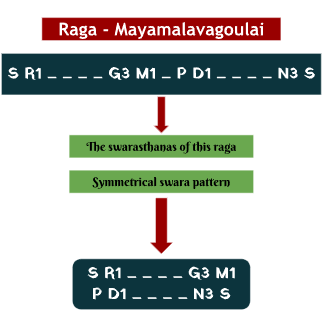
Understanding Mayamalavagowla raga notes requires knowing the specific swarasthanas used. The raga employs Suddha Rishabham (R1), Antara Gandharam (G3), Suddha Madhyamam (M1), Suddha Dhaivatam (D1), and Kakali Nishadam (N3). These specific note positions create a distinctive sound pattern that students can quickly recognize. The consistency of these positions across both ascending and descending scales makes memorization straightforward while building strong pitch accuracy from the very beginning.
Complete Structure with All Seven Swaras
The primary reason Mayamalavagowla raga serves as the first raga to learn in Carnatic music is its complete seven-note structure. As a Sampoorna raga, it contains all seven swaras in both directions.
This completeness gives students exposure to the full range of S R G M P D N S. When students master Mayamalavagowla raga notes, they gain confidence to approach more complex ragas that may use only five or six notes.

Symmetrical Swara Pattern
One remarkable feature that makes Mayamalavagowla raga pedagogically valuable is its symmetrical swara pattern. This symmetry helps students understand pitch and position relationships more intuitively than ragas with irregular patterns.
Understanding the Mirror Pattern
The second half of the scale (P D1 N3 S) mirrors the movement patterns of the first half (S R1 G3 M1). This creates a balanced, elegant structure that students can visualize and remember easily without struggling.
This symmetrical pattern in Mayamalavagowla raga allows students to apply their learning from the lower octave directly to the upper octave. Once they understand how the first four notes relate to each other, they already know how the upper four notes will behave. This reduces cognitive load significantly and accelerates the learning process, making early musical education more enjoyable and less frustrating for beginners.
Three Basic Intervals in Mayamalavagowla
The Mayamalavagowla raga notes demonstrate three fundamental intervals that appear throughout Carnatic music, making it an excellent teaching tool for understanding pitch relationships.

The Three Interval Types
Small Interval: The distance between S and R1 repeats in G3 and M1, and again in P and D1. This teaches precise pitch control.

Medium Interval: The distance between M1 and P represents a clear, comfortable jump that students easily identify.

Large Interval: This wider gap appears between R1 and G3, and again between D1 and N3, teaching navigation of larger pitch jumps.
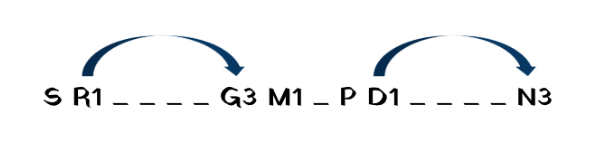
These consistent patterns in Mayamalavagowla raga help beginners understand and internalize pitch spacing early in training, creating muscle memory that serves throughout their musical journey.
Range of Low and High Notes
The Mayamalavagowla raga includes extreme swarasthanas at both ends, giving students early experience with the full range of notes.
This range exposure in Mayamalavagowla raga notes helps students understand vocal range requirements, navigate between registers, and gain awareness of note placement. By practicing Mayamalavagowla raga, students build vocal flexibility needed for complex ragas while maintaining proper technique.
Click on the blog below to know why "Sankarabharanam" is the king of Ragas in Carnatic Music.

Beginner-Friendly Without Gamakas
What makes Mayamalavagowla raga the ideal first raga to learn in Carnatic music is its membership in Swasthaana Vishaddha ragas. These ragas sound complete even when sung with plain notes, without ornamentation.
Unlike ragas needing gamakas to reveal their beauty, Mayamalavagowla raga sounds beautiful with plain notes. This allows students to focus on pitch accuracy first and add ornamentation gradually.
Why Mayamalavagowla is the Foundation
The Mayamalavagowla raga combines multiple pedagogical advantages making it perfect for starting Carnatic music education.
Watch this video to know more!
When students master Mayamalavagowla raga, they gain solid technical foundation, pitch accuracy, pattern recognition skills, confidence, and musical understanding. These advantages explain why teachers choose Mayamalavagowla raga as the first raga to learn in Carnatic music.
Learning Carnatic Music at Spardha School of Music
Building a strong foundation in Carnatic music requires proper guidance and structured, systematic learning. Spardha School of Music offers comprehensive Carnatic vocal training designed to help students of all levels develop their musical abilities.
At Spardha, we make learning Carnatic music accessible, enjoyable, and truly rewarding:
Live and Online Personalized Classes: One-on-one instruction ensures individual attention tailored to your learning style.
Flexible Learning at Your Own Pace: Our flexible approach allows you to progress comfortably through concepts, learning when it suits your schedule.
Performance Opportunities: Regular open mics and multiple other events help build confidence and stage presence in supportive environments.
Friendly and Supportive Professional Teachers: Our instructors combine professional expertise with warm teaching styles, creating comfortable learning environments where students thrive.
Ready to begin your Carnatic music journey? Book your free trial class today and experience quality instruction that makes learning effective and enjoyable.
Explore the gateway to joy, Raga "Mohanam" in Carnatic Music in the blog below.

Conclusion
The Mayamalavagowla raga earns its place as the first raga to learn in Carnatic music through its structural clarity, symmetrical patterns, complete scale coverage, and beginner-friendly characteristics.
Its symmetrical swara pattern helps students visualize pitch relationships, while the three basic intervals teach fundamental spacing concepts. The inclusion of extreme swarasthanas gives students experience with the full range needed.
Most importantly, Mayamalavagowla raga sounds complete without ornamentation, allowing beginners to focus on pitch accuracy before adding complex gamakas.
Students who master Mayamalavagowla raga notes find subsequent ragas easier to learn. The patterns and intervals transfer directly to more complex structures.
Understanding why Mayamalavagowla raga holds this position deepens appreciation for Carnatic music pedagogy. This raga represents centuries of educational wisdom, providing the perfect entry point into South Indian classical music.
Frequently Asked Questions
1.What is Mayamalavagowla raga?
Mayamalavagowla raga is the 15th Melakarta raga in Carnatic music, containing all seven swaras in both ascending and descending patterns, making it the traditional first raga taught to beginners due to its complete and symmetrical structure.
2. Which is the hardest raag?
Todi is often considered one of the hardest ragas due to its complex gamaka requirements and delicate note positions, requiring advanced control and years of practice to render authentically.
3. Which raga is the king of ragas?
Bhairavi is traditionally called the "king of ragas" in Carnatic music due to its versatility, emotional depth, and ability to be performed at any time of day with various emotional expressions.
4. What is the significance of Mayamalavagowla in practice?
Mayamalavagowla provides the foundation for understanding all seven swaras, their positions, and basic intervals, making it essential for building proper technique, pitch accuracy, and musical understanding in Carnatic music training.