Table of Contents
Have you ever noticed how some songs lift your mood instantly while others sit heavy in your chest for hours? You are not just imagining it, and it is not purely emotional either. There is actual structure behind why music makes you feel what it makes you feel. The difference between a song that sounds triumphant and one that sounds heartbroken often comes down to one fundamental choice made before a single note is performed, major or minor.
Understanding this distinction between major vs minor scale will not just make you a better musician. It will change the way you listen to music forever.
It All Starts With Steps
Before getting into scales, there is one foundational idea worth knowing: half steps and whole steps.
A half step is the smallest distance between two notes. On a piano, moving from E to F is a half step. A whole step is simply two half steps combined, moving from C to D, for example. That is it. No complex theory, just small movements between notes.
Every major vs minor scale is essentially a pattern of these movements. Change the pattern, and you change the entire emotional character of the music. That is the core of what separates a major scale from a minor one.
The Major Scale: Why It Sounds the Way It Does
The major scale follows this interval pattern: whole, whole, half, whole, whole, whole, half.
Take C major as an example. Starting from C and applying that pattern gives you: C, D, E, F, G, A, B. Play those notes in order and you will immediately recognise the sound, bright, stable, resolved. It is the sonic equivalent of a sunny afternoon.
That feeling is not accidental. The placement of the half steps, specifically between the third and fourth notes, and again between the seventh and eighth, creates a sense of arrival. Your ear expects the scale to land where it does, and when it does, it feels satisfying.
This is why major scales appear so frequently in pop music, film scores that want to inspire, national anthems, and children's songs. The sound communicates confidence and clarity without the listener needing to know a single thing about music theory.
The Minor Scale: Where Emotion Gets Complicated
Minor scales work differently, and that difference is everything.
The natural minor scale follows this pattern: whole, half, whole, whole, half, whole, whole. Notice how the half steps fall in different places compared to the major scale. That shift changes the emotional pull of the music entirely. Where the major scale resolves cleanly, the minor scale lingers. It carries weight.
Take A minor as an example: A, B, C, D, E, F, G. Same notes as C major, different starting point, completely different feeling.
But the natural minor is just the beginning. There are two important variations that composers and musicians rely on constantly.
The harmonic minor raises the seventh note by a half step. In A harmonic minor, that means G becomes G#. The result is an interval between the sixth and seventh notes that sounds almost exotic, tense, dramatic, slightly unsettling in the best possible way. A lot of classical music and flamenco guitar leans on this sound.
The melodic minor takes a more fluid approach. It raises both the sixth and seventh notes on the way up, then reverts to the natural minor pattern on the way down. This makes ascending lines feel smoother and more vocal. It was developed partly because singers found certain minor intervals awkward to pitch accurately, the melodic minor solved that while keeping the emotional depth of the minor tonality.
Relative Major and Minor: The Same Notes, a Different World
Here is something that surprises most people when they first encounter it: every minor vs major scale has a minor scale hiding inside it, using exactly the same notes.
C major and A minor share every note including, C, D, E, F, G, A, B. The only difference is where you start. Begin on C and you hear brightness. Begin on A and you hear something entirely more melancholic.
This relationship is called relative major and minor. Composers use it constantly. A piece can begin in C major, shift to A minor, and return, all without changing a single note in the key signature. The emotional landscape shifts dramatically while the underlying material stays the same. It is one of the most elegant tools in music when we talk about major vs minor scale.
Major and Minor Chords
Scales give you the notes. Minor and major chords are what happen when you stack them.
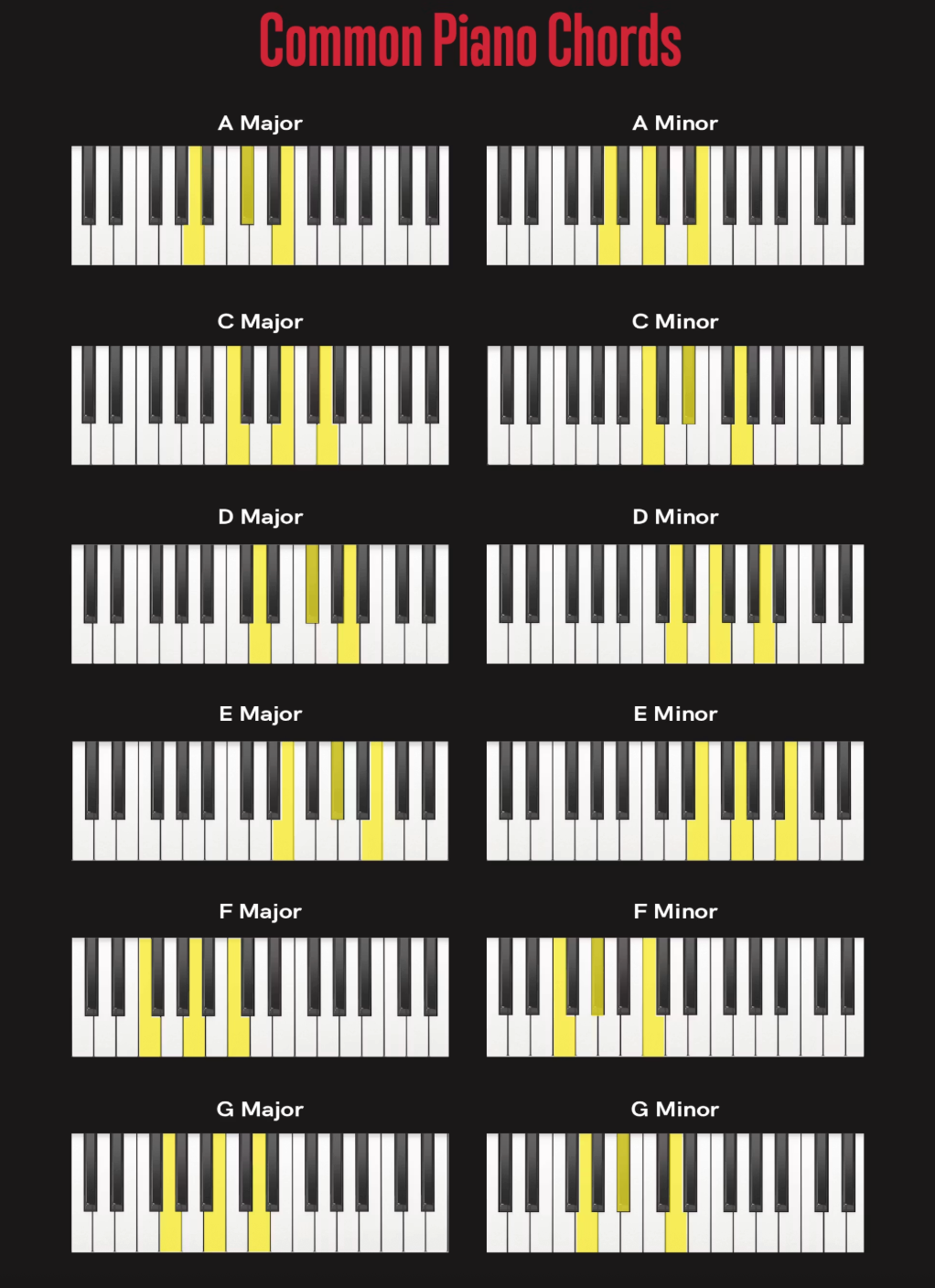
A major chord uses three notes: the root, a major third (four half steps up), and a perfect fifth (seven half steps up). C major is C, E, and G. It sounds open and strong.
A minor chord adjusts one thing: the major third drops by a half step, becoming a minor third (three half steps up). A minor is A, C, and E. That single change, one half step, is what makes the chord sound heavier, darker, more emotionally loaded.
This is worth sitting with for a moment. One half step. That is the entire difference between a minor and major chord that sounds triumphant and one that sounds heartbroken.
Beyond basic triads, chords extend further. Seventh chords add one more note above the fifth. A C major seventh chord i.e., C, E, G, B has a warm, slightly jazzy quality. A C minor seventh, C, E♭, G, B♭, takes that warmth and adds a layer of wistfulness to it. Extended chords go further still, adding ninths, elevenths, and thirteenths for increasing complexity and colour.
These are the chords you hear in jazz, neo-soul, and sophisticated film scores.
How Scales and Chords Work Together
Scales and minor and major chords are not separate concepts. They are two sides of the same idea.
When a composer writes in C major, the chords they build come from the notes of that scale. The melody moves through those same notes. Everything fits together because it shares a common source. Shift to a minor key and the chords change accordingly, pulling the harmony into different emotional territory.
One technique worth knowing is modal interchange, borrowing a chord from a parallel key. A song in C major might borrow E♭ major from C minor for a single moment, creating an unexpected shift that feels surprising but not wrong. Radiohead built much of their harmonic vocabulary on this. So did The Beatles.
Understanding this is not about becoming a music theorist. It is about hearing music differently, recognising why a particular moment in a song hits you the way it does.
Major vs Minor Pentatonic
The major vs minor pentatonic scale which is five notes instead of seven, follows the same major/minor logic. The major pentatonic sounds folk-like and open. The minor pentatonic is the backbone of blues and rock guitar.
When you hear a guitarist improvise over a rock song, they are almost certainly working from the minor pentatonic. It fits naturally over minor chord progressions and has just enough tension to keep things interesting without ever sounding wrong.
Why Learning This Properly Changes Everything
Reading about major scale vs minor scale is one thing. Understanding them in your hands, on an instrument, with a teacher who can correct what you cannot hear yourself, that is where the real shift happens.
Music theory is not meant to live on a page. It is meant to come alive through practice. When you genuinely understand why a harmonic minor scale sounds the way it does, when you can feel the difference between a major and minor chord progression before you can name it, that is when music stops being something you consume and becomes something you can actually create.
Start Learning at Spardha School of Music
At Spardha School of Music, we teach music the way it is meant to be taught, with depth, patience, and genuine attention to each student's pace and goals. Whether you are picking up an instrument for the first time or looking to build real theoretical understanding behind what you already play, our courses are designed to take you from where you are to where you want to be.
Our students learn not just to play, but to understand. Because musicians who understand their instrument and the theory behind it grow faster, express more, and enjoy the process far more deeply.
If this article made you curious, that curiosity is worth following. Enrol in a course at Spardha School of Music and start building something that lasts.
Frequently Asked Questions
What is the simplest difference between a major and minor scale?
The major vs minor scale is about the pattern of whole and half steps. Major scales sound bright and resolved; minor scales sound darker and more emotionally complex, all because of where the half steps fall.
Can the same notes be in both a major and minor scale?
Yes. Every major scale shares its notes with a relative minor scale. C major and A minor use identical notes, just starting from different points.
Why do minor chords sound sad?
A minor chord lowers the middle note of a major chord by one half step. That small change alters the harmonic tension in a way the ear interprets as heavier or more sorrowful.
What is the minor pentatonic scale used for?
It is the foundation of blues, rock, and R&B improvisation. Its five-note structure fits naturally over minor chord progressions and is one of the first scales most guitarists learn to solo with.