Table of Contents
Quick Summary
Laya in music refers to the steady flow, tempo, or pace of time in a musical performance. In Indian classical music, the three primary types of laya are Vilambit (slow), Madhya (medium), and Drut (fast). While Tala defines the recurring rhythmic cycle, laya in music determines the speed at which that cycle is performed. Understanding what is laya in music helps singers and instrumentalists maintain rhythmic stability, coordinate with accompaniment, and perform techniques such as layakari, including Thaah, Dugun, Tigun, and Chaugun.
Music can be said to be the language of emotions for everyone, but behind every song, there is a structured foundation that keeps the whole structure stable and consistent, which is none other than the rhythm and tempo of the song. This element of the song in Indian classical music, whether it be Hindustani or Carnatic music, is termed Laya. It becomes very important for the singer, musician, or music lover to have knowledge about Laya to have a complete understanding of Indian classical songs.. In this guide, we will unpack the concept of what is laya in music , explore its three primary speeds Vilambit, Madhya, and Drut and highlight how mastering tempo can transform performance.
Defining Laya: The Soul of Musical Tempo
To begin with, laya in musical terms is considered to be the term for tempo, rhythm or the constant flow of time. It is the same distance between one beat and another (Matras). As a ticking clock has a consistent speed, so does Laya form the grid where notes (Swaras) and rhythms (Tala) are formed.
Laya is much more than just speed. Laya is an aesthetic context that establishes the mood (Rasa) of the entire composition. The slow motion brings in peace and devotion whereas the fast motion produces joy and excitement. When we study the concept of laya in music from ancient texts such as the Natya Shastra or Sangeet Ratnakar, we come to know that it is the equal spacing between two events i.e., the gap between sound.
Beat 1 Beat 2 Beat 3 Beat 4
| <--- Laya ---> | <--- Laya ---> | <--- Laya ---> | <--- Laya ---> |
The Relationship Between Laya and Tala
Even though the two may be used synonymously by the novices, Laya and Tala are different elements:
- Laya: The tempo or the rhythm of time itself.
- Tala: The cyclical pattern of the beats arranged in a certain way into measures, claps, and waves.
Imagine Tala to be one frame of a movie, and Laya is how fast the movie should be shown, or the frame rate of the movie. Without an appropriate Laya, the most complicated Tala cannot retain its symmetry, proportions, or beauty. One can perform a sixteen beat cycle or a twelve beat cycle, but the emotional weight of that performance will depend entirely on the chosen Laya.
The Three Primary Speeds of Laya
Laya in music is commonly discussed through three primary speeds: Vilambit, Madhya and Drut. These three forms of laya musical practice allow performers to move from slow, spacious musical development to faster and more energetic passages.
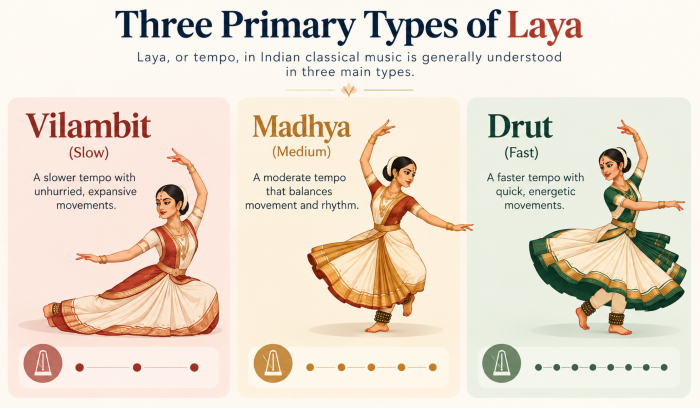
Vilambit (Slow) ────────> Madhya (Medium) ────────> Drut (Fast)
Contemplation Balance & Grace Virtuosity & Climax
1. Vilambit Laya (Slow Tempo)
Vilambit Laya is the slow and deliberate tempo. As there are huge gaps between successive beats, this gives artists ample room to delve into the microtonalities of each Swara.
- Features: Spacious, meditative, serene, majestic and highly emotional.
- Use: Usually found in the introduction parts of classical music concerts, for instance, in Bada Khayal of Hindustani Vocal Music, in slow Dhrupads and also in Alap-Jod portions of Instrumental music.
- Artistic Embellishments: Gives artists enough scope to perform Meend, Gamak, Khatka, Murki and other intricate ornamentations of classical music without being in haste.
- Difficulty: The maintenance of Vilambit Laya demands high control on breath, patience of mind, accuracy and inner sense of timing due to large gaps between beats.
2. Madhya Laya (Medium Tempo)
Madhya Laya refers to an easy pace, akin to the regular walking pace or the resting rate of heartbeat. It is important for creating a vital link between meditation and intense rhythm performances.
- Features: Balanced, elegant, expressive, lyrical, and accessible to the audience.
- Use: Commonly found in compositions of Chhota Khayal, Thumri, Dadra, Ghazals, and other lighter forms. It acts as the default tempo for training students in voice culture and instrumental training in laya music and classical education.
- Sound Effects: Provides scope for balanced phrasing, lyrical bol-alaps, moderate rhythmic variations, and narration through lyrics.
- Difficulty: The key challenge here is maintaining uniformity without moving on to higher or lower tempos accidentally. The tendency among beginners is to move to higher tempos when they move up the melody in Madhya Laya.
3. Drut Laya (Fast Tempo)
Drut Laya is the fast tempo of music, characterized by fast pace of music energy in the form of exciting note sequences, fast singing (Taans), and dazzling rhythms (Layakari).
- Features: Vigorous, dramatic, skillful, dazzling, and enjoyable.
- Uses: It is used near the end of performance of a raga through fast Bandishes, Tarana, and Jhala.
- Dramatic Ornaments: Emphasizes fast scale runs (Sapat Taans), complicated phrase fragments (Koot Taans), and dazzling percussion work on the Tabla and Pakhawaj.
- Trouble: Maintaining fast speed without losing the quality of pitches, lyrics, and accurate striking of the principal beat (Sam).
Comparative Overview of the Layas
The following table summarizes how each Laya functions within traditional and contemporary performances:
Layakari: The Art of Rhythmic Play and Mathematics
When a performer becomes capable of playing at an even and constant pace, the next step for them to consider would be learning about the concept of Layakari. It involves playing at varied paces and subdividing them over a rhythm cycle. Layakari plays an integral role in Indian rhythm tradition.
Thaah (1:1) : [ • ] [ • ] [ • ] [ • ]
Dugun (2:1) : [ • • ] [ • • ] [ • • ] [ • • ]
Tigun (3:1) : [ • • • ] [ • • • ] [ • • • ] [ • • • ]
Chaugun (4:1) : [ • • • • ] [ • • • • ] [ • • • • ] [ • • • • ]
Some basic and complex examples of Layakari rhythms are:
- Thaah (Barabar/Single Speed): Singing or playing one note per beat (1:1). It sets the basic beat.
- Dugun (Double Speed): Singing or playing two notes or beats within the exact time span of one beat (2:1).
- Tigun (Triple Speed): Playing or singing three notes within a single beat (3:1).
- Chaugun (Quadruple Speed): Playing or singing four notes per beat (4:1). This is often used in Taans and Tihais.
- Chhagun (Sextuple Speed): Singing or playing six notes per beat (6:1).
- Kuadi (Fractional 1.5 times): A complex rhythm involving six notes spread across four beats (3:2 ratio).
- Biadi (Fractional 1.75 times): A complex rhythm where seven notes are played across four beats (7:4 ratio).
- Paadi (Fractional 1.25 times): A difficult rhythm involving five notes in four beats (5:4 ratio).
Why Understanding Laya Matters for Every Musician
No matter if you have begun your career with laya musicals, learning the classical Indian musical instruments such as Sitar, Sarod, Flute, and Tabla or taking lessons in vocal training, gaining the sense of laya musical sense is vital and will give you all of the following advantages:
- Creating your own Metronome: Stops the necessity to always think about your counting externally.
- Improving your intonation: Tempo helps to avoid unnecessary rushing and ensures that each of your notes gets enough time to sound clearly.
- Synchronizing your ensemble: Helps to play perfectly together with accompaniment and percussion players, especially during polyrhythmic parts and unison Tihais.
- Increasing the range of emotions and dynamics: The ability to change the speed smoothly enables complete freedom for creative purposes.
Practical Tips to Master Laya
No matter if you have begun your career with music, learning the classical Indian musical instruments such as Sitar, Sarod, Flute, and Tabla or taking lessons in vocal training, gaining the sense of laya in music is vital and will give you all of the following advantages:
- Creating your own Metronome: Stops the necessity to always think about your counting externally.
- Improving your intonation: Tempo helps to avoid unnecessary rushing and ensures that each of your notes gets enough time to sound clearly.
- Synchronizing your ensemble: Helps to play perfectly together with accompaniment and percussion players, especially during polyrhythmic parts and unison Tihais.
- Increasing the range of emotions and dynamics: The ability to change the speed smoothly enables complete freedom for creative purposes.
Frequently Asked Questions
What do you mean by laya?
In music and dance, laya means the tempo, speed, or rhythm. It is the steady flow of time between beats or notes in a performance. You can think of the taal as the fixed rhythmic map, and the laya as the speed at which you travel along it.
What are the three types of laya?
In Indian classical music and dance, laya means tempo or rhythm. The three main types of laya are Vilambit Laya (slow tempo), Madhya Laya (medium tempo), and Drut Laya (fast tempo).
What does laya mean in Carnatic music?
Laya in Carnatic music refers to the continuous flow of time, tempo, and rhythm. It is the uniform spacing between beats and serves as the foundational pulse that anchors both vocalists and instrumentalists. Often described as the "father" of music alongside shruti (pitch/mother), laya governs the aesthetic and mathematical symmetry of a performance.
What is a Tala in Indian music?
A tala (or taal) is a repeating rhythmic cycle that structures time and meter in Indian music.The Sanskrit word literally translates to "clap" or "palm". While Western music typically moves forward in linear bars (like a 4/4 time signature), a tala operates like a circular clock that loops endlessly. It forms one of the two foundational pillars of Indian classical music, working alongside the raga (the melodic framework). Think of the raga as what notes you play, and the tala as when you place them within the cycle.