Table of Contents
Quick Summary
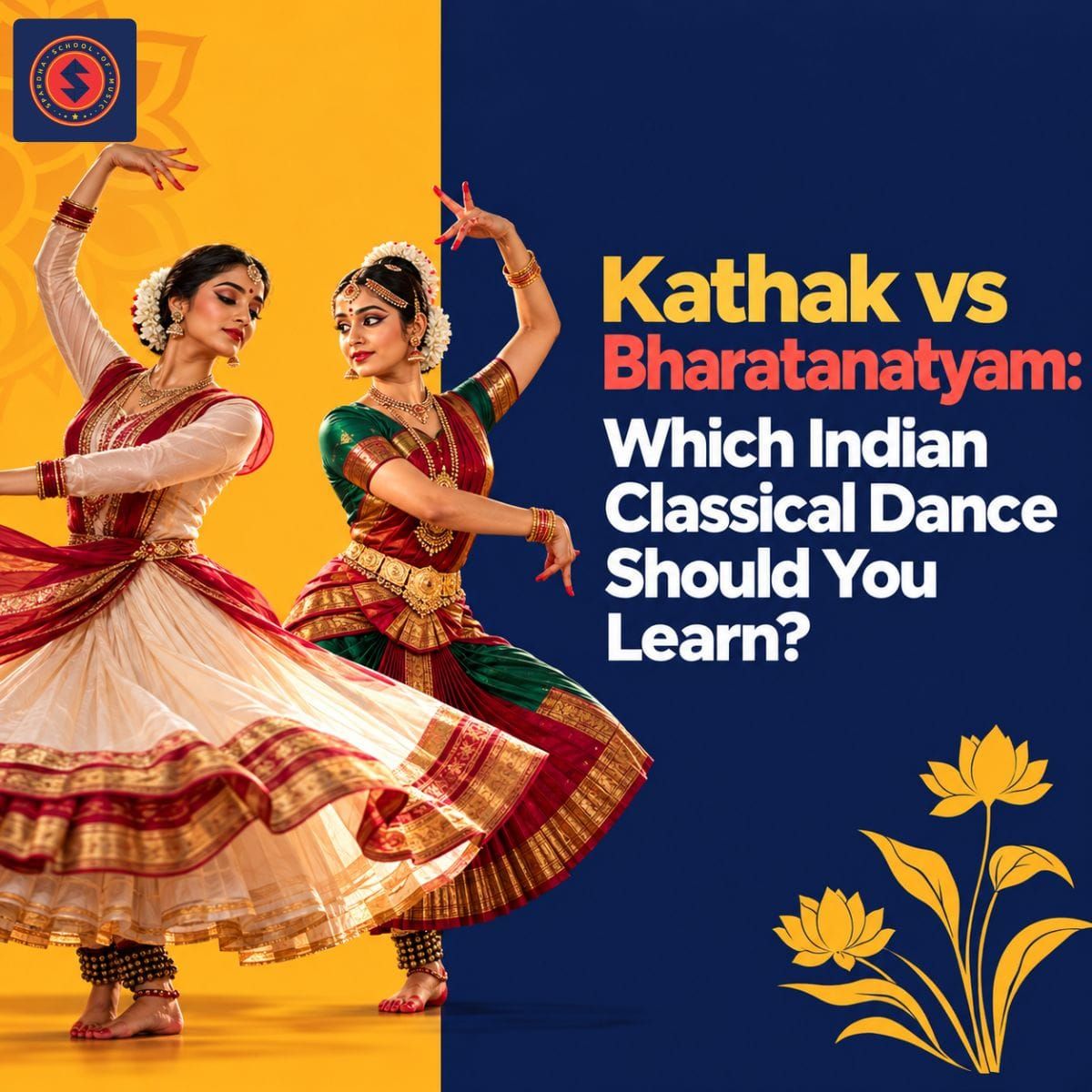
Kathak vs Bharatanatyam is a comparison between two major Indian classical dance traditions with distinct movement vocabulary, musical traditions and performance styles. Kathak is associated with North India and is particularly known for rhythmic footwork, spins, intricate compositions, storytelling and its connection with Hindustani music. Bharatanatyam, associated particularly with Tamil Nadu and South India, is recognised for its structured adavus, geometric postures, hand gestures, facial expressions and strong connection with the Carnatic music tradition. Both use nritta (pure dance), nritya (expressive dance) and abhinaya to varying degrees, but they create very different visual and rhythmic experiences.
If you are deciding between Bharatanatyam and Kathak, the biggest difference is not simply where they originated. It is how the body moves, how rhythm is expressed, how stories are communicated and what kind of musical structure accompanies the dancer.
Both require discipline, repetition and practice, but the learning experience can feel quite different.
What Is Kathak?
Kathak is an Indian classical dance form historically associated with North India. The Centre for Cultural Resources and Training describes Kathak as a combination of music, dance and narrative, with its development connected to traditions including the medieval Ras Lila of the Braj region. Over time, Kathak became highly stylised in both Hindu and Muslim courts. It is also closely associated with the Hindustani musical tradition.
The word Kathak is connected to katha, meaning story. Storytelling remains an important part of the form, but Kathak is equally recognised for its sophisticated rhythmic vocabulary.
A Kathak performance can include:
- Tatkar or rhythmic footwork
- Hastaks and hand movements
- Chakkars or spins
- Taal and rhythmic compositions
- Abhinaya
- Thaat
- Aamad
- Toda and Tihais
- Gat and Gatnikas
- Parans
- Tarana or devotional compositions
The interaction between dancer, rhythm and music is one of the defining characteristics of Kathak. CCRT notes that both nritta and abhinaya in Kathak allow significant scope for improvisation.
What Is Bharatanatyam?
Bharatanatyam is a major Indian classical dance tradition associated particularly with Tamil Nadu and South India. CCRT (Centre for Cultural Resources and Training) traces its textual foundations to works including Bharata Muni’s Natya Shastra and Abhinaya Darpana, while noting that the present-day repertoire was substantially shaped in the 19th century by the Tanjore Quartet.
Bharatanatyam combines rhythm, precise body movements, hand gestures, facial expressions and storytelling. Its training is strongly associated with adavus, which are systematic movement sequences forming the foundation of technique.
A Bharatanatyam performance can include repertoire such as:
- Alarippu
- Jatiswaram
- Shabdam
- Varnam
- Padam
- Tillana
- Mangalam
The form combines nritta, or pure dance, with nritya, where movement and expression communicate the meaning of the accompanying text. CCRT also notes the strong role of abhinaya in Bharatanatyam.
Kathak vs Bharatanatyam: Key Differences
The difference between Bharatanatyam and Kathak becomes easier to understand when you compare their movement, rhythm, music and performance vocabulary.
The distinction is not absolute; both forms contain considerable variation and both combine technique, rhythm and expression.
Kathak vs Bharatanatyam: Footwork and Movement
One of the clearest differences between Kathak and Bharatanatyam is the way each form approaches movement.
Kathak Footwork
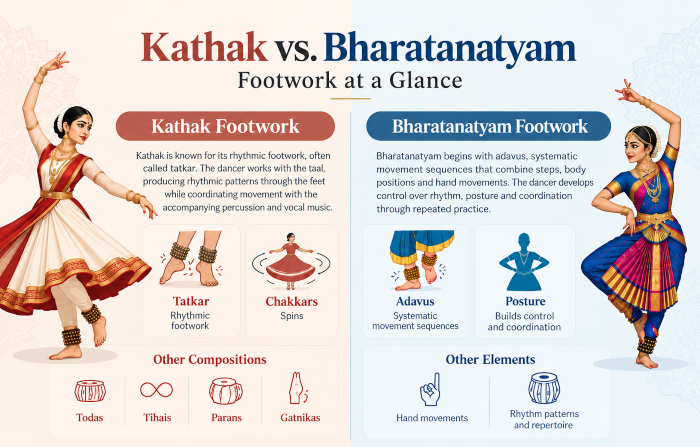
Kathak is particularly known for its rhythmic footwork, often called tatkar. The dancer works with the taal, producing rhythmic patterns through the feet while coordinating movement with the accompanying percussion and vocal music.
Spins, or chakkars, are another recognisable feature. More advanced Kathak repertoire also includes compositions such as Todas, Tihais, Parans and Gatnikas.
At Spardha, the Kathak Foundation course introduces rhythmic footwork, hand movements, Taal Teentaal, Abhinaya and basic spins. Its later courses build towards compositions including Thaat, Aamad, Parans, Tihais and Gatnikas.
Bharatanatyam Footwork
Bharatanatyam begins with adavus, systematic movement sequences that combine steps, body positions and hand movements.
The dancer develops control over rhythm, posture and coordination through repeated practice of these foundational movements. Spardha’s Bharatanatyam Foundation, for example, introduces basic Tatadavus, rhythm response, hand gestures and introductory choreography.
As students progress, they work on increasingly complex adavus, postures, rhythm patterns and repertoire.
Bharatanatyam and Kathak: Difference in Expressions
Both forms use abhinaya, but their overall movement vocabulary creates different visual experiences.
In Kathak, storytelling can involve facial expressions, hand movements and the interpretation of poetry or lyrical compositions. CCRT describes Kathak’s narrative dimension and its use of expressive dance alongside pure dance.
In Bharatanatyam, facial expressions, eye movements, hand gestures and body positions play an important role in communicating characters, emotions and stories. Its repertoire includes dedicated expressive pieces alongside technically demanding rhythmic sections.
So if you are comparing Bharatanatyam and Kathak, both are expressive forms but they use different movement languages to achieve that expression.
Kathak vs Bharatanatyam: Music and Rhythm
Music is another major difference.
Kathak is closely connected with Hindustani music, and rhythm plays a central role in the form. Dancers work with taal, rhythmic syllables and compositions while coordinating footwork and movement with the music.
Bharatanatyam is traditionally accompanied by Carnatic music. A Bharatanatyam ensemble can include a vocalist, mridangam player, violinist, flautist or veena player, along with a nattuvanar who conducts the dance recitation.
This means your interest in Indian music can also influence which form feels more familiar. Someone already interested in Hindustani music may find Kathak’s musical environment familiar, while a learner interested in Carnatic music may naturally connect with Bharatanatyam.
Kathak vs Bharatanatyam: Repertoire
The two forms also have different performance structures.
Kathak Repertoire
A Kathak performance may include:
- Thaat
- Aamad
- Tatkar
- Toda
- Tihai
- Paran
- Gat
- Gatnikas
- Abhinaya
- Tarana
As students advance, the compositions become more rhythmically complex and dancers develop greater control over tempo, footwork and improvisation. Spardha’s Kathak Method Book 2, for example, introduces Thaat, Aamad, Parans, Tihais, Tatkar and Gatnikas within Taal Teentaal.
Bharatanatyam Repertoire
Bharatanatyam has a more structured traditional recital sequence that can include:
- Alarippu
- Jatiswaram
- Shabdam
- Varnam
- Padam
- Tillana
- Mangalam
CCRT describes Alarippu and Jatiswaram as early pure-dance components, while the Varnam combines nritta and nritya and the later repertoire gives greater space to abhinaya.
Kathak vs Bharatanatyam Costumes
The costumes make the difference between the two forms immediately visible.
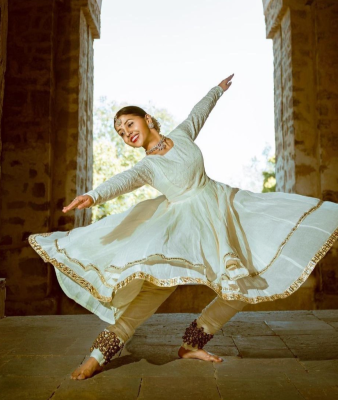
Kathak costumes can vary by gharana and performance tradition. Female dancers may wear a flowing lehenga-choli or anarkali-style costume, while other traditional costume styles are also used.
Bharatanatyam costumes are more structured, typically featuring a pleated front that opens during movement, along with traditional jewellery, temple-inspired accessories and ankle bells.
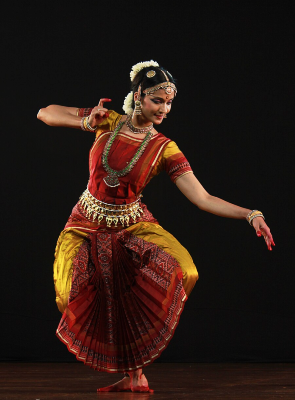
The costume is not simply decorative. It supports the movement vocabulary of each form and contributes to the visual identity of the performance.
Which Is Easier: Kathak or Bharatanatyam?
There isn’t a universal answer to whether Kathak or Bharatanatyam is easier.
Both are classical dance forms that require:
- Regular practice
- Rhythm training
- Coordination
- Physical conditioning
- Memorisation
- Expression
- Technique
- Patience
The form that feels more manageable may depend on your previous dance experience and what kind of movement you naturally enjoy.
If you enjoy rhythm, fast footwork, spins and compositions, you may find Kathak particularly engaging.
If you enjoy structured movement sequences, posture, hand gestures, expressions and a detailed classical repertoire, Bharatanatyam may suit your learning preferences.
Neither should be treated as an “easy” classical dance. Both require consistent training.
Kathak vs Bharatanatyam for Beginners
Both can be started by beginners.
You don’t need to know every technical term before your first class. A structured foundation course can introduce the vocabulary gradually.
For example, Spardha’s Bharatanatyam Foundation starts with basic footwork, rhythm response, hand gestures and introductory choreography, while its Kathak Foundation introduces basic footwork, hand movements, Taal Teentaal, Abhinaya and basic spins.
This makes the choice less about which dance is “better for beginners” and more about which movement language you want to learn.
Kathak vs Bharatanatyam for Kids
Both forms can provide children with structured exposure to rhythm, movement, discipline and performance.
For younger learners, the most important factor is usually whether the teaching approach keeps them engaged while building correct fundamentals.
Spardha offers structured pathways for both forms, with Foundation courses followed by progressive levels. Its Bharatanatyam pathway includes Foundation, Method Books and ISTD grades, while its Kathak pathway includes Foundation, Method Books and certification pathways including ABGMM and ISTD.
Kathak vs Bharatanatyam for Adults
Adults can also begin either form.
You don’t need to have started classical dance as a child to explore one of these traditions. The realistic expectation, however, is that progress comes through consistent practice rather than a few classes.
Spardha states that its Bharatanatyam programme has no upper age barrier and that adults can learn the form. Its Kathak programme similarly states that adults can start without an upper age limit.
For adults balancing work and other commitments, the ability to maintain a regular practice schedule is likely to matter more than age.
Which One Should You Learn: Kathak or Bharatanatyam?
Instead of asking which form is better, start with what you want from your dance education.
Choose Kathak if you are drawn to:
- Rhythmic footwork
- Spins and chakkars
- Hindustani music
- Taal and rhythmic compositions
- Improvisation
- Storytelling and Abhinaya
- Compositions such as Toda, Tihai and Paran
Choose Bharatanatyam if you are drawn to:
- Adavus
- Structured technique
- Strong postures and body lines
- Hand gestures and eye movements
- Carnatic music
- Classical repertoire
- Detailed expressive storytelling
- Traditional Indian dance aesthetics
Still Can’t Decide?
Watch performances of both forms before enrolling.
Don’t just watch the final performance. Look at the feet, posture, hand movements, rhythm and expressions. Notice which movements make you curious enough to want to try them yourself.
That reaction can tell you more than a generic “Kathak vs Bharatanatyam” comparison.
Learn Kathak or Bharatanatyam Online with Spardha
If you want to explore either form from home, Spardha offers live 1-on-1 online classes for both Kathak and Bharatanatyam.
The Bharatanatyam pathway progresses from Foundation to higher levels, with training covering adavus, rhythm, hand movements, posture, expressions and repertoire. The programme also includes ISTD certification pathways.
The Kathak pathway begins with Foundation and progresses through Method Books and certification options. Students work on footwork, hand movements, Taal Teentaal, Abhinaya, spins and progressively more complex compositions.
Both pathways are structured rather than being limited to learning individual choreography. That matters if your goal is to actually understand and develop the classical form over time.
Conclusion
The difference between Bharatanatyam and Kathak becomes much clearer once you look beyond their names. Kathak brings together rhythmic footwork, spins, storytelling and Hindustani musical traditions, while Bharatanatyam combines adavus, structured postures, hand gestures, expressions and a repertoire rooted in the Carnatic musical tradition.
Both are demanding classical disciplines, and neither needs to be reduced to a question of which one is easier or better. The better starting point is to ask what kind of movement, music and performance language you want to spend time learning.
If rhythm, footwork and spins immediately catch your attention, Kathak may be the form you want to explore.
If structured adavus, expressive gestures, posture and classical repertoire appeal to you, Bharatanatyam may be the direction you want to take.
And if you’re still unsure, try an introductory class in both. Sometimes the right classical dance form is simply the one that makes you want to practise again the next day.
Frequently Asked Questions
What is the main difference between Kathak and Bharatanatyam?
The main difference lies in their movement vocabulary, musical traditions and performance styles. Kathak is strongly associated with rhythmic footwork, spins, storytelling and Hindustani music, while Bharatanatyam is known for adavus, structured postures, hand gestures, expressions and its connection with Carnatic music.
Which is easier, Kathak or Bharatanatyam?
Neither is universally easier. Both require regular practice, rhythm, coordination, physical control and expressive skills. Your experience and personal preference can influence which form feels more natural.
Can beginners learn Kathak and Bharatanatyam?
Yes. Both can be learned from a foundation level. Spardha's beginner pathways introduce the fundamentals gradually rather than assuming prior classical dance experience.
What is the difference between Bharatanatyam and Kathak footwork?
Kathak places a strong emphasis on rhythmic footwork such as tatkar and also features chakkars or spins. Bharatanatyam builds its technique around adavus, which combine coordinated steps, body positions and hand movements.
Is Kathak based on Hindustani music?
Yes. Kathak has a strong historical connection with the Hindustani musical tradition.
Is Bharatanatyam based on Carnatic music?
Yes. Bharatanatyam traditionally uses the Carnatic music system, with accompanying musicians such as a vocalist and mridangam player, along with other instruments depending on the performance.
Can adults learn Kathak or Bharatanatyam?
Yes. Adults can begin learning either form. Spardha specifically states that its Bharatanatyam programme has no age barrier and that adults can learn, while its Kathak programme also states that there is no upper age limit.
Which is better for kids: Kathak or Bharatanatyam?
Both can provide structured classical dance training for children. The choice can depend on whether the child is more interested in Kathak's rhythmic footwork and spins or Bharatanatyam's adavus, gestures, posture and expressive movement.
Can I learn Kathak or Bharatanatyam online?
Yes. Both forms can be taught online when classes are live and the teacher can observe and correct the student's movements. Spardha offers live 1-on-1 online classes for both Kathak and Bharatanatyam, with structured learning pathways.