Table of Contents
There's a particular kind of frustration with musicians who've been playing for years but hit an invisible ceiling. They can reproduce songs very well and follow a teacher's instructions. But ask them why a chord progression feels the way it does, or how to build a melody from scratch, and they go quiet. Not because they lack talent, but in reality no one ever taught them the language underneath the music.
That language is music theory which can completely change everything. Want to know how? Read out this blog to get detailed information.
What Is Music Theory?
Music theory is the study of how music works. It's the framework that explains why certain notes sound good together, how rhythm creates feeling, why a minor key carries weight that a major key doesn't, and how composers across centuries have structured their ideas into something an audience can feel.
At the basic music theory level, you're looking at building blocks such as, notes, scales, intervals, chords, rhythm, and tempo. These aren't abstract academic concepts, but they're the actual mechanics of every song you've ever loved. When you understand them, you stop experiencing music passively and start understanding it actively.
Basic music theory is often misunderstood as sheet music reading or rote memorization of rules. It's neither. It's closer to learning grammar after you've already been speaking a language for years. Suddenly, everything you were doing intuitively has a name, a structure, and a logic and that understanding opens up a completely new level of control over what you create and perform.
Online music theory and lessons have made this knowledge more accessible than it's ever been. You no longer need to sit in a conservatory classroom to learn the fundamentals. But access alone doesn't replace structure and it is exactly what separates musicians who plateau from those who keep growing.
5 Reasons Why Learning Music Theory Is Important
1. It Gives You a Map When You're Composing
Without theory, composing a song is a lot of trial and error. You play notes until something sounds right, you adjust until it feels close, and you hope the result holds together. With theory, you understand why something works and that understanding means you can make intentional choices instead of lucky ones.
Knowing that a dominant seventh chord creates tension that wants to resolve, or that moving from the fourth to the first chord feels like coming home these aren't just academic facts. They're tools. A musician with theory knowledge composes with direction. One without it composes with hope.
This is the difference between an artist who struggles to finish a song and one who can sit down with a clear idea and build it out, section by section, with confidence.
2. It Makes You a Significantly Better Collaborator
Music is rarely made alone. Bands, orchestras, studio sessions, live performances. Music is collaborative by nature. And collaboration requires a shared language.
When a guitarist says "let's go to the five chord" or a producer mentions "the melody sits in the Dorian mode," musicians with theory knowledge follow immediately. Those without it either bluff or fall behind. In a studio session, falling behind costs time and money. In a band, it creates friction that erodes trust over time.
Learning music theory makes you fluent in the language that professional musicians speak. You can take direction, give direction, and contribute ideas that other musicians can immediately understand and build on. That fluency is worth more than most musicians realise until they're in a room where everyone else has it and they don't.
3. It Trains Your Ear in Ways That Practice Alone Cannot
Ear training is a core component of music theory and it's one of the most underestimated skills a musician can develop. When you study intervals, you start to hear the distance between notes in real time. When you study chord qualities, you begin to identify whether a chord is major, minor, diminished, or augmented just by listening. When you understand rhythm patterns, you stop miscounting and start feeling where the beat sits.
This is not a passive skill. It takes deliberate practice. But the musicians who have developed their ear through theory can transcribe a song they've heard once, identify a chord progression by ear, and catch a wrong note in a recording before the engineer points it out.
Practice builds muscle memory. Theory builds musical intelligence. You need both and one accelerates the other significantly.
4. It Speeds Up Learning New Music
Musicians with a solid theory foundation learn new pieces faster. Not slightly faster, noticeably faster. Because instead of memorising a song note-by-note, they're recognising patterns they already understand.
A chord progression they've seen before. A scale they know intimately. A rhythmic structure they can feel without counting. Theory turns new music from a foreign language into a familiar dialect. The basic shapes are the same , only the specific expression changes.
This compounds over time. Every new piece builds on existing theoretical knowledge, and that existing knowledge makes the next piece easier to absorb. Musicians without theory are essentially starting from scratch with every new song. Musicians with theory are building on a foundation that keeps getting stronger.
5. It Connects You to the Full History of Music
Music theory is not a modern invention. It stretches back to ancient Greece, through the medieval modes, through the Baroque era, the Classical period, Jazz, Blues, and into everything being made today. Learning theory connects you to that entire lineage.
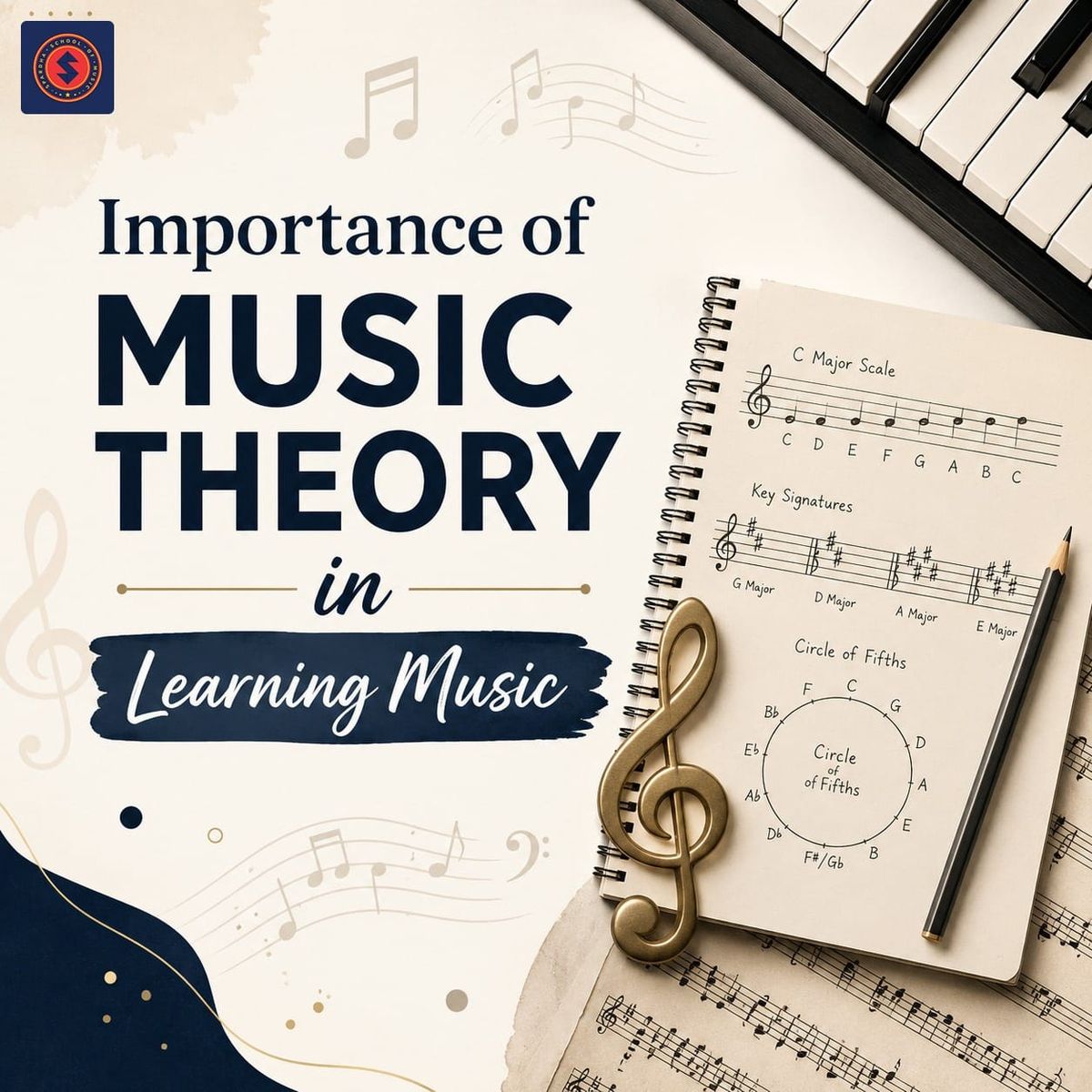
When you understand the circle of fifths, you understand a principle that Bach used and that modern pop producers still reach for. When you understand call and response in rhythm, you're touching something that lives in West African drumming, gospel music, and hip-hop simultaneously. Theory reveals these connections and those connections make music richer, more meaningful, and more interesting to make.
Knowing where a musical idea comes from doesn't limit creativity. It expands it. The most innovative musicians in history from Mozart to Miles Davis to A.R. Rahman understood the rules well enough to know exactly when and how to break them.
Start Learning at Spardha School of Music
Understanding music theory is one thing. Building it into your playing, your composing, and your musical thinking through structured, expert-guided practice is another entirely. That's what Spardha School of Music offers.
At our music institute, online Music theory & lessons aren't taught as a separate academic subject disconnected from actual playing. It's woven into every lesson, every practice session, and every performance so that the knowledge you build has immediate, practical application. Whether you're a complete beginner trying to understand basic music theory or an experienced musician looking to fill the gaps in your foundation, our courses are designed to meet you exactly where you are.
Our faculty brings both deep theoretical knowledge and real performance experience to every class. That combination is rare and it's what makes the difference between theory that sits in a notebook and theory that actually changes how you play.
Register for a course at Spardha School of Music today and start building the musical foundation that everything else grows from. Your instrument already has the range. Theory gives it depth.
Frequently Asked Questions
What is music theory, and do I really need it?
Music theory is the study of how music is constructed, notes, scales, chords, rhythm, and how they interact. You don't need it to enjoy music, but if you want to compose, collaborate professionally, or genuinely understand what you're playing rather than just reproduce it, theory is essential.
Is basic music theory difficult to learn?
Basic music theory has a learning curve, but it's not as steep as most people assume. Concepts like major and minor scales, basic chord construction, and reading rhythmic notation are accessible to beginners with consistent practice. The key is learning in a structured environment with proper guidance rather than piecing it together from scattered sources.
Can I learn music theory online?
Yes, online music theory lessons have made the subject genuinely accessible. The quality of what's available has improved significantly. That said, online learning works best when it's structured and guided rather than self-directed and scattered. A proper course with qualified teachers will take you further faster than random video tutorials.
At what point should a musician start learning music theory?
Ideally, from the beginning, but it's never too late to start. Musicians who begin theory early develop faster and with fewer bad habits. Musicians who come to theory after years of playing often describe it as a revelation and suddenly understanding why things they'd been doing intuitively actually work. Whenever you start, the return on that investment is immediate.