Table of Contents
Quick Summary
Gamak is a form of musical ornamentation in Indian classical music that adds movement, expression and character to notes. It involves controlled pitch variations and oscillations that help communicate the identity and mood of a raag. Gamak is used in both Hindustani and Carnatic classical music, although its application varies by musical tradition. Unlike alankar, which focuses on structured patterns of notes, gamak adds expressive movement to them. Learning gamak through guided practice helps vocalists develop pitch control, melodic expression and a deeper understanding of raag presentation.
Introduction: The Soul of Indian Classical Voice
In the profound and traditional lineage of Hindustani classical music, a note or a swar is never perceived only as a mere fixed point or anchor of frequency. In the theoretical POV, the swar might be represented as the “straight note” which becomes the index or parameter of pitch perfectness, but according to the Indian Knowledge System (IKS), such clinical sound is considered as Shushka or “dry’ and devoid of the life force called “Prana” Indian Musicology views it as an unornamented note as a skeleton without its flesh. The true essence of a Raga does not reside in the notes itself, its embodied in the fluid spaces between them.
Now, here comes the concept of Gamak, which can be defined as the careful expressive transition between Srutis (microtones), which sounds more of reverberation of notes.This is an alankaar which gives a Raga its character and makes it special. A melody without such inflections is nothing more than a bland sequence of notes like a lifeless body.
As we deep dive into this exploration, we shall find out the Shastra based foundations of Gamak, moving from the acoustic movement of sound to the 13th-century classifications of Sharangadeva. We will differentiate these dynamic movements with patterns and provide a detailed roadmap for the students or enthusiasts to master these complex vocal maneuvers through disciplined Riyaz/Abhayas (practice).
The Mechanics of Sound: Defining Gamak in Music
To be able to accurately know what Gamak is, from an academic perspective, one needs to analyze the same from the point of view of physics of sound, as its not just a random change in the pitch of the note but a controlled rhythmic oscillation wherein the note changes from its basic frequency to its close micro tones with a certain purpose.
The Role of Gamak in Raga Identity
Gamak is where the difference between Ragas with similar scales becomes the biggest factor. The extensive knowledge of the Gurus show the identity of the Raga through the Wazan (weight) of Gamak. Think of Raga Darbari Kanada for example, where the aesthetics is created by the heavy and serious Andolita Gamak on the Komal Ga and Ma. This is not some simple kind of oscillation – these are broad and slow swings that involve close Srutis.
In comparison, Raga Bhairav has narrow and frequent oscillations, such as from Shuddha Ga to Komal Dha, Shuddha Ma to Pa, etc. If we use heavy swinging Gamak from Darbari in Bhairav, the whole aesthetic structure of the Raga will fall apart. Therefore, Gamak is not an "effect", but a structural element that determines the microtonal "grammatical" structure of the melodic space.
Comparative Framework: Gamak vs. Alankar
Alankar (which literally means "ornament," but in this case refers to patterns in music) forms the basic structure. These are melody variations such as Sa-Re-Ga, Re-Ga-Ma, and so on, which helps in improving sur stability and knowledge about basic swars and helping in Raag applications. In this regard, while Alankar is the basic structure itself, Gamak is considered as the "soul" of that structure.
The term Gamak Alankar is the point where both these worlds come together. Gamak Alankar is a kind of fusion where the student sings a melodic pattern in an organized manner with the help of Gamak oscillation only. For instance, the student will not sing Sa Re Ga in the form of three separate sounds but will add a double or triple pulse to each note by way of Gamak.
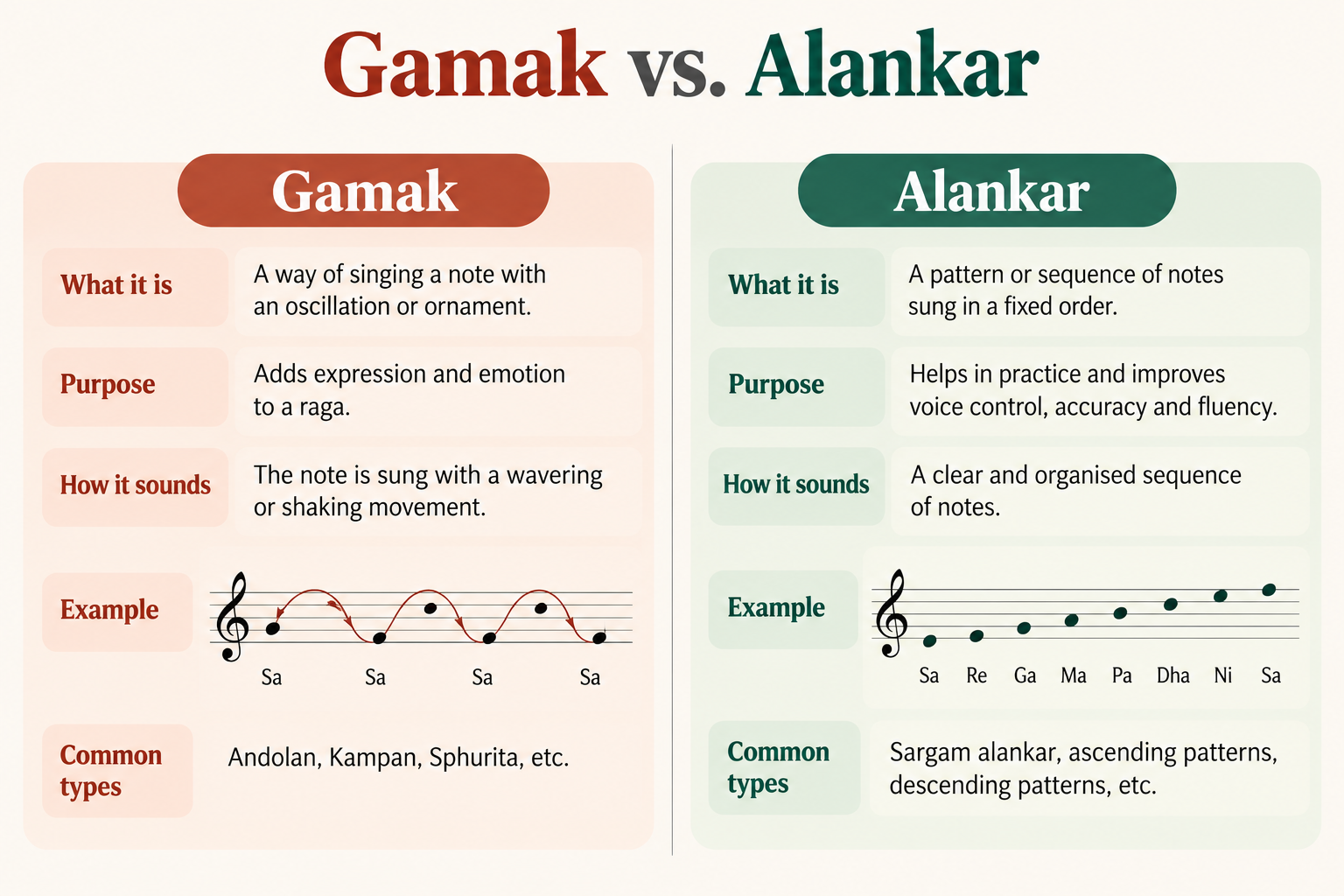
Comparison Matrix: Alankar vs. Gamak
Historical Taxonomy: The 15 Types of Gamak
The best archived documentation available on vocal rasa is found in none other than Sangeet Ratnaar by Sharangadev, of 13th century, where he identified 15 types of Gamaks, which are termed as “Panchadas Gamak” or 15 Gamaks. Here’s the Detailed breakdown :-
1. Tiripa: Very fast shimmering effect. According to some sources it lasts only 1/8th of a beat, creating a kind of "quivering" effect in the sound.
2. Sphurita: Very fast stress which begins from a lower adjacent note. It possesses "energy" in its sound, usually used for ascending parts.
3. Kampita: Very soft, tremor-like oscillation on a single note. It is rather expressive and usually used for creating certain emotional coloring.
4. Leena: Slow process of melting of one note into another with the help of oscillation so subtle that it merges into the target note.
5. Andolita: Slow, massive swing-like oscillation. This ornament is characteristic for Raga Darbari and needs great breath control in order to create a magnificent "swing" without losing the pitch.
6. Vali: Circular ornament creating a kind of "spiral" of sounds and touching several neighboring microtones at once.
7. Kurula: It is made by a “knotted” sound of glottal, forming a sharp and crisp Gamak, resembling the blossoming of a floral bud.
8. Tribhinna: A three-note Gamak executed in rapid succession, with no space between notes.
9. Ahata: It is an ‘articulated’ Melakarta Gamak, i.e., it begins with a
10. Ullasita: Fast melodic runs are played by gliding on the voice and ‘skipping’ or ‘sliding’ up to the target note.
11. Plavita: It’s bigger and lasts longer than a Kampita oscillation, up to a full beat or even longer.
12. Gumpita: Vibrating at the throat or chest center and often described as a "humming" or "swelling" of the note.
13.Mudrita: Produced by closing the mouth or narrowing the aperture of the lips to create a muted, delicate oscillation.
14.Namita: A subtle "bowing" of the note, where the pitch is lowered slightly in a graceful arc before returning.
15.Misrita: As the name suggests, this is a "mixed" Gamak, combining two or more of the above types into a complex, compound ornament.

Regional Contrast: Hindustani vs. Carnatic
While both systems respect the 15 styles, there is a difference in their usage. While the use of the Dasavida Gamaka system is more extensive in Carnatic Music, where it is hard to find a Swara that does not have ornaments. The other way round, in Hindustani Music, it depends on the context. A vocalist may hold the same note Shuddha for some seconds and then give out a heavy gamak.
Gamak in Hindi Musicology and Gharanas
The living tradition of North Indian gamaks lies within the purview of the Gharana system. In Hindi Musicology, the term गमक (Gamak) is invariably related to “Swar ka Kampan” i.e., vibration of note, and “Gambhirya” or gravity of sound. Strategic Importance of Gharanas Each Gharana has its own style for execution of Gamak:
•Dhrupad Gharanas: This is the oldest style, employing a (Vajra-sadrsya Prayog) i.e., "thunderbolt-like" use of gamak. Gamak here is deep and heavy and comes purely from diaphragm to produce vibration in the chest cavity needing great physical energy.
•Khayal (Gwalior, Agra, Patiala): These employ “Gamak ki Taan”. It is a speedy melodic phrase where every note is decorated by a sharp Gamak. Especially in Agra Gharana, the Gamak is noted for its masculine vigor and rhythmic push.
•Thumri/Light Classical: Here Gamak becomes delicate. Here, the importance is of Aahat Swar or "struck notes" as well as delicate micro-vibration technique for Shringar rasa or romantic expression.
The Practitioner’s Path: Vocal Mastery and Exercises
They should remember that Gamaks can’t be “pushed” but have to be “achieved” through the months of proper practice and training of your upper respiratory system and vocal cords. Discipline without technique results in a “quaking” voice, not a “singing” one.
Step-by-step Riyaz / Abhyas
Stage 1: Diaphragmatic Conditioning
Before even attempting to produce one oscillation, you need to establish a solid foundation of the Nabhikendra. Sit in the Sukhasana posture. Take a deep breath into your navel area rather than into your chest. Make sure you are producing a continuous sound of the Sa (tonic) for half a minute. If the sound trembles, then your foundation is not strong enough.
Step 2: Slower Gamak Alankar Patterns (Vilambit Laya)
This step is done in a 16 beat cycle (Teental).Exercise: Sa-Sa, Re-Re, Ga-Ga, Ma-Ma...
- Exercise: Sa-Sa, Re-Re, Ga-Ga, Ma-Ma...
- Technique: In the first pulse of the beat, sing the sharp note. In the second pulse of the beat, put pressure on the abdomen to create a single microtone.
- Effect: The pitch should return to its actual place (Swar Sthan) immediately following the vibration.
Stage 3: Speed and Precision (Madhya to Drut Laya)
Once the slow oscillation is clean, increase the tempo. The challenge is maintaining the "weight" as the speed increases.
- Drill: Sing a normal “Sa Re Ga Ma Pa Dha Ni Sa’ ” where every note has a triple-pulse Gamak.
- Guru's Tip: Use a Tanpura or Tanpura App on high volume. If your Gamak causes the dissonance with the Tanpura’s sound then your pitch center is not matching.
Navigating Challenges: Common Pitfalls to Avoid
The path to mastering Gamak is littered with technical errors. A seasoned pedagogue identifies three critical "diseases" of the voice:
- Throat Constriction (Gala-Phadna): This is the most dangerous error. Students often try to create the "shake" by tightening the muscles around the larynx. This produces a "bleating sheep" sound. Solution: Keep the throat as open as if you are yawning, and move the impulse to the navel.
- Pitch Distortion (Besura Singing): If the oscillation is too wide, you lose the foundational note. You must have "check-notes." Regularly stop the oscillation and hold the note flat to ensure you are still on the correct Swar Sthan. If you are out of tune, no amount of ornamentation will save the performance.
- Over-Ornamentation: A common mistake of the novice is to use Gamak on every note. This clutters the Raga. A mature artist knows when to use a smooth Meend (slide) or a delicate Khatka to provide contrast. Silence and stability are just as important as movement.
Conclusion: The Masterclass Checklist
Gamak serves as the means through which the vocalist can infuse Prana or "life" into the ancient, silent structures of Ragas. To understand and control the technique is akin to mastering the Prana or energy of sound itself. As a result of studying the 15 classical types of Gamak and training the diaphragm in Gamak exercises, one develops into Vidwan (scholar-artist).
Practitioner’s Checklist for Daily Riaz
- Breath Support: Am I using diaphragm (Nabhikendra) support, or singing from the throat?
- Raga Context: Does this Gamak belong in this particular Raga? (Should it be heavy in case of Darbari? Should it be delicate in the case of Bhairav?)
- Pitch Center: Am I returning to the correct Swar Sthan after every oscillation?
- Tempo Progression: Have I mastered Vilambit (slow) tempo before moving onto Drut (fast) Taans?
Learning Gamak is a lifelong journey. I recommend you practice these drills in your daily Riaz and listen to the recordings of the great masters of the Dhrupad and Khayal styles of vocal music. You will hear 15 types of Gamak in its essence.
Frequently Asked Questions
What is gamak in Indian music?
Gamak (or gamaka) is a vital form of musical ornamentation or embellishment used in both North (Hindustani) and South (Carnatic) Indian classical music
What is the difference between meend and gamak?
Meend is a smooth, continuous glide from one note to another, while gamak is a forceful, oscillating movement or shake around a note or set of notes.
What is the meaning of gamak in English?
In English, gamak (or gamaka) translates to musical ornamentation, embellishment, or a graceful shake/oscillation of a note in Indian classical music.
What are the 15 types of gamak?
In Indian classical music (particularly Carnatic music and historical treatises like Sharangadeva's Sangita Ratnakara), the 15 traditional types of gamaka (or panchadasha gamaka) are the essential ornamentations, shakes, and graceful curves applied to notes to bring a raga to life :-
The 15 Types of Gamakas
1. Tiripa / Tiripa
2. Sphurita
3. Kampita
4. Leena
5. Andolita
6. Vali (or Valeetha)
7. Tribhinna
8. Kurula
9. Ahata
10. Ullasita
11. Plavita
12. Humpita (or Humphita)
13. Mudrita
14. Namita
15. Misrita