Table of Contents
Quick Summary
Udit Narayan is one of India's most celebrated playback singers, known for defining the sound of Bollywood romance during the 1990s and early 2000s. From Papa Kehte Hain to Tujhe Dekha To, his songs remain timeless classics loved across generations.
There are voices you recognise instantly, and then there's Udit Narayan.
A single note from him and you know exactly where you are: a 90s theatre, a family living room with the television on, a car ride where someone's father has the radio tuned to Vividh Bharati. The best Udit Narayan songs don't just bring back memories; they bring back the specific texture of a period in Indian life that millions of people carry with them regardless of where they grew up or where they live now.
He won three National Film Awards for Best Male Playback Singer, singing for Shah Rukh Khan, Aamir Khan, Salman Khan, and Hrithik Roshan across the films that defined those actors' careers. It was his voice that shaped what romance sounded like in Hindi cinema for nearly two decades. And he did it with a vocal quality that combined technical precision with an emotional directness that very few singers in any tradition achieve.
This is the definitive guide to his greatest recordings, organised by era, with context on what makes each one significant and why they still hold up.
Well, who is Udit Narayan?
Born in Bhardaha, in the Saptari district of Nepal, Udit Narayan Jha trained in classical music before venturing into Hindi film playback singing in the early 1980s. His early recordings were promising, but his breakthrough came with a film that changed everything.
Qayamat Se Qayamat Tak, in 1988, introduced Aamir Khan to Indian cinema and introduced Udit Narayan’s voice to the mainstream. The combination was pretty decisive. From that point through the 2000s, he was arguably the defining male voice of Hindi film music, a record that holds when you actually count the films, the songs, and the consistency of quality across them.
Quick Facts About Udit Narayan
What made his voice distinctive wasn't just its warmth, though the warmth is real and immediately recognisable; it was the emotional specificity. Udit Narayan didn't sing romance in the generic way possible but with a particular quality of longing and tenderness that suited the storytelling style of 90s Hindi cinema so precisely that the two became inseparable in popular memory.
Best Udit Narayan Songs by Era
The Songs That Launched Everything: Late 1980s
Papa Kehte Hain (Qayamat Se Qayamat Tak, 1988)
The Udit Narayan song that started it all. Written by Majrooh Sultanpuri and composed by Anand-Milind, this piece captures a young man's awareness of his father's expectations alongside his own sense of where his life should go. The melody is deceptively simple, and Udit's rendering of it is emotionally nuanced in a way that strikes for what was essentially a debut-level mainstream recording.
It remains one of the most culturally embedded songs in Hindi film history, referenced across contexts from Father's Day articles to coming-of-age discussions, four decades after its release.
Dil Deewana (Maine Pyar Kiya, 1989)
Ram Laxman's composition and Udit Narayan's voice together produced what many consider the most romantic song of the late 1980s. The orchestration is lush in the way that the period demanded, but what makes the recording last is the lightness Udit brings to the vocal - it sounds genuinely joyful rather than performed.
Maine Pyar Kiya was Salman Khan's defining early film, and Dil Deewana was its musical heart.
Did You Know? - Udit Narayan has recorded songs in more than 30 Indian languages.
The Golden Decade: 1990s
This is where the Udit Narayan best songs list gets most crowded, and for good reason. The 1990s were the period of his deepest creative output, aligned with a generation of composers and directors who were making some of the most ambitious Hindi commercial cinema ever produced.
Pehla Nasha (Jo Jeeta Wohi Sikandar, 1992)
Composed by Jatin-Lalit and written by Majrooh Sultanpuri, this song about the first overwhelming experience of falling in love is one of the most precisely observed romantic recordings in Hindi film music. The tempo is slow, and the melody gives Udit room to breathe between phrases in a way that many faster compositions don't.
The song's arrangement creates a quality of suspended time, where everything else drops away except the feeling it’s emoting. That's harder to achieve than it sounds.
Jaadu Teri Nazar (Darr, 1993)
Shiv-Hari's composition from one of Shah Rukh Khan's earliest significant roles. The song belongs to one of cinema's most memorable obsessive love narratives, and Udit's vocals carry the correct emotional register, comprising intense without becoming threatening, vulnerable underneath the surface of devotion. It's a difficult emotional balance to strike in a film context, and the vocal performance is part of why the song works as well as it does.
Ek Ladki Ko Dekha (1942: A Love Story, 1994)
R.D. Burman's final complete film before his death in January 1994 produced some of his most beautiful compositions, and this is the one that most people return to. The melody is genuinely complex in its construction, as it seems simple on first listening and reveals more structure with each repeated hearing.
Udit Narayan's rendering is one of the finest vocal performances in his catalogue precisely because he doesn't overwork it. The restraint matches the melody's quiet beauty.
Tujhe Dekha To (Dilwale Dulhania Le Jayenge, 1995)
There are Udit Narayan top songs, and then there's Tujhe Dekha To, which sits in its own category. DDLJ became the longest-running Hindi film in cinematic history, and this song is the emotional anchor of its opening act. Jatin-Lalit's composition and Anand Bakshi's lyrics describe the experience of seeing someone and knowing immediately that your life has changed.
The song works on a technical level because of the way it builds from a quiet, almost spoken opening through to the full melodic statement of the chorus. It works on an emotional level because Udit Narayan doesn't try to oversell the moment; he trusts the melody.
Mere Sapno Ki Rani (Dilwale Dulhania Le Jayenge, 1995)
The other DDLJ anchor from Udit Narayan, and a completely different emotional register from Tujhe Dekha To. Where the first song is introverted and tender, this one is exuberant and forward-moving, the joy of pursuit rather than the quiet shock of recognition. The two songs together demonstrate his range within a single film.
Do Dil Mil Rahe Hain (Pardes, 1997)
Nadeem-Shravan's composition from a film that addressed the Indian diaspora experience directly, and the song's emotional content about two people finding each other across distance and difference, resonated particularly strongly with NRI audiences. It remains one of the most-played Udit Narayan songs at diaspora community events globally.
Ladki Badi Anjani Hai (Kuch Kuch Hota Hai, 1998)
Jatin-Lalit again, and a lighter tonal register than most of his major romantic recordings. The playfulness in this song shows a dimension of his vocal personality that the more earnest romantic pieces don't fully reveal. Kuch Kuch Hota Hai was a cultural phenomenon, and this song contributed directly to the film's widespread appeal.
The 2000s: Enduring Into a New Era
Taal Se Taal Mila (Taal, 1999)
A.R. Rahman's Taal soundtrack is one of the finest film music albums in any language from the 1990s, and this particular track showcases Udit Narayan working with a composer whose aesthetic is completely different from the Jatin-Lalit or Nadeem-Shravan sound that defined much of his earlier work. The rhythmic complexity of Rahman's composition demands a different kind of precision from the vocalist, and the recording proves that Udit's technique was genuinely adaptable.
Yun Hi Chala Chal Raahi (Swades, 2004)
His later career produced fewer songs of the same cultural weight as his 1990s peak, but this A.R. Rahman composition is the clear exception. Sung with Kailash Kher and Hariharan, the song demonstrates that his voice retained its essential quality well into the 2000s and that the right composition could bring out everything that made his earlier recordings so significant.
What Udit Narayan's Voice Actually Teaches Singers
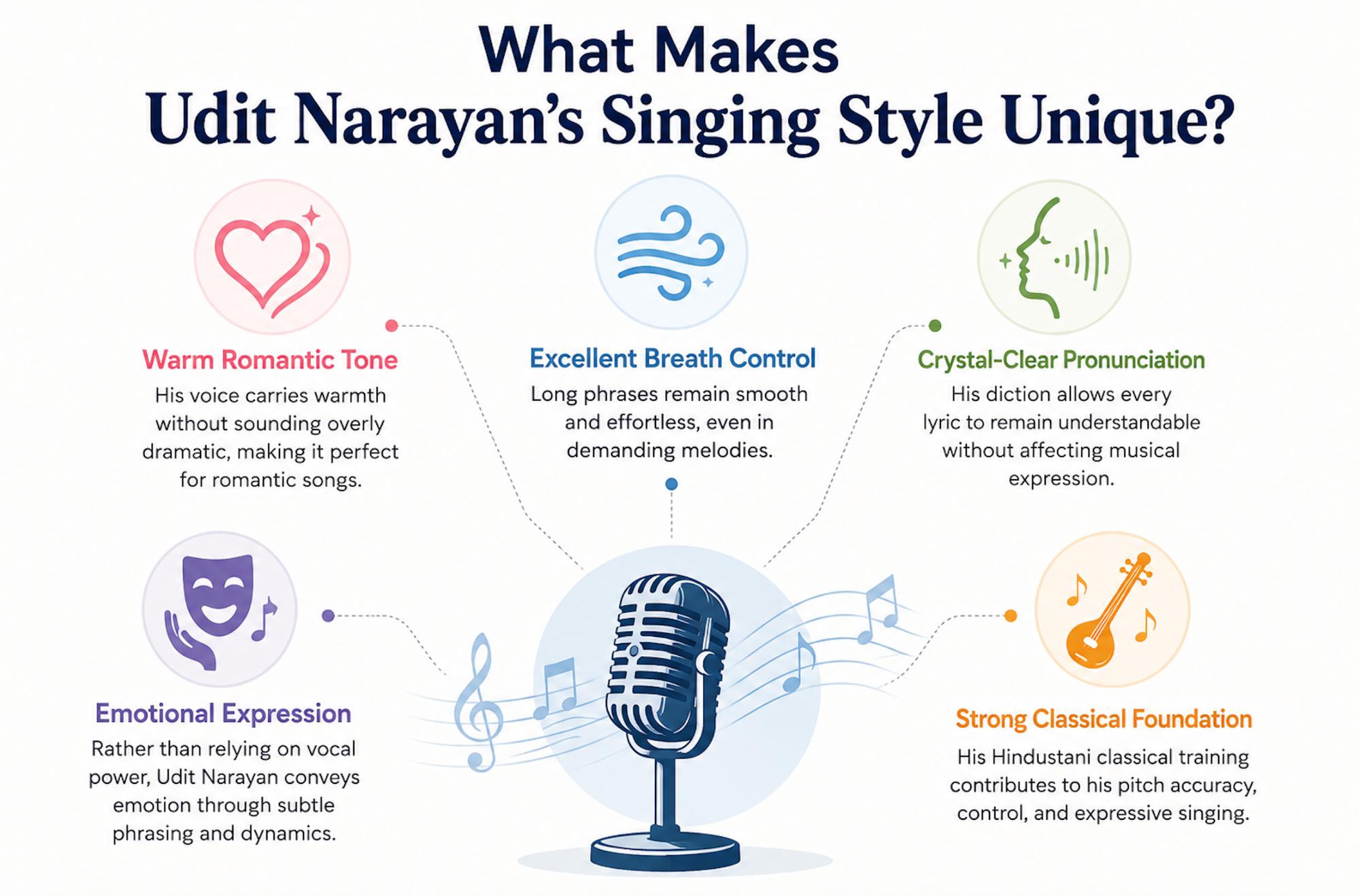
The best Udit Narayan songs are a curriculum in a specific approach to male romantic vocal expression in Hindi film music.
His breath control allowed him to sustain long phrases without audible effort, as the ease is deliberate, not accidental. The pitch accuracy of the singer is extremely high across a catalogue spanning decades and a wide variety of composers. But the quality most worth studying is his approach to emotional calibration. He rarely overdoes. The dramatic moments in his recordings are almost always achieved through melodic placement and phrasing rather than through volume or intensity of effort.
That restraint is a learned quality. It reflects deep classical training applied with intelligence to a popular form. For any singer learning Hindi film music, studying how Udit Narayan handles the space between notes and the weight of a phrase is as instructive as any technical exercise.
Learn to Sing Like the Legends at Spardha
Udit Narayan's vocal style sits at the intersection of Hindustani classical training and Hindi film music expression. Understanding how he phrases a thumri-influenced melody in a film song requires the same foundational work that any serious vocal student needs: breath support, raga awareness, and emotional precision.
At Spardha School of Music, our vocal instructors work across both classical and contemporary Hindi film music traditions. Whether your goal is to sing the songs that defined an era or to build the technical foundation that makes those songs achievable, our live, 1-on-1 online classes give you instruction that's genuinely matched to your voice and your goals.
Book a free trial class today at Spardha School of Music and start building the voice behind the songs you love.
Conclusion
The Udit Narayan song catalogue is one of the most consistent bodies of work in the history of Hindi film music. Across three decades and hundreds of recordings, his voice remained identifiable, emotionally honest, and technically reliable in a way that very few playback singers sustained. The songs on this list aren't just hits. They're documents of how a generation felt about love, longing, and the specific joy of being young in India during a particular stretch of cultural time.
Listen to them with attention rather than just as background. The technique underneath the feeling is worth studying.
Frequently Asked Questions
What is the most famous Udit Narayan song of all time?
Tujhe Dekha To from DDLJ (1995) and Papa Kehte Hain from QSQT (1988) are the two most consistently cited. Among critics and musicians, Ek Ladki Ko Dekha from 1942: A Love Story is frequently noted as his finest vocal performance technically.
How many National Film Awards has Udit Narayan won?
Three National Film Awards for Best Male Playback Singer, making him one of the most decorated male playback singers in Indian cinema.
Which composers brought out the best in Udit Narayan's voice?
Jatin-Lalit produced some of their finest recordings across DDLJ, Jo Jeeta Wohi Sikandar, and Kuch Kuch Hota Hai. R.D. Burman's final compositions in 1942: A Love Story also produced extraordinary results. A.R. Rahman's work with him on Taal demonstrated his versatility with more rhythmically complex material.
Did Udit Narayan have classical training?
Yes. His foundation in Hindustani classical music is audible in the way he handles melodic phrases, his breath control, and the precision of his pitch across a wide range. That classical grounding is one of the reasons his voice remained consistently strong across a very long career.
Are Udit Narayan's songs suitable for learning to sing?
His recordings are excellent material for intermediate to advanced vocal students specifically. The restraint in his style teaches the important lesson that emotional power in singing comes from placement and phrasing rather than volume. Beginners may find his more complex melodic lines challenging initially, but simpler pieces like Dil Deewana are accessible starting points.
What makes Udit Narayan different from other playback singers of his era?
His closest contemporaries, namely Kumar Sanu and Sonu Nigam, brought different qualities. Kumar Sanu was more openly emotive. Sonu Nigam was technically bolder. Udit Narayan's defining quality was a combination of warmth and restraint that made him the most appropriate vocal match for the romantic storytelling style that dominated 1990s Hindi cinema. He sounded like he meant it without overselling it.