Table of Contents
Quick Summary
Looking for the best online dance classes for yourself or your child? This guide helps you choose the right dance class online by comparing live and pre-recorded lessons, exploring popular styles like Bollywood, Bharatanatyam, Kathak, and Hip-Hop, and explaining what to look for in a great instructor. You'll also discover how Spardha School of Music's live 1-on-1 online dance classes offer personalized learning for kids and adults, flexible schedules, and expert guidance to help every student learn with confidence.
Finding a good dance class online is genuinely harder than it should be.
Not because the options aren't there - there are thousands of them. The problem is that most platforms are built around volume rather than quality. Pre-recorded videos are marketed as classes, group sessions with thirty students and one instructor who can't see anyone clearly, and beginner content repackaged at every level. Sorting through that to find something that actually teaches you to dance takes more time than most parents or working adults have.
This guide cuts through it. Here's what to look for in online dance classes at every age and level, which dance styles translate well to an online format, and how to evaluate a class before you commit to it.
Why Online Dance Classes Work Better Than People Expect
The most common objection to learning dance online is the space. The second most common is that a teacher can't really see you through a screen. Both concerns are reasonable. Neither is a dealbreaker.
On space: most styles taught at beginner and intermediate levels require roughly two metres by two metres of clear floor. That's a cleared living room corner, a bedroom with furniture pushed back, or any room with enough clearance to extend both arms. Classical styles like Bharatanatyam require more deliberate footwork practice, but the spatial requirement isn't dramatically different from what you'd need for a bedroom workout.
On visibility: this depends almost entirely on the format. A pre-recorded tutorial can't see you at all. A live, 1-on-1 class with a real instructor watching your movement in real time is a fundamentally different experience. The teacher sees your hand position, footwork, posture, and timing, and corrects them in the moment. The screen is a different medium from a studio mirror, but it works.
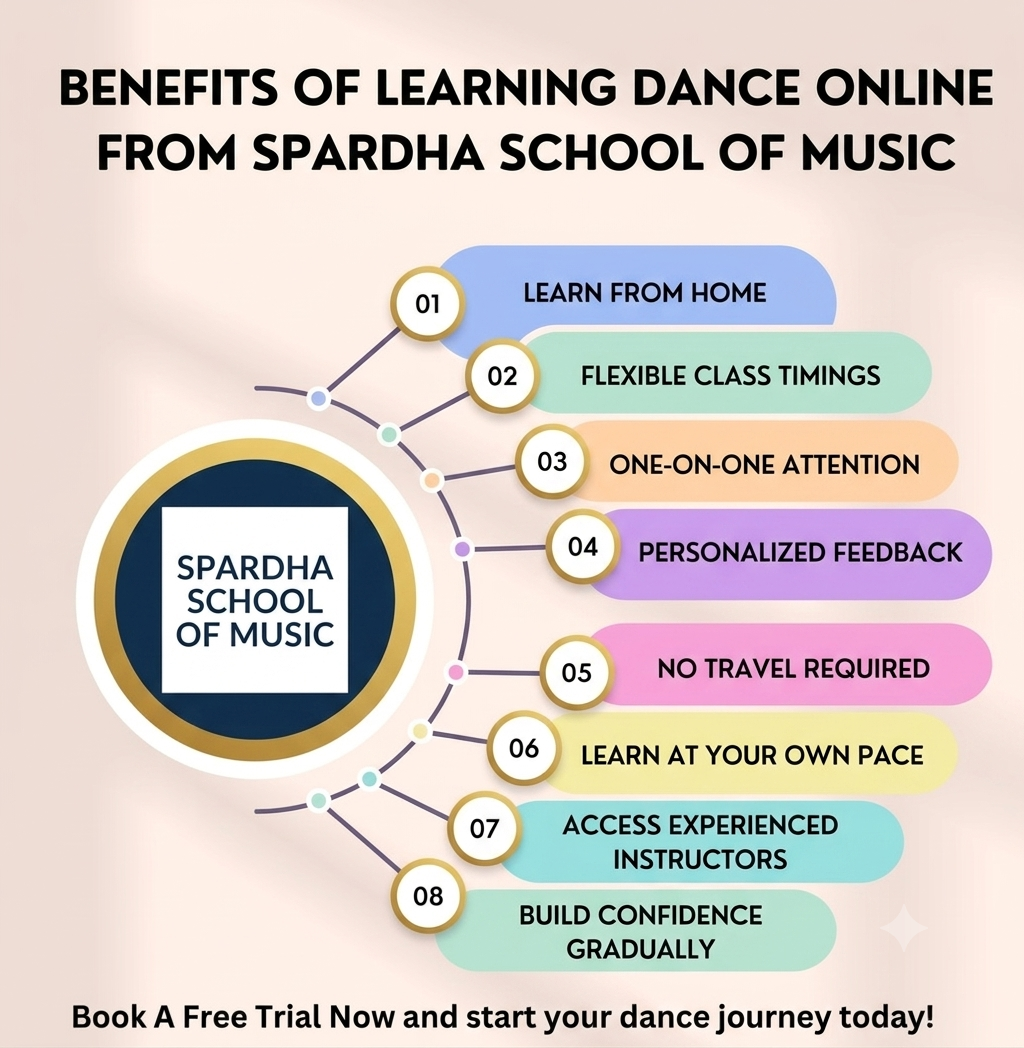
Benefits of Learning Dance Online From Spardha School of Music
- Learn from home
- Flexible class timings
- One-on-one attention
- Personalized feedback
- No travel required
- Learn at your own pace
- Access experienced instructors
- Build confidence gradually
Online Dance Classes for Kids: What to Look For
Online dance classes for kids are the fastest-growing segment of the dance education market, and for good reason. For parents managing school schedules, activity conflicts, and the logistics of getting a child to a physical studio on time, the flexibility of online classes is more than a convenience. It's often the difference between a child actually learning dance and the intention quietly fading.
But not every online format works for children, as the child’s age matters significantly when evaluating a class.
Ages 4 to 7
This age group needs maximum instructor attention and minimum screen complexity. A 1-on-1 format, or a very small group of no more than three or four students, is the only format that can be genuinely engaging for a young child while the teacher can catch errors before they become habits.
Classes for this age should be short, say 30 to 40 minutes maximum, and built around games, stories, and playful repetition rather than technical drilling. The goal at this stage isn't technique. It's building coordination, rhythm awareness, and a positive relationship with movement.
Best Dance Styles
- Bollywood
- Creative Movement
Focus Areas
- Coordination
- Rhythm
- Confidence
- Fun learning
Ages 8 to 12
By this age, children can sustain longer sessions, adapting genuine techniques. This is the age range where the choice of dance style starts to matter, because different styles build different foundational skills. Bollywood dance at this age builds rhythm and expressiveness. Bharatanatyam builds discipline, posture, and precision of footwork. Hip-hop builds spatial awareness and rhythmic improvisation.
The best online dance classes for kids in this range combine structured technical progression with enough variety to keep a child invested. A curriculum that plateaus quickly or repeats the same material without developing it will lose a child's interest faster than almost anything else.
Recommended Dance Styles
- Bollywood
- Bharatanatyam
- Kathak
- Hip-Hop
Skills Developed
- Musicality
- Technique
- Discipline
- Expression
Ages 13 to 16
Teenagers learning to dance online benefit from having a bit more autonomy over what they practice. At this age, motivation is closely tied to personal interest, like a teenager who chooses the style themselves will practise consistently in a way that one pushed into a parent-selected style often won't.
The instructor relationship matters more at this age as well. A teacher who gives real, honest feedback rather than blanket encouragement produces better results with teenagers, who can generally tell the difference between genuine assessment and automatic praise.
Best For
- Skill development
- Stage performances
- Exams
- Competitive dancing
Online Dance Classes for Adults: The Honest Version
Online dance classes for adults come with a specific psychological obstacle that children don't have: self-consciousness. Adults are acutely aware of looking awkward in a way that most children aren't, and that awareness inhibits the kind of relaxed, experimental movement that learning dance actually requires.
A good online instructor knows this and designs the learning environment around it. The 1-on-1 format helps enormously here. There's no group to feel awkward in front of, no comparison with more advanced students in the same room, and no audience for the inevitable mistakes that are part of learning anything physical.
Adults also have different goals from children, and those goals should shape which class format is the right fit.
Adults learning for fitness benefit from Bollywood dance, Zumba-influenced formats, or high-energy contemporary styles. The cardio benefit is real and documented, and the musical engagement makes the workout feel qualitatively different from a gym session.
Adults learning for a specific occasion - a wedding performance, a family event, a particular choreography they want to master, need short-term, goal-oriented instruction. A structured package focused on a single piece of choreography is more efficient than a broad, general curriculum.
Adults learning for the joy of it are the most rewarding students to teach and often the most consistent in practice. Hobbyist adult learners who come to dance without external pressure typically progress faster in expressiveness, if not always in technical speed, than students who are performing out of obligation.
The Key Point for Adults
The pace of an online class can be adjusted in a way that a physical studio class often can't. A live, 1-on-1 online class with a certified instructor moves at exactly your pace, which, for adult learners, is often the single biggest factor in whether they stick with it.
Which Dance Styles Work Best Online?
Not every style translates to a screen with equal effectiveness. Here's a practical breakdown.
- Bollywood dance translates excellently to an online format. Because the style emphasises upper-body expressiveness, facial expressions, and narrative gestures, it remains highly visible on camera. Furthermore, while the footwork patterns are important, they are generally easy to learn without an instructor physically present in the room.
- Bharatanatyam works exceptionally well in live online classes when instructors provide real-time feedback on posture, mudras, expressions, and footwork. If you’re looking for a recommended Bharatanatyam online class, choose a live, structured program with personalized guidance rather than pre-recorded lessons.
- Kathak is equally effective online, as instructors can guide footwork, chakkars, rhythm, and expressions through live sessions. If you’re searching for the best Kathak class in India, look for certified teachers, one-on-one feedback, and a structured curriculum that supports steady progress.
- Western contemporary and hip-hop are well-suited for online learning, particularly for intermediate and advanced students who already possess foundational body awareness. Beginners, however, benefit from in-person instruction early on, as spatial awareness and weight transfer are more difficult to communicate through a screen.
- Ballet is the style where online instruction has the most genuine limitations, specifically because of the detailed footwork and body alignment requirements that a teacher really needs to assess from multiple angles. It's learnable online, but requires more deliberate camera work and a particularly experienced online instructor.
How Spardha's Online Dance Classes Work
At Spardha School of Music, every dance class online is a live, 1-on-1 session with a certified instructor. There are no pre-recorded substitutes, no large groups where you disappear into the background, and no generic content sent to every student regardless of level.
Spardha offers online Bollywood, Bharatanatyam, and Kathak classes for both kids (aged 6 and above) and adults. Whether you’re looking to learn energetic Bollywood choreography, master the graceful movements of Bharatanatyam, or explore the rhythmic storytelling of Kathak, each course follows a structured curriculum designed for beginners as well as learners with prior experience.
Classes are scheduled around your availability, not a fixed studio timetable. The first session is free.
Book a free trial class today at Spardha School of Music and spend 30 minutes finding out what the right instructor and the right format actually feel like.
Conclusion
A high-quality online dance class is not merely a compromised version of an in-person session; for most students, it is actually the superior option. It offers greater scheduling flexibility, access to world-class instructors, and a truly personalised learning pace. For children, online dance classes thrive across all age groups when the format is right, specifically in small groups or one-on-one sessions where the instructor can actively see and correct the student. For adults, online classes work best when the barrier of self-consciousness is removed through private instruction rather than group formats.
The format is fine. The instructor is everything.
Frequently Asked Questions
What is the best dance class online for a child who has never danced before?
A 1-on-1 or very small group Bollywood dance class is usually the best starting point for children new to dance. The style is culturally familiar, the energy is high enough to keep younger children engaged, and the technical demands scale well from beginner to intermediate level.
How do I know if an online dance class is actually teaching technique or just entertainment?
The clearest signal is whether the instructor gives specific, corrective feedback during the class. Instructors who only encourage and never correct are prioritising the child's immediate comfort over their actual development. Good instruction includes both.
Can very young children, under six, take online dance classes?
Only if the format is right, which should be extremely short, highly playful, and ideally 1-on-1 for children under six, so the instructor can hold the child's attention and manage the session at his/her own pace. Group online classes for this age group very rarely work well.
Are online dance classes for adults as effective as in-person classes?
For most adults, yes. The 1-on-1 live format provides the same quality of instruction as an in-person class and removes the self-consciousness that group studio settings often create for adult learners. The main difference is that some physical adjustments an instructor might make in person need to be communicated verbally online.
What do I need at home to take an online dance class?
A cleared space of roughly two metres by two metres, a device with a working camera and microphone positioned to show your full body, a stable internet connection, and comfortable clothing you can move in. No specialist flooring or equipment is needed.
How long before I see real progress in an online dance class?
With consistent practice between sessions, most beginners notice clear improvement within six to eight weeks. The pace depends heavily on how much time is spent practising outside of class — a weekly lesson with no practice between sessions will progress considerably more slowly than the same lesson with 15 minutes of daily practice.
Does Spardha offer online dance classes for both kids and adults?
Yes. Spardha's Bollywood Dance course is open to students aged 6 and above, with an appropriate curriculum structured for different age groups. Adult hobbyists, working professionals, and senior learners are all welcome and taught at a pace that suits their starting point.