Table of Contents
Quick Summary
Lata Mangeshkar is regarded as one of India's greatest playback singers, with a career spanning more than seven decades. This guide explores the best Lata Mangeshkar songs, what makes her singing style unique, and why music students still study her recordings today. Whether you're a lifelong fan or someone learning Hindustani vocals, these songs offer valuable lessons in musical excellence.
Lata Mangeshkar is regarded as one of India’s greatest playback singers, with a career spanning over seven decades. Her songs continue to influence singers, musicians, and music students because of their technical excellence, emotional depth, and timeless appeal. This guide explores the best Lata Mangeshkar songs and what aspiring vocalists can learn from them.
This isn't a list of her most popular recordings, though several of those appear. It's a guide to the recordings that genuinely represent what she was capable of, what made her voice unlike any other, and why the best Lata Mangeshkar songs still stop people mid-conversation when they come on the radio.
Lata Mangeshkar at a Glance
What Made Lata Mangeshkar's Voice Singular
Before the list, it's worth being specific about technique, because "her voice was beautiful" doesn't explain anything.
Her pitch accuracy was extraordinary and remained so across a career spanning seven decades. Singers who perform into their sixties and seventies often lose the upper register or develop wobble in sustained notes. She didn't, or at least not to any degree that affected the emotional impact of her recordings.
Her breath control allowed her to carry phrases that other singers would have broken. The sustained notes in compositions like Lag Ja Gale or Ae Mere Watan Ke Logon require the kind of lung management that classical training builds, and her early training under her father, the classical singer and composer Deenanath Mangeshkar, gave her exactly that foundation.
But the quality that most singers who've studied her identify isn't technical; it's her approach to a lyric. She didn't just sing words; she found the emotional weight of each syllable and placed it precisely where the melody needed it to land. That's a different skill from having a beautiful voice, and it's the rarer one.
Key Characteristics of Lata Mangeshkar’s Singing
Best Lata Mangeshkar Songs: The Complete List by Era
The 1950s: Establishing the Voice
Aayega Aane Wala (Mahal, 1949)
Technically a late 1940s recording, but its cultural life belongs to the decade that followed.
Composed by Khemchand Prakash and written for a ghost story that became one of Hindi cinema's first genuine thriller successes, this is the song that announced to the industry that something genuinely new had arrived.
The melody circles back on itself in a way that creates unease without ever becoming discordant. Her vocal quality here is already fully formed.
Pyar Hua Iqrar Hua (Shree 420, 1955)
Shankar-Jaikishan's composition from Raj Kapoor's most beloved film, sung with Manna Dey.
The duet format shows a different dimension of her voice, the way she harmonises and responds rather than leading from the front.
The rain sequence in the film that accompanies this song became one of Indian cinema's iconic images, and the song is inseparable from it.
Jab Dil Hi Toot Gaya (Shaheed, 1948 / re-released in various forms)
Her rendering of grief in this song predates most of what would later define her career, and it demonstrates that the emotional range was always there, not something she developed over time. The restraint in the voice is as instructive as the feeling it carries.
The 1960s: The Peak
This decade produced the highest concentration of what most musicians and critics consider the finest of Lata Mangeshkar's best songs across her entire career.
Lag Ja Gale (Woh Kaun Thi, 1964)
A composition by Madan Mohan is most frequently cited when people want to point to a single recording that contains everything Lata Mangeshkar was capable of.
The melody is built in Raag Bhairavi, the raga of farewell and dawn, and the emotional weight of that raga's associations sits underneath every phrase.
What makes this recording specific rather than generally beautiful is the way she handles the space between phrases. The silence is as composed as the notes. That's not something you can teach someone who doesn't already understand music at a structural level.
Aap Ki Nazron Ne Samjha (Anpadh, 1962)
Another Madan Mohan composition, and the one that most clearly demonstrates how a melody can be shaped differently by a vocalist than by its written form.
The phrase endings here are given weight that the notation alone doesn't account for. She's interpreting, not performing.
Ae Mere Watan Ke Logon (Live Performance, 1963)
This is the most significant single vocal performance in the history of Indian popular music in terms of its historical impact. Written by Kavi Pradeep and composed by C. Ramchandra, the song was performed live in front of Prime Minister Jawaharlal Nehru at a Republic Day event following the 1962 Sino-Indian War. Nehru reportedly wept after listening to the song, which was broadcast on national radio and became the defining musical document of a national moment of grief and resilience.
It is neither a film song nor a love song. It sits in a different category from most of her recorded work, and that's precisely what makes it essential.
Tere Bina Zindagi Se Koi (Aandhi, 1975)
R.D. Burman's composition from a film with a politically fraught release history, this song has an intimacy that his more orchestrally ambitious compositions from the same period don't always achieve. She matches that intimacy note for note.
The 1970s: Range and Reinvention
Bada Natkhat Hai (Shree Krishna Janmashtami, 1971)
Her devotional recordings are sometimes treated as a separate category from her film work, but the quality of her voice in these pieces is inseparable from the classical training that also shaped her film singing. This recording in particular demonstrates the continuity between the two.
Tere Mere Milan Ki Ye Raina (Abhimaan, 1973)
S.D. Burman's composition is from a film about two singers whose professional relationship damages their marriage, a subject that resonates differently knowing the real-life dynamics of the Hindi film music industry.
Sung with Kishore Kumar, the duet is one of the finest in Hindi film music specifically because the two voices achieve genuine conversation rather than parallel performance.
Dil To Hai Dil (Muqaddar Ka Sikandar, 1978)
Kalyanji-Anandji's composition from a film dominated by Amitabh Bachchan's screen presence. Her voice occupies the emotional core of this recording in a way that demonstrates how a playback singer can define a character's inner life more completely than the visual performance does.
Kya Hua Tera Wada (Hum Kisise Kum Naheen, 1977)
An R.D. Burman composition that was sung by Mohammed Rafi, this track is one of the most emotionally complex Lata Mangeshkar hit songs from the decade, the lyrical content is about a broken promise, and the interplay between the two voices creates the impression of a genuine, painful conversation rather than a performance of one.
The 1980s and Beyond: The Voice That Stayed
Didi Tera Devar Deewana (Hum Aapke Hain Koun, 1994)
Her popular recordings in the later period of her career naturally attracted younger audiences who hadn't grown up with the 1960s and 1970s material.
This song from one of the highest-grossing Hindi films of the decade introduced her voice to a generation that knew her primarily as a cultural institution rather than as a working recording artist.
Sheesha Ho Ya Dil Ho (Aasha, 1980)
Composer: Laxmikant–Pyarelal
This soulful melody showcases Lata Mangeshkar’s ability to blend strength and vulnerability. Her controlled voice and expressive phrasing make every lyric resonate with listeners.
Music students can learn
- Breath management
- Dynamic control
- Emotional interpretation
Jiya Jale (Dil Se, 1998)
Composer: A.R. Rahman
Although music production styles had changed dramatically by the late 1990s, Lata Mangeshkar adapted beautifully to A.R. Rahman’s contemporary compositions. Her graceful vocals blend effortlessly with modern orchestration while retaining classical elegance.
Luka Chuppi (Rang De Basanti, 2006)
Composer: A.R. Rahman
One of the final masterpieces of her career, Luka Chuppi is a moving conversation between a mother and her son. The emotional honesty in Lata Mangeshkar’s voice demonstrates that great singing is about expression as much as technique.
Music students can learn
- Emotional storytelling
- Controlled phrasing
- Voice maturity
- Singing with simplicity
Dikhdo Ek Baar (Various Live Recordings)
Her semi-classical and classical concert recordings from the 1980s onward document a voice that retained its essential quality with remarkable consistency.
The thumri and bhajan recordings from this period are studied by classical vocal students today as examples of how Hindustani classical technique is maintained through a popular music career.
Lata Mangeshkar Ke Gaane: The Hindi-Language Dimension
For listeners who search for Lata Mangeshkar ke gaane (the Hindi-language phrase for her songs), the catalogue extends well beyond the film songs that dominate English-language discussions of her work. Her recordings of bhajans, ghazals, and semi-classical compositions in Hindi and regional languages represent an equally significant body of work that gets less attention in mainstream coverage.
Her recordings with Pandit Hridaynath Mangeshkar, her younger brother and one of the finest composers working in the classical tradition, produced some of the most structurally sophisticated recordings in her catalogue. These pieces are less commercially prominent but are deeply valued by classical music scholars and students.
Why These Songs Still Matter for Music Students
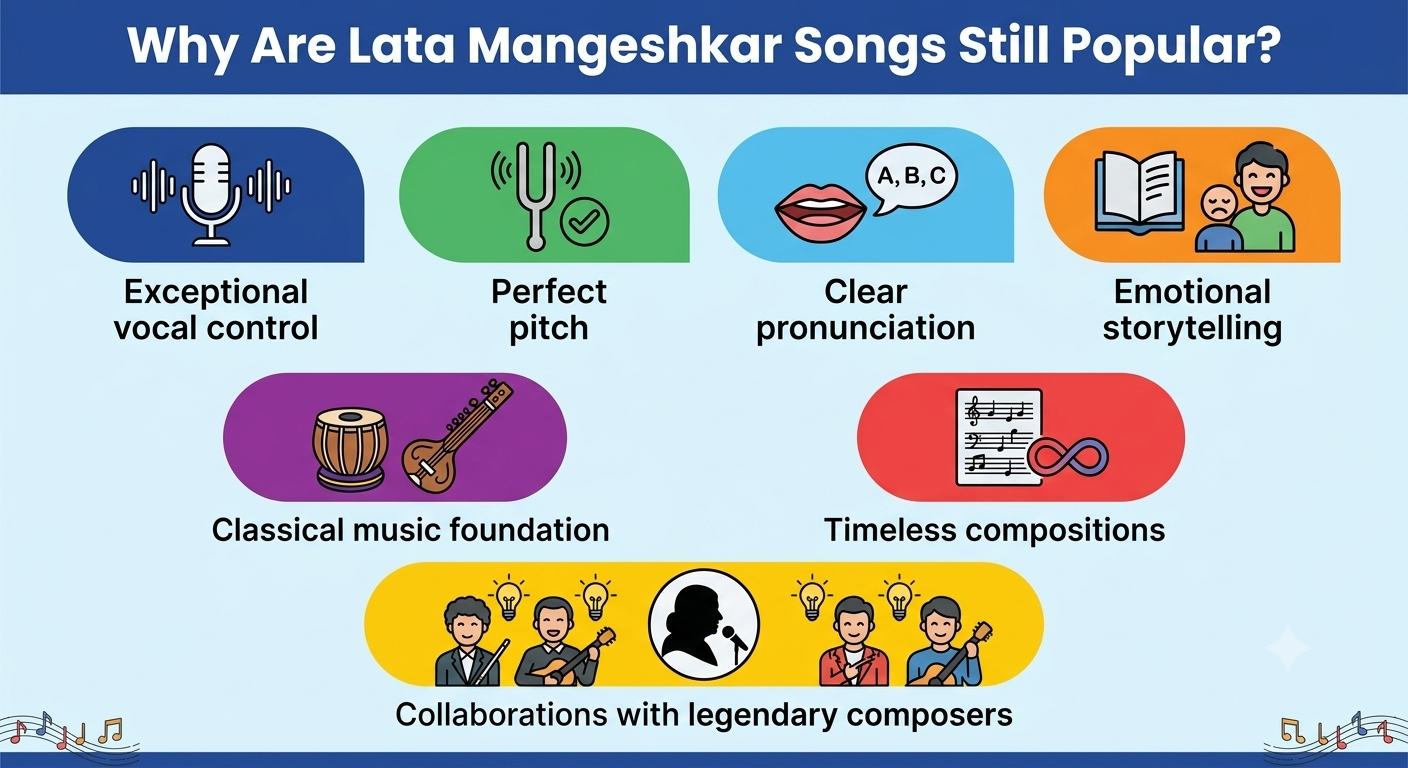
Any serious student of Indian classical or semi-classical singing should spend deliberate time with Lata Mangeshkar recordings, not as background listening, but as study material.
Perfect Pitch: Her note accuracy remained remarkably consistent throughout her career, making her recordings an excellent reference for developing pitch control.
Breath Control: Long musical phrases flow naturally without audible breaks, demonstrating excellent breathing techniques.
Clear Pronunciation: Every word is easy to understand, showing how diction enhances musical expression.
Emotional Interpretation: Rather than relying on dramatic vocal effects, she expressed emotions through subtle phrasing and dynamics.
Classical Influence: Even her film songs reflect the discipline of Hindustani classical music, making them valuable study material for aspiring vocalists.
Learn Hindustani Vocals at Spardha School of Music
Many aspiring singers dream of performing timeless melodies like Lag Ja Gale, Aap Ki Nazron Ne Samjha, or Ae Mere Watan Ke Logon. While these songs require advanced vocal control, every singer begins by building strong fundamentals.
At Spardha School of Music, students learn through live one-on-one online Hindustani vocal classes designed for beginners, intermediate learners, and advanced singers. Lessons focus on developing the same foundational skills heard in the performances of legendary artists like Lata Mangeshkar.
Students benefit from:
- Live one-on-one online classes
- Experienced Hindustani vocal instructors
- Structured curriculum from beginner to advanced levels
- Training in voice culture, breath control, pitch accuracy, and music theory
- Personalized lesson plans based on individual learning goals
- Flexible scheduling for children, adults, and working professionals
- Performance opportunities, workshops, and regular student recitals
Book a free trial class today at Spardha School of Music and start building the voice behind the songs that have lasted.
Conclusion
Lata Mangeshkar songs aren't just recordings. They're a seven-decade document of what Indian music was capable of at its highest level of expression. From the 1940s recordings that announced a singular voice to the devotional compositions and film songs of her later career, the consistency of quality across that span is something that no other figure in Indian popular music has matched.
The Lata Mangeshkar hit songs on this list are starting points, and not endpoints. Each one rewards repeated, attentive listening and teaches something specific about what a trained, intelligent vocalist does with a melody that a less developed singer would leave unexplored.
Frequently Asked Questions
Which is the most famous Lata Mangeshkar song?
Ae Mere Watan Ke Logon has the strongest claim to this title in terms of historical significance and cultural impact. Lag Ja Gale is the most consistently cited among musicians and critics as her finest vocal recording. Among her own catalogue, these two songs and Aayega Aane Wala are the most frequently referenced in serious discussions of her legacy.
How many songs did Lata Mangeshkar record in her lifetime?
The figure most commonly cited is around 30,000 songs across over thirty languages, though this number has been disputed. The Guinness World Record she held for "most recorded artist" was later removed from the record books amid verification questions. What's not disputed is that her recorded output across languages, decades, and genres is unparalleled in Indian music history.
What is Lata Mangeshkar ke gana and why do people search for it?
"Lata Mangeshkar ke gane" is simply Hindi for "Lata Mangeshkar's songs." Hindi-speaking audiences searching in their native language use this phrase to find playlists, recordings, and information about her work. The search volume reflects how deeply embedded her music is across generations of listeners who engage with her primarily in Hindi rather than in English.
Which composers worked best with Lata Mangeshkar?
Madan Mohan is most frequently cited by musicians as the composer who most fully understood and used her voice. Their collaborations produced some of the finest recordings in Hindi film music history. S.D. Burman, Shankar-Jaikishan, Laxmikant-Pyarelal, and R.D. Burman all produced extraordinary work with her across different decades and different aesthetic frameworks.
Can beginners learn to sing Lata Mangeshkar songs?
Some of her simpler melodies are accessible to intermediate beginners with basic pitch control and some breath training. However, the recordings that represent her genuine artistry are intermediate-to-advanced material. A beginner who tries Lag Ja Gale without adequate foundational training will learn the notes and miss everything that makes the song significant. The more productive approach for beginners is to listen analytically while building the foundational technique that will eventually make those recordings learnable.
Did Lata Mangeshkar have classical training?
Yes. She trained under her father, Deenanath Mangeshkar, a classical singer and theatre actor, from early childhood. She later studied under Aman Ali Khan of the Bhendi Bazaar gharana. That classical foundation is audible in her breath management, her intonation, and her approach to melodic phrasing throughout her career, regardless of whether she was recording a film song, a bhajan, or a ghazal.