

Table of Contents
Have you ever started a playlist to study but suddenly started feeling that time is passing slowly and you aren't able to focus? Well, these situations are normal as people's emotions are affected in different ways. But when it comes to calming the mind, improving concentration, or diverting mood, music always helps and heals.
If you’re the one who is looking for the best background music for studying and improving focus, this blog is definitely for you. Here we will talk about various types of music that work best as background music for studying, the science behind them, and also give you some great practical tips so you can use music to help get the most out of your study time.
Learn about Indian Folk Musicians and their contribution to Indian Culture.

Why Music Sometimes Helps And Sometimes Hurts
Music affects your mood, excitement level, and attention. If the music is in tune with your mood and also a personal favorite, then it can help with anxiety and provide a peaceful environment. But if the music is highly distractive, it can also impact your mood, and distract you from doing your work. In a nutshell, context and choice of music are two different things.
Match Music to the Task: A Quick Rule of Thumb
- Creative brainstorming / ideation: Slightly stimulating, melodic tracks that lift mood (think upbeat classical or mellow electronic).
- Reading & Deep Comprehension: Unobtrusive, predictable instrumental music or ambient soundscapes.
- Repetitive or Mechanical Tasks: Rhythmic, groove-based tracks can increase speed and sustain attention.
- Memorisation: Calm, low-arousal music that doesn’t demand linguistic processing.
Best genres & sound types for focused studying
Let’s break down the most effective genres, and list specific music you can start using today.
1. Instrumental Classical Music
Classical music is one of the most recommended choices for studying music. It offers structured harmony and stimulation to the brain without overwhelming it.
Composers such as Johann Sebastian Bach, Wolfgang Amadeus Mozart, and Ludwig van Beethoven created instrumental works that are rhythmically balanced and intellectually engaging.
Classical compositions worth considering include:
- Mozart - Sonata for Two Pianos in D Major (K.448)
- Bach - Air on the G string
- Beethoven - Moonlight Sonata (1st movement)
- Frédéric Chopin - Nocturne Op. 9 No. 2
Classical music excels at:
- Reading comprehension
- Analytical thinking
- Writing assignments
- Solving math problems
2. Lo-Fi/Chillhop
In recent years, lo-fi has become almost synonymous with study culture. With soft, mellow rhythms and nostalgic feelings, lo-fi generally provides a calm and positive studying environment. Nowadays, this type of background music is popular due to social media platforms such as YouTube, TikTok, and streaming services, where long lo-fi playlists and live streams have attracted millions of listeners who use them while studying, working, or relaxing.
Lo-fi helps with:
- Minimising verbal distractions
- Providing a sense of emotion
- Helping maintain concentration for long periods of time.
If you are a fan of contemporary sounds and are looking for a type of background music that will help you concentrate, then consider lo-fi as your best option.
3. Bollywood Background Music for Focus
For many students, silence can make them feel uncomfortable. Thus, many learners prefer listening to Bollywood music while studying. But lyrical Bollywood songs can distract comprehension.
What’s the solution? Bollywood background music, instrumental versions and film scores. They are ideal when you prefer culturally familiar melodies, you want subtle emotional motivation, or you are doing light to moderate tasks
Instrumental scores from composers like A.R. Rahman, Shankar Mahadevan, and Amit Trivedi. These composers have created rich instrumental arrangements that work beautifully as background music.
Check out some legendary Indian Music Directors and their hits in the blog below

Recommended Bollywood Instrumentals are:
- Instrumental version of Kun Faya Kun
- Background score from Rockstar
- Instrumental theme from Taare Zameen Par
- Instrumental tracks from Lagaan
4. Ambient Music
Ambient Music is vocal & instrumental sounds without clear rhythms used as a form of soothing environment.
The inventor of ambient sound, Brian Eno, produced an album entitled Music for Airports, made specifically for background environmental sound.
Ambient Music is the best option for you to:
- Have no distractions when working on something
- Be creative & write
- Get into a flow state
- Prefer a more subtle texture as opposed to melody
- It lies in the background & does not compete for your attention.
5. Meditation Background Music
Sometimes one may start feeling very anxious while studying, trying to meditate with music is one way you can have more control over your mind.
Most meditation music has:
- Soft piano
- Gentle flute
- Singing bowls
- Slow instrument drones
- Nature sounds: Rain, water, forest
There are some artists such as Deva Premal, who create sounds for the purpose of meditating and inducing a deep level of calmness in the listener.
Indeed, meditative music is very helpful to listen to prior to starting a study session, during study time or when your nerves are high during preparation for an exam. It will help to lower your cortisol levels and shift your brain into a more focused state.
6. Instrumental Film Scores
Instrumental movie soundtracks combine orchestral depth with emotional energy. Composers like Hans Zimmer and Ludovico Einaudi have produced instrumental tracks that inspire without distracting. Film scores are mostly considered when you want motivation to work on a creative project or emotional drive without lyrics.
What to Avoid When Choosing Background Music
- Even the best background music can become distracting if not selected thoughtfully. One major mistake is playing music at a high volume. When the sound dominates your environment, it shifts from background calming support to distraction, increasing your distraction level.
- Another issue is when songs change drastically in tempo or intensity. Sudden musical transitions prevent your mental rhythm and break concentration. Similarly, tracks with heavy lyrics form obstacles in reading and writing processes, making comprehension more difficult.
- Lastly, emotionally triggering songs, especially personal favourites can shift your focus toward memories and feelings rather than your task. Thus, effective background music should enhance focus subtly, not demand attention.
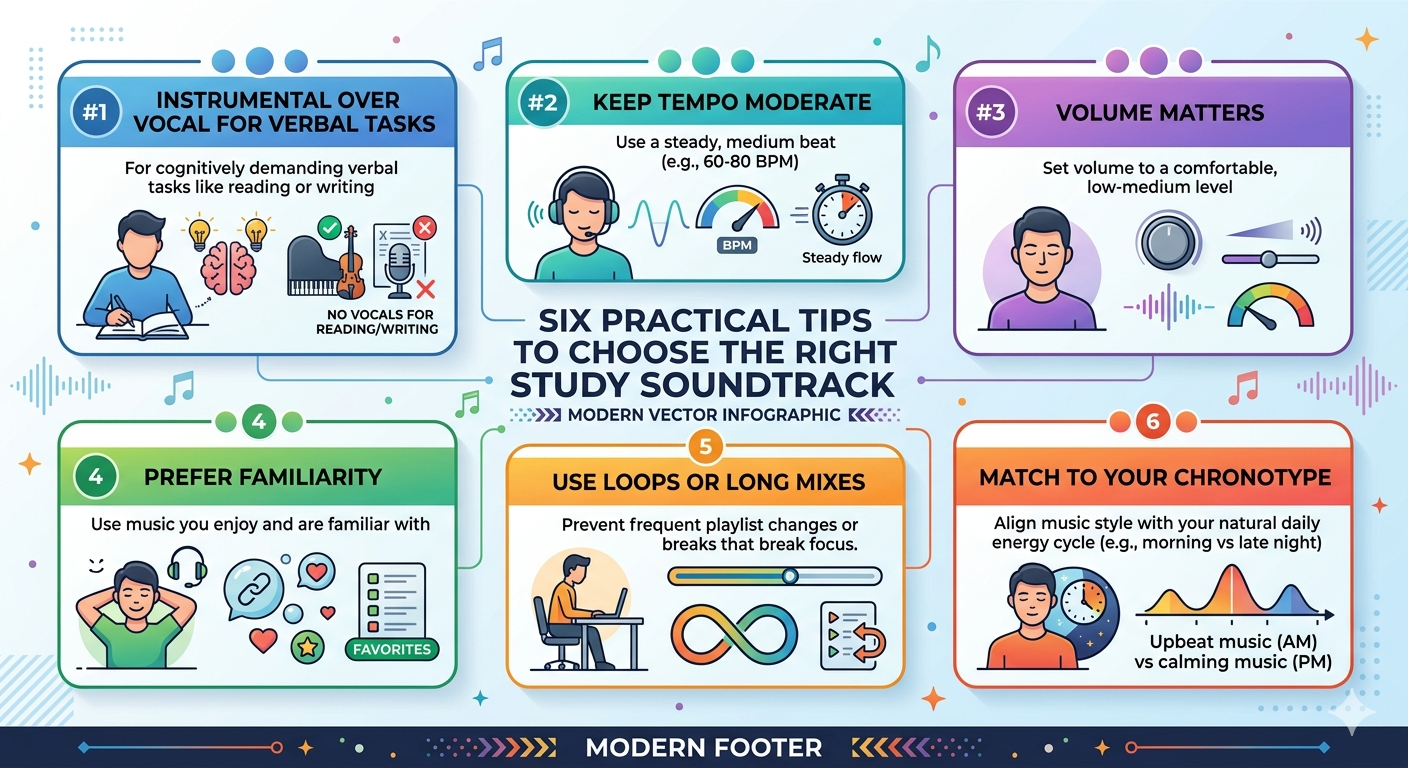
Six Practical Tips to Choose the Right Study Soundtrack
- Instrumental over vocal for cognitively demanding verbal tasks: lyrics compete with language processing, so choose instrumental tracks for reading or writing.
- Keep tempo moderate: 60–90 BPM is often comfortable for focus; faster tempos increase arousal and may be helpful for repetitive tasks.
- Volume matters: Keep music low, loud music increases cognitive load and reduces retention.
- Prefer familiarity: Familiar tracks are less distracting than new, attention-grabbing music; choose playlists you know.
- Use loops or long mixes: Avoid playlists with too high pitches; continuous mixes like lo-fi streams and ambient albums help to maintain focus.
- Match to your chronotype: If you’re a morning person, may prefer energetic instrumental; night owls often do best with calm ambient or lo-fi.
Personal Differences: What the Research Says
Everyone has their own choice, and what works beautifully for one person may not work at all for someone else. Some individuals benefit from studying in complete silence, while others find that soft background music helps them concentrate better. Certain learners may respond positively to classical compositions, whereas others feel more productive with lo-fi beats or meditation background music.
The key is to understand your personal learning style and experiment with different approaches. Pay attention to how your mind responds, whether your focus improves, stays consistent, or declines. There is no universal formula. The most effective study environment is the one that supports your concentration, comfort, and long-term productivity.
Quick Evidence Snapshot
- Preferred background music has been shown to enhance task-focused attention on sustained but low-demand tasks.
- The classic “Mozart effect” produced short-lived spatial reasoning gains; the broader claim that classical music boosts IQ is not supported as a general rule.
- Binaural-beat research shows physiological brainwave effects, but behavioral improvements are inconsistent, promising, not definitive.
- Groove-based instrumental “workflow” music was linked to modest speed and mood improvements in recent experiments.
- Lo-fi streams are widely used and small studies indicate they can support concentration for students, though large-scale controlled evidence is still developing.
A Simple 3-step Experiment To Find Your Perfect Study Sound
- Pick three playlists (calm classical, lo-fi, and ambient/noise).
- Do three similar study sessions (45–60 minutes each) with only one playlist per session.
- Choose the playlist that gives the best mix of performance and comfortable mood, and tweak volume/tempo from there.
Final Thoughts
Music is a powerful tool but not a universal fix. The right approach is experimental: start with instrumental, familiar, low-variation music; match the music to your activities, and adjust volume and tempo mindfully.
It can be Bollywood background music, instrumental classical music, lo, fi beats, or meditation background music, and the right sound will change your study sessions drastically.
Explore some best traditional Indian Musical Instruments in the blog below!

Want To Learn Music to Improve Your Focus?
Do you know learning music itself can be healing? Yes, it has been observed that regular music practice can help students' brains to be more attentive and focused. So, if you’re looking for a long-time mental peace, improve concentration through music, trust Spardha School of Music. The institution offers various online classes designed for beginners as well as advanced learners, helping students develop musical skills while enhancing creativity, discipline, and overall cognitive focus.
Frequently Asked Questions
1. What type of music is best to study with?
Generally, the most favourable study background music is that which is instrumental and not too distracting. Music genres like classical, lo-fi, ambient, and soft with film, instrumental scores are excellent choices as they prevent the brain from being overloaded with information. For activities such as reading, writing, and memorization, music without words is the most appropriate.
2. Can music in the background really help focus?
Indeed, background music can increase focus provided that the song you choose is apt. Instrumental pieces with a consistent rhythm are good for keeping one's attention and they can also isolate a person from environmental distractions. On the other hand, songs with lyrics or a very energetic type of music might make it more difficult to understand and remember, especially when performing complicated tasks.
3. Is Bollywood background music good for studying?
Bollywood background music is a good choice if it consists of only the instruments. Background scores and instrumental versions of Bollywood songs are better than songs with words. Instrumentals from composers such as A.R. Rahman or Amit Trivedi usually contain the emotional depth without distracting lyrics and they can be used for light to moderate study sessions.
4. Can meditation background music help during exam preparation?
Yes, meditation background music can reduce stress and improve mental clarity. Soft instrumental sounds, natural ambience, and calming piano music help regulate breathing and calm the nervous system. This is especially helpful before starting study sessions or during revision periods.
5. Is it better to study in silence or with background music?
It depends on the individual and the task. Some people perform better in silence during high-concentration work. Others benefit from soft background music that blocks external noise. The best approach is to experiment with both methods and observe your productivity levels.
6. What type of background music should I avoid while studying?
Avoid loud music, songs with strong lyrics, fast EDM, or emotionally intense tracks. If you find yourself singing along or focusing more on the music than your work, it is no longer effective background music.