Table of Contents
Quick Summary
Durga Puja songs in Bengali aren't just festival music. They're a seasonal language. Every year, from the first notes of Mahalaya to the final Bijaya Dashami farewell, specific songs mark specific emotional moments across the five days of celebration. The tradition spans from the 1931 Mahishasura Mardini radio broadcast. It is still played before dawn on Mahalaya every single year, through the golden-era recordings of Hemanta Mukherjee, Shyamal Mitra, and Manna Dey, to contemporary releases that arrive each Puja season like scheduled emotions. The Durga Puja gaan catalogue is one of the richest seasonal music traditions in any culture.
If you've grown up in Bengal, the Puja isn't just something you see. It's something you hear coming.
Weeks before the pandals go up, a distinct autumn air settles in; that crispness Bengalis call sharadiya akash, the October sky. Right on cue, the first strains of a Durga Puja song begin drifting from radios, television screens, and local markets. By Mahalaya, the sonic environment has shifted entirely - the city sounds and feels different.
That's not an accident. The Bengali Durga Puja gaan tradition spans nearly a century in its modern form. Over decades, it built a body of music deeply woven into collective memory. Certain tracks don't just evoke the memories of Puja because they are Puja, making the two entirely inseparable.
This is the list those songs deserve.
Top 15 Bengali Durga Puja Songs
1. Mahishasura Mardini by Birendra Krishna Bhadra (1931)
The foundation of everything. This is technically not a single song but a complete composition of nearly ninety minutes; the Mahishasura Mardini programme has been broadcast on All India Radio before dawn on every Mahalaya since 1931. Scripted by Bani Kumar, the music was composed by Pankaj Kumar Mullick, with narration and recitation by the legendary Birendra Krishna Bhadra.
Birendra Krishna Bhadra’s iconic recitation of the Chandipath anchors this legendary broadcast. Alongside him, timeless voices like Sandhya Mukherjee, Shyamal Mitra, Dwijen Mukherjee, Manabendra Mukhopadhyay, and Arati Mukherjee deliver the devotional score. For millions of Bengalis, this exact sound marks the official dawn of Mahalaya and the start of Puja. No other program in Indian radio history holds such an unbroken, decades-long bond with its listeners.
It opens with the conch sound and Ya Chandi and closes with Shanti Dile Bhori. In between, the world changes slightly.
2. Jago Durga Jago Dashapraharanadharini
The most immediately recognisable Durga Puja song from within the Mahishasura Mardini programme. Durga’s invocation as the ten-armed goddess has been hummed by generations of Bengali children who woke before dawn on Mahalaya to listen with their respective families. Moreover, even the ones who don't follow the full programme know this opening invocation.
3. Dugga Elo by Monali Thakur
A celebratory agamani composition that captures the relief and joy that accompany Durga's arrival. The title announces that Dugga has come, which captures the festive energy of Shashthi morning. Dugga Elo is among the most broadly known Bengali Durga Puja songs list entries for families with children.
4. Dhak Baja Kashor Baja by Shreya Ghoshal
The contemporary Bengali Durga Puja song that has become definitional for the festival's modern sound. Shreya Ghoshal's vocals bring the celebratory energy of the dhak, i.e. the drum central to Bengali Puja, into a composition that crosses generations with unusual ease. It plays everywhere during the Puja days, be it in pandals or restaurants or cars. This Shreya Ghoshal track has earned that ubiquity rather than simply achieved it through marketing.
5. Uma Ase Notun Saje by Ankita Bhattacharya
An agamani composition featuring Ankita’s vocals celebrating Uma's arrival dressed anew, this song carries the specific quality of a daughter returning home. Well, it’s not just the goddess, but the familiar figure of the child who left for her in-laws and comes back. Unlike grander devotional pieces, its emotional warmth feels intimate and maternal. That grounded, domestic comfort is precisely why it lingers with listeners long after the music stops.
6. Durge Durge Durgatinashini by Asha Bhosle
A devotional invocation that appears consistently in the Durga Puja gaan repertoire across decades and generations of singers, thanks to Asha Bhosle. The repetition of the name itself - Durge, the fortress, the one who removes suffering has a mantra quality that makes it appropriate for the aarti moments of Saptami through Navami.
7. Ogo Amar Agamani by Sipra Basu
One of the most beloved agamani songs in the Bengali tradition. Sipra Basu's recording remains the standard reference for this track. The song captures a mother's sheer joy at Durga's return, showcasing the agamani sub-genre at its most accessible and warm. This sits near the top of any honest Bengali Durga Puja songs list for emotional resonance.
8. Ay Re Chute Ay Pujor Gondho Eshe Geche
The standard children's song of Puja. The smell of Puja has arrived, i.e. pujor gondho, and this composition captures the excitement of the youngest generation for whom the festival is primarily about new clothes, sweets, and the inexplicable electricity of those five days. Beloved across generations precisely because every adult who hears it remembers being the child running toward the pandal.
9. Shishire Shishire Sharodo Akashe by Subhamita Banerjee
A song about the October sky itself, the sharpness of the autumn air that signals Puja is approaching. The seasonal specificity of Durga Puja gaan is one of its most distinctive qualities, and this composition is the clearest example. Subhamita Banerjee turns a simple reflection on the weather into a profound expression of inner emotion. That seamless shift from the physical world to the human heart is the hallmark of truly great poetry.
10. O Menoka O Menoka by The Nandy Sisters
A song from Menaka's perspective, who is Durga's mother, the one who waits for her daughter to return and then watches her leave again on Dashami. The emotional complexity here is extraordinary: the same love that makes the arrival joyful makes the departure devastating. Among Bengali Durga Puja song compositions that address the bijaya register, this one by Antara and Ankita Nandy is the most directly human in its emotional subject.
11. Dugga Dugga by Sunidhi Chauhan
A contemporary crossover composition that has become widely played during the Puja season. Sunidhi Chauhan's evergreen vocal energy fits the celebratory pandal atmosphere perfectly. The track offers an easy entry point for younger listeners, securing its spot on modern Durga Puja playlists for an audience less familiar with classic agamani repertoire.
12. Mrinmoyee Tumi Mago by Debashri Banerjee
A devotional composition that addresses the clay goddess directly; Mrinmoyee means she who is made of clay, with a tenderness that acknowledges both the divinity of the idol and its temporary nature. The theological awareness in the lyrics gives this Durga Puja song a depth that purely celebratory compositions don't attempt.
13. Bolo Dugga Maiki
A festive street-level composition, the sonic equivalent of the crowd outside the pandal on Ashtami night. The call and response implied by the title, ‘Bolo Dugga Ma ki, jai’, is essentially the festival's most communal expression, the moment when strangers in the street feel connected by a shared devotion and a shared joy. This Bengali Durga Puja song captures that specific energy better than most.
14. Elo Je Maa by Abhijeet and Shreya Ghoshal
A contemporary agamani composition by Jeet Gannguli from Bengali superstar Dev’s film Challenge 2, whose warm production and accessible melody made it a natural Puja season release. Dev's film appearances alongside Puja-season music releases represent a specific tradition in the Bengali entertainment calendar, and this song fits comfortably within the Bengali Durga Puja songs list of the contemporary era.
15. Asche Bochor Abar Hobe
The default Bijaya song. The phrase itself, next year, again, is the emotional essence of Dashami: the farewell that contains the promise of return, the grief that is already coloured by anticipation. The Durga Puja cycle is built around this specific combination of loss and faith, and the best bijaya compositions in the Durga Puja gaan tradition hold both without resolving either. This one holds both.
The Three Musical Seasons of Durga Puja
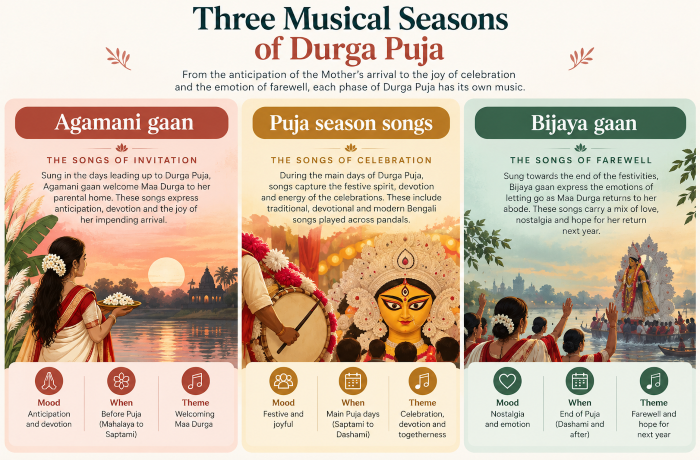
Before the songs, let’s talk about the structure. The Bengali Durga Puja songs list isn't a flat collection; it breaks into distinct emotional phases that mirror the festival's own arc.
- Agamani gaan: They are the songs of arrival, played in the days leading to Mahalaya and throughout Shashthi and Saptami. The celebration is about the goddess coming home, i.e. Durga returns to her maternal home on earth, bringing her children with her.
- Puja season songs: These are the celebratory middle songs that reflect the sounds of the pandal-hopping days, the dhak-accompanied evenings, and the collective joy of Ashtami and Navami.
- Bijaya gaan: Capturing the quiet weight of Bijoya, these tracks reflect the profound emotional depth of Dashami. Joy and sorrow intertwined, anchored by that quintessential Bengali promise: asche bochor abar hobe, which translates to ‘we will meet again next year’.
Why This Music Lasts
The Bengali Durga Puja song list across a century of Bengali music history demonstrates something that purely commercial music rarely achieves: these songs have become inseparable from the experience they accompany. You cannot fully hear them outside their seasonal context, and you cannot fully experience their seasonal context without them.
That's not nostalgia but the function that music performs when it's been composed specifically for a ritual moment rather than for general consumption. The agamani gaan and bijaya songs were always for this five-day window, which is why they've accumulated emotional weight year on year in a way that general-release music can't.
Learn to Sing These Songs at Spardha
The Durga Puja gaan tradition is one of the finest bodies of devotional and seasonal music in any language. For Bengali families raising children away from Kolkata, say Mumbai, Delhi, London, Toronto or Dubai, keeping this musical tradition alive means actively passing it on.
At Spardha School of Music, our Bengali vocal instructors teach classical, devotional, and contemporary Bengali music in live, 1-on-1 online sessions. Whether you want to learn the agamani compositions for family celebrations, develop your voice in the devotional repertoire, or simply stay connected to a musical tradition that matters to you, our certified instructors teach with the cultural depth these songs deserve.
Book a free trial class at Spardha School of Music today and start learning the songs that make the Puja feel like home.
Conclusion
The best Durga Puja song in Bengali isn't a single recording. It's an entire seasonal ecosystem of music that spans devotion, celebration, and grief in a five-day arc that Bengalis carry with them regardless of where in the world they end up. The Durga Puja gaan tradition began in earnest with the 1931 Mahalaya broadcast and has never stopped growing, with each generation adding new compositions that find their place alongside the older ones.
Hear these fifteen. Then hear the ones they lead you toward. The tradition is deep enough that you'll never reach the end. Shubho Sharadiya.
Frequently Asked Questions
What is the most famous Durga Puja song in Bengali?
The Mahishasura Mardini recitation by Birendra Krishna Bhadra, broadcast every Mahalaya since 1931, holds the broadest recognition across generations. Within that programme, Jago Durga Jago Dashapraharanadharini is the most immediately recognisable invocation. Whereas, among the contemporary Bengali Durga Puja songs, Dhak Baja Kashor Baja by Shreya Ghoshal has become definitional for the modern festive sound.
What is Durga Puja gaan and how is it different from regular Bengali songs?
Durga Puja gaan specifically refers to songs composed for the Durga Puja season, including agamani songs welcoming the goddess, devotional compositions for the puja days, and bijaya songs for Dashami farewell. They differ from general Bengali music in their seasonal specificity and their function within a ritual context rather than as standalone entertainment.
What are agamani songs and when are they played?
Agamani songs are the songs of Durga's arrival, played in the days leading to Mahalaya and through the early days of the Puja. They celebrate the goddess returning to her maternal home on earth, typically narrating the joy of her mother Menaka and the anticipation of her arrival. Furthermore, they form the most devotionally specific sub-category of the Bengali Durga Puja songs list.
Is there a complete Bengali Durga Puja songs list with old and new songs?
The tradition spans from classical recordings like the Mahishasura Mardini programme through golden-era compositions from the 1950s-1970s to contemporary releases that arrive each Puja season. A complete Bengali Durga Puja song list would include hundreds of recordings across all these periods, with the fifteen songs in this article representing the most essential entry points.
Can these songs be learned through online music classes?
Yes. Many of the agamani and devotional compositions have straightforward melodic structures that intermediate and advanced vocal students can learn with proper guidance. The cultural context and pronunciations are as important as the melody itself, which is why learning from a teacher with Bengali classical and devotional training is particularly valuable for these songs.