Table of Contents
Quick Summary
Alankar in music refers to structured patterns and musical ornaments used in Indian classical music to develop technique and add expression to a melody. Also known as palta in Hindustani music, alankars use swaras such as Sa, Re, Ga, Ma, Pa, Dha, and Ni in ascending and descending patterns. Regular alankar practice, or riyaz, helps musicians improve pitch accuracy, rhythm, breath control, vocal or instrumental agility, and musical expression. For beginners, starting with simple patterns such as Sa Re Ga and gradually increasing speed can build a strong foundation for Indian classical music.
If you are stepping into the world of Indian classical music whether as a vocalist, flutist, or harmonium player there is one basic concept you will get to see on day one: Alankar.
To someone entirely new to this art form, these exercises might look and sound like simple vocal warm-ups, basic finger drills, or repetitive scales. However, ask any experienced musician, and they will tell you that alankar in music is considered the bedrock of a musician's daily practice (riyaz). It is the essential, magical bridge that connects raw, basic notes to beautiful, expressive, and soulful singing and playing. Without this foundation, the deeper complexities of Indian music remain entirely out of reach.
What is Alankar in Music?
The word Alankara translates to "ornament" or "decoration" in the ancient Sanskrit language.
Just as jewelry enhances physical beauty, Alankars enhance the beauty of a musical piece. Imagine a plain piece of fabric; by itself, it is functional and simple. But when a skilled artisan embroiders it with intricate, colorful threads, it becomes a masterpiece. In the same way, plain musical notes are transformed into breathtaking art when ornamented with alankar in music.
In a practical sense, an Alankar (often called a palta in Hindustani music) is a structured, regular pattern of musical notes (swaras) practiced in ascending (Aaroh) and descending (Avroh) order.
Ancient Roots and Classical Treatises
The concept is ancient and central to both Hindustani (North Indian) and Carnatic (South Indian) music traditions, having been described in revered texts like Bharata Muni's Natya Shastra and Sharangdev's Sangeet Ratnakar. These ancient musical treatises are incredibly important because they laid down the theoretical and historical framework for everything musicians do today.
By studying these treatises, we learn that ornamentation was never an afterthought in Indian music; it was built into the very foundation of how melodies were constructed centuries ago. In fact, Purandara Dasa, the father of modern Carnatic music, designed foundational learning exercises specifically based on alankars in music. This historical continuity shows that no matter the era, the path to musical mastery always begins with these essential patterns.
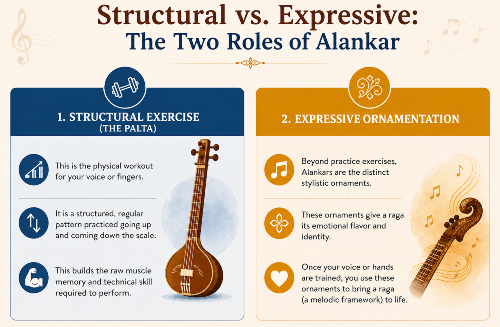
Structural vs. Expressive: The Two Roles of Alankar
In the daily life of a musician, an alankar in music serves two very distinct but equally important purposes. Understanding this difference is key to your growth.
- Structural Exercise (The Palta): This is the physical workout for your voice or fingers. As mentioned, it is a structured, regular pattern practiced going up and coming down the scale. This builds the raw muscle memory and technical skill required to perform.
- Expressive Ornamentation: Beyond practice exercises, Alankars are the distinct stylistic ornaments that give a raga its emotional flavor and identity. Once your voice or hands are trained, you use these ornaments to bring a raga (a melodic framework) to life.
The Expressive Alankar in Music: Detailed Techniques
Indian classical music rarely uses isolated, static notes (staccato); instead, notes are beautifully linked together. Western classical music often features notes played cleanly and separately, like stepping on distinct stones across a river. Indian classical music, however, is like the flowing water of the river itself- continuous, fluid, and connected.
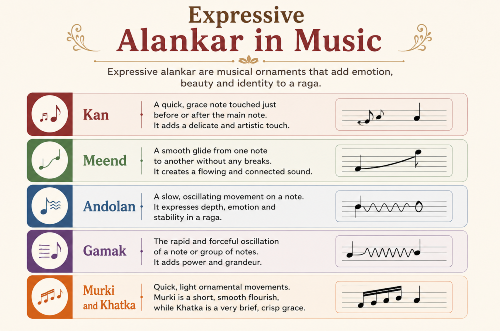
Here are the four major types of expressive Alankars include:
1. Kan (Grace Notes)
These are subtle, swiftly touched notes used to link different swaras, often acting as the starting point for longer glides. Think of a Kan as a tiny, fleeting shadow of a note. You do not stay on it; you just lightly tap it to give the main note more context and color. It acts as a springboard that launches the musician into the next primary melody.
2. Meend (Glides)
A fluid, continuous glide from one note to another. This is alankar in music, is the most famous and recognizable sound in Indian classical music.
- Complexity: It is highly complex because the speed and trajectory of the glide depend entirely on the rules of the raga. You cannot simply slide between two notes any way you wish; you must follow the precise emotional path dictated by the raga's historical tradition.
- Instrumental vs. Vocal: Instrumentalists may play a quick meend after plucking a string, known as a Ghaseet, while vocalists might perform a fast-paced version called a Soont.
3. Andolan (Gentle Swing)
A slow, microtonal oscillation that starts on a fixed note and gently swings to touch the periphery of another. This is not a fast, nervous shaking. Instead, it is a very slow, deliberate, and emotional swaying motion. It is used in serious, deep ragas to create a profound feeling of longing, gravity, or searching.
4. Gamak (Heavy Oscillation)
A fast-paced, heavy oscillation between notes delivered with deliberate force and vigor. Where the Andolan is soft and gentle, the Gamak is powerful, dramatic, and bold. It requires immense control from the diaphragm and creates a feeling of excitement and tension in a performance.
5. Murki and Khatka (Fast Flourishes)
Lighter, rapid renditions of note clusters that add subtle flair to a performance. These are lightning-fast decorations, often used in lighter, semi-classical music styles. They act as delicate, sparkling highlights within a melodic phrase, bringing a sense of playfulness and elegance.
Connecting Alankar to Rhythmic Structures (Taal)
While it is easy to think of Alankars only in terms of melody, their true power is unlocked when combined with rhythmic structures (Taal and Laya). Indian classical music relies heavily on intricate mathematical beat cycles.
When you practice a structured palta, you are not just singing notes freely; you must fit those notes perfectly into a specific rhythm, such as Teentaal (a 16-beat cycle) or Dadra (a 6-beat cycle).
- The Math of Music: If you are practicing a three-note pattern (like Sa-Re-Ga), you must calculate how to fit those three notes evenly across the beats of the drum (Tabla).
- Speed Variations: As you improve, you learn to sing or play the same Alankar at double speed (Dvigun) or quadruple speed (Chaugun) while the background drum beat remains steady.
This deep connection between the melody of the Alankar and the mathematics of the rhythmic cycle is what creates a truly well-rounded, masterful musician. It forces your brain to process both sound and time simultaneously and thus answers the question about what is alankar in music in actuality ?
Why Daily Alankar Practice (Riyaz) is Essential
While they may seem like simple warm-ups, Alankars are actually a powerful system for refining your musical personality. Daily practice provides profound benefits:
1. Improves Pitch and Rhythm
It helps you develop impeccable pitch accuracy (sur) and a solid sense of timing and tempo (laya). Because Indian music does not use backing chords or harmonies to hide mistakes, your pitch must be absolutely perfect. Practicing these exercises trains your ear to recognize the exact frequency of every single note, ensuring you never sing or play out of tune.
2. Builds Physical Flexibility
Singing or playing patterns involving 2 to 4 notes pushes your voice or fingers to move with ease, building the agility needed for fast, complex improvisations. Just like an athlete must stretch and do drills to prepare for a game, a musician must do these drills on alankar in music, so that when it is time to perform a rapid, thrilling musical passage, their muscles react instantly and effortlessly.
3. Enhances Breath Control
Holding notes and moving through sequences improves breath management for both vocalists and wind instrumentalists. A singer or a flute player cannot simply stop for a breath in the middle of a beautiful musical phrase. Practicing long, demanding Alankars expands lung capacity and teaches you how to ration your air effectively over long periods of time.
4. Strengthens Musical Imagination
As you master different patterns, your brain naturally begins to form new musical ideas, laying the groundwork for creative improvisation. Classical music is not just about memorizing songs; it is about creating spontaneous art on stage. By running these mathematical note patterns through your mind daily, your brain learns how to build beautiful, original melodies in real-time.
Practice Patterns for Beginners
If you want to start practicing, here are three basic patterns to incorporate into your daily routine:
(Note: In Hindustani music, the seven basic notes are Sa, Re, Ga, Ma, Pa, Dha, and Ni. Capital letters indicate a higher octave).
Pattern 1 (Single Notes)
This basic, straight scale is your daily starting line. It grounds you and helps you check your baseline pitch accuracy.
- Aaroh (Ascending): Sa Re Ga Ma Pa Dha Ni SA
- Avroh (Descending): SA Ni Dha Pa Ma Ga Re Sa
Pattern 2 (Double Notes)
This pattern forces you to articulate the same note twice. It is excellent for developing clarity and stability in your voice or on your instrument's fretboard.
- Aaroh: Sa Sa, Re Re, Ga Ga, Ma Ma, Pa Pa, Dha Dha, Ni Ni, Sa’ Sa’
- Avroh: Sa’ Sa’, Ni Ni, Dha Dha, Pa Pa, Ma Ma, Ga Ga, Re Re, Sa Sa
Pattern 3 (Three-Note Groupings)
This is where agility begins. Moving in triplets trains your mind to look slightly ahead of the current note you are playing.
- Aaroh: Sa Re Ga, Re Ga Ma, Ga Ma Pa, Ma Pa Dha, Pa Dha Ni, Dha Ni Sa’
- Avroh: Sa’ Ni Dha, Ni Dha Pa, Dha Pa Ma, Pa Ma Ga, Ma Ga Re, Ga Re Sa
Pattern 4 (Advanced Four-Note Groupings - Bonus Exercise)
Once you master the first three, try grouping notes in fours to build even more stamina and rhythmic discipline:
- Aaroh: Sa Re Ga Ma, Re Ga Ma Pa, Ga Ma Pa Dha, Ma Pa Dha Ni, Pa Dha Ni Sa’
- Avroh: Sa’ Ni Dha Pa, Ni Dha Pa Ma, Dha Pa Ma Ga, Pa Ma Ga Re, Ma Ga Re Sa
5 Expert Tips for an Effective Riyaz (Practice)
Simply repeating the notes is not enough; how you practice is just as important as what you practice. To get the most out of your Alankars, keep these expert tips in mind:
1. Use a Tanpura or Harmonium
Always practice with a drone instrument to maintain correct pitch alignment. You should never practice in complete silence. The drone (typically the sound of the Tanpura) provides a continuous background pitch. Your goal is to blend your voice or instrument perfectly into that background sound. This constant comparison is what develops a world-class musical ear over time.
2. Hold the 'Sa'
Spend time holding the base note ('Sa') steadily before moving through the patterns to stabilize your voice. Before you run a marathon, you must learn to stand still. Dedicate the first 5 to 10 minutes of your session just holding a long, unwavering Sa. This calms your mind, relaxes your throat, and anchors you into the musical scale for the rest of your practice.
3. Start Slow
Focus on perfect accuracy and clarity before trying to speed up. A common mistake beginners make is prioritizing speed over clear, even notes. If you practice fast but slightly out of tune, you are simply training yourself to be permanently out of tune. Always start at a very slow pace. Only increase your speed when you can play the entire pattern perfectly.
4. Practice in "Aakar"
Instead of always singing the note names (Sa, Re, Ga), practice singing the patterns using just the vowel sound "Aa" (Aakar). This is a crucial step for vocalists. When you sing the syllables, your brain uses them as a crutch. This trains your ear to recognize the melodies purely by their sound. It forces you to rely entirely on internal pitch memory, which is essential when you begin singing actual song lyrics later on.
5. Be Consistent
Consistency is far more important than marathon sessions. Many beginners think they need to practice for four hours on a Sunday to get better. This is completely false. Just 10 to 30 minutes of daily practice is enough to yield incredible, noticeable results. The brain and muscles need daily repetition to build permanent pathways. Short, highly focused, daily sessions will always beat long, irregular, and exhausting ones.
Beyond the Basics: The Mental and Psychological Benefits of Riyaz
While we have discussed the technical and historical aspects of Alankar, it is vital to acknowledge the psychological impact of this daily practice. In Indian traditions, riyaz (practice) is not merely homework; it is treated as a form of meditation and spiritual devotion.
When you sit down every morning, turn on your Tanpura, and begin reciting these structured, mathematical patterns, you are engaging in intense mindfulness.
- It requires you to block out the stresses of the outside world.
- It forces you to focus entirely on the present moment, listening intently to the microscopic vibrations of sound.
- This daily discipline builds immense patience, emotional resilience, and deep mental focus that spills over into every other area of your life.
The repetitive nature of the palta calms the nervous system, turning a simple musical exercise into a daily grounding ritual.
Conclusion: A Lifelong Companion
Alankars are not just beginner exercises that you quickly outgrow and leave behind once you learn how to play complex songs or beautiful ragas. They are lifelong tools and trusted companions for every musician on their journey.
Whether you are a seasoned maestro warming up backstage before a massive arena performance, or a complete beginner sitting down cross-legged on the floor for your very first lesson, you will rely on the exact same patterns. Returning to these simple, foundational structures daily is what keeps a musician's tone pure, their rhythm tight, and their ability to express deep emotion profoundly moving.
Do not rush the process. Embrace the simplicity of the patterns, respect the ancient traditions they come from, and trust that this daily discipline is quietly transforming you into a master. Turn on your Tanpura app, take a deep, steady breath, hold your Sa, and start your beautiful Alankar journey today
Frequently Asked Questions
What is alankar in music?
Ans. In Indian classical music, an alankar means an ornament or decoration. It is a structured pattern of musical notes (swaras) sung or played in specific ascending (aaroh) and descending (avroh) sequences. Alankars act like jewelry for a melody, helping build voice control, finger speed, and precision
What is Alankar in a song?
Ans. An alankar (meaning "ornament" or "decoration" in Sanskrit) in Indian music refers to a specific pattern of musical notes (swaras) used either as a vocal exercise for training or as an artistic embellishment to make a melody sound beautiful and expressive.
What is Sargam and Alankar?
Ans. Sargam Alankar refers to decorated, repeating musical note patterns used in Indian classical music for daily practice (riyaz) to build voice and instrument control. The core notes are Sa, Re, Ga, Ma, Pa, Dha, Ni, practiced in ascending (Aroha) and descending (Avaroha) sequences
What are the seven notes of Sargam?
Ans. The seven basic notes of sargam in Indian classical music are Sa, Re (or Ri), Ga, Ma, Pa, Dha, and Ni. These notes form the foundational octave, known as the Saptak, and correspond to Western solfège (Do, Re, Mi, Fa, Sol, La, Ti).
How to learn alankar?
• Know the notes: Learn the seven basic swaras and their higher/lower octaves.
• Use a reference: Practice with a physical harmonium, a keyboard, or a mobile pitch application.
• Start slow: Sing simple patterns like Sa Re Ga, Re Ga Ma, Ga Ma Pa at a steady, slow pace.
• Do both Swar and Akar: Sing the notes first (Swar) and then practice singing them on an open "Aa" vowel sound (Akar)
• Increase speed gradually: Raise your tempo only after you can hit every single note cleanly without wavering.