Table of Contents
Vishal Das
Hindustani Vocal Faculty
Spardha School of Music
If you've ever sat in a darkened concert hall with jasmine-scented air and the hum of the tambura, you've experienced musical history come alive. As a singer explores a meditative alap in Todi or a spirited variation in Kalyani, they're following a blueprint laid out centuries ago: the melakarta ragas system, one of the most sophisticated melodic frameworks in world music.
Carnatic music's "grammar" consists of the 72 melakarta ragas, which aren't mere technicalities but the genre's very DNA, marrying mathematical precision to emotional expression.
Explore some old bollywood songs to practice if you're learning singing!

Whether you're a student preparing for ABGMVM/BSPM exams or an enthusiast seeking deeper understanding, grasping this system opens up endless musical possibilities.
What is a Melakarta Raga?
The term "melakarta" comes from two Sanskrit roots:
- Mela = collection or group
- Karta = creator or doer
Thus, "melakarta" means "that which creates or generates groups."
These ragas are also called Janaka Ragas (Parent Ragas). Just as every shade of green derives from yellow and blue, thousands of Janya ragas (derivative ragas) stem from these 72 parent scales.
The Four Essential Rules
For a raga to qualify as a melakarta raga, it must meet strict criteria:
These rules create what musicologists call "a clean laboratory of sound" where each interval can be studied in its purest form.
Historical Evolution: The Birth of the System
The melakarta ragas system evolved through centuries of musical scholarship.
Ancient Foundations
Before the term "melakarta" existed, ancient Tamil music had the Pann classification, while the Natyashastra defined Jatis. As the number of ragas grew, a more systematic organization became essential, but it happened in phases:
Venkatamakhi (17th Century)
The pivotal moment came with 17th-century scholar Venkatamakhi and his monumental work, Chaturdaṇḍī Prakāśikā. He mathematically predicted all possible scales, establishing the foundation for the 72 melakarta ragas list.
His original system included some non-linear movements, but he introduced the Kanakangi-Ratnangi framework still used today.
Govindacharya (18th Century)
Musicologist Govindacharya formalized the system into the Sampurna Melakarta scheme we use today. He insisted every parent raga maintain absolute linearity and completeness. This version, called the Kanakambari-Phenadyuti system, became the academic standard embraced by the Carnatic Trinity—Tyagaraja, Muthuswami Dikshitar, and Syama Sastri.
But why 72?
The number 72 may seem arbitrary but it’s actually a mathematical certainty derived from combining the 12 semitones of an octave.
Understanding the Note Combinations
The calculation:
- 6 (Ri/Ga combinations) × 6 (Da/Ni combinations) = 36 variations
- 36 × 2 (for both Ma types) = 72 melakarta ragas
Shuddha vs. Prati Madhyama
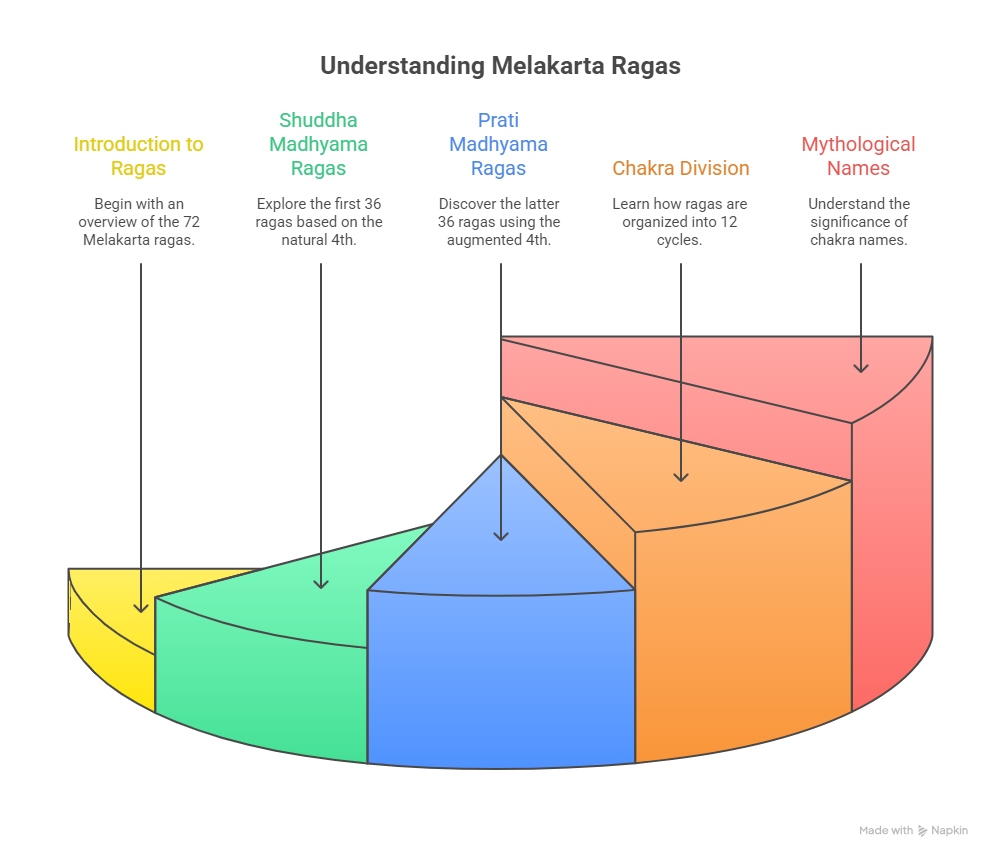
The 72 melakarta ragas split into two equal halves based on the fourth note:
This single note change dramatically alters a raga's emotional color.
The 12 Chakras: Organizing the Melakarta Chart
For easier navigation, the melakarta chart divides the 72 melakarta ragas list into 12 Chakras (cycles) of 6 ragas each. Each Chakra has a meaningful Sanskrit name rooted in Indian mythology.
First Half: Shuddha Madhyama Chakras (Ragas 1-36)
Second Half: Prati Madhyama Chakras (Ragas 37-72)
Knowing a raga's Chakra instantly reveals its Ri and Ga variations, while its position within the Chakra indicates its Da and Ni. It's a perfect indexing system for the melakarta ragas.
The Katapayadi Code: Hidden Numbers in Names
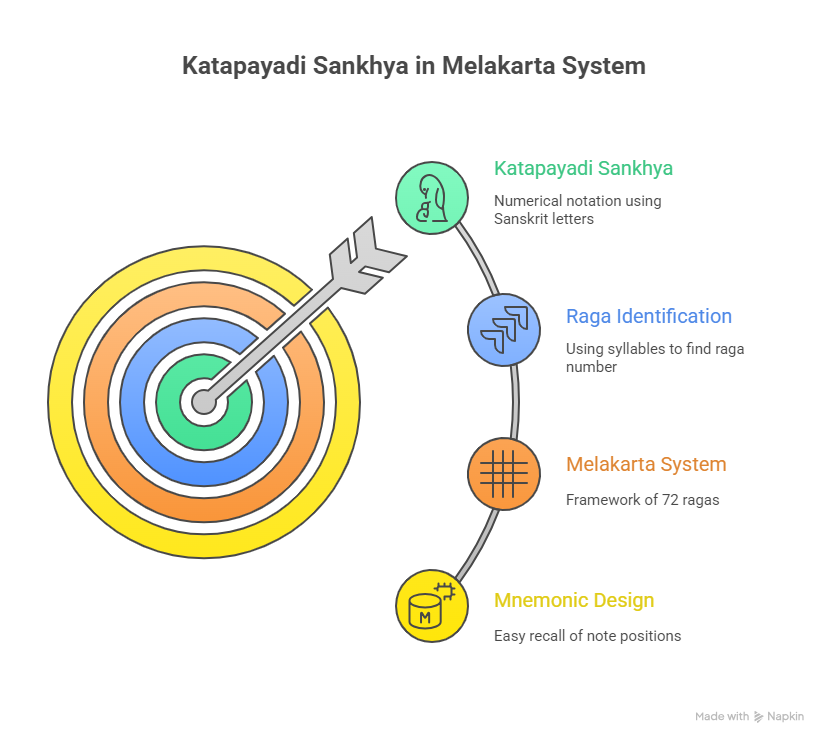
One of the most ingenious features of the melakarta ragas system is the Katapayadi Sankhya. It’s an ancient Indian numerical notation where Sanskrit syllables encode numbers.
The first two syllables of a melakarta raga's name reveal its exact position among the 72.
How the Code Works
Example 1: Mayamalavagaula
- Ma = 5
- Ya = 1
- Reverse the digits (per the rule "Ankaanaam Vaamato Gatih") = 15
- Result: Mayamalavagaula is the 15th melakarta raga
Example 2: Kharaharapriya
- Kha = 2
- Ra = 2
- Reverse = 22
- Result: Kharaharapriya is the 22nd melakarta raga
This mnemonic marvel allowed musicians to remember each raga's "address" in the 12×6 grid simply by speaking its name.
Explore Raga and time theory in the blog below!

Popular Melakarta Ragas
While all melakarta ragas are mathematically equal, some have achieved greater prominence in concert performance and pedagogy.
The Six Essential Melakarta Ragas
Mayamalavagaula is typically the first scale taught to Carnatic students because of its clear, distinguishable intervals. Hanumatodi dominates major concert performances due to its emotional depth.
Learn more about Mayamalavagaula the first raga to be taught!

Practical Applications: Why Study Melakarta Ragas Today?
If you’re pursuing ABGMVM/BSPM Music credentials, the melakarta ragas form the syllabus foundation, enabling structured answers about:
Academic Benefits
- Raga Classification: Determining whether a raga is parent or derivative
- Svara Identification: Recognizing specific note types within scales
- Comparative Musicology: Analyzing Carnatic scales versus Hindustani Thaats
Performance Benefits
The melakarta ragas system offers far more than exam preparation. As legendary musician R. K. Srikantan noted: "A musician who comprehends the melakarta system comprehends the boundaries. They know which notes to rely on and which create the 'tension' that makes a raga beautiful."
Understanding melakarta ragas enhances:
- Manodharma (Improvisation): Creating spontaneous variations within proper boundaries
- Raga Recognition: Identifying parent influences in derivative ragas
- Composition: Crafting new pieces with structural integrity
The Complete 72 Melakarta Ragas List
Here's a quick reference table for all 72 melakarta ragas:
Shuddha Madhyama Group (1-36)
Prati Madhyama Group (37-72)
Melakarta Chart: Quick Reference Guide
Understanding the melakarta chart structure helps musicians quickly identify raga characteristics:
Key Features of the Melakarta Chart
The melakarta chart functions as a periodic table of musical emotions, organizing all possibilities systematically.
Learning Path: Mastering the Melakarta Ragas
For students beginning their journey with melakarta ragas, here's a structured approach:
Beginner Level (6-12 months)
- Start with Mayamalavagaula (Raga 15)
- Learn basic svara patterns
- Practice identifying parent ragas in film songs
- Understand the 12 Chakra structure
Intermediate Level (1-2 years)
- Study 10-15 prominent melakarta ragas
- Learn Katapayadi encoding
- Practice raga identification by ear
- Explore janya raga relationships
Advanced Level (2+ years)
- Master all 72 melakarta ragas
- Study comparative analysis with Hindustani system
- Compose original pieces within melakarta frameworks
- Develop improvisation skills (manodharma)
Begin Your Journey with Spardha School of Music
If mastering the melakarta ragas system has sparked your interest in Carnatic music, Spardha School of Music offers the perfect platform to transform that curiosity into skill. With a carefully curated curriculum, expert-certified teachers, and personalized 1:1 live online classes, Spardha caters to learners across ages, whether you're a beginner exploring Mayamalavagaula or an advanced student perfecting Kalyani improvisations.
Conclusion
The 72 melakarta ragas system exemplifies how science and art can unite harmoniously. It proves that structure liberates creativity.
When you study the melakarta chart, you learn a knowledge system that has survived war, migration, and digital revolution as relevant to today's smartphone-equipped student as it was to palm-leaf manuscript scholars 400 years ago.
Frequently Asked Questions
1.What are the 72 melakarta ragas?
The 72 melakarta ragas are the complete set of parent scales in Carnatic music, systematically organized into 12 Chakras. Each uses all seven notes in linear ascending and descending patterns, forming the foundation for thousands of derivative ragas.
2. What is a melakarta raga?
A melakarta raga is a parent scale in Carnatic music that contains all seven notes (Sa, Ri, Ga, Ma, Pa, Da, Ni) in strict linear order without any zigzag patterns. It must have identical ascending and descending structures with only one version of each note.
3. Who is the father of melakarta raga?
Raamamaatya first suggested the mela system of ragas. But Venkatamakhi, a 17th-century musicologist, is credited as the father of the melakarta system as he detailed and presented it through his work Chaturdaṇḍī Prakāśikā. Govindacharya later refined it into the current Sampurna Melakarta system we use today.
4. Which is the first melakarta raga?
Kanakangi (also called Kanakambari) is the first melakarta raga, using all seven shuddha (pure) notes with the scale S R₁ G₁ M₁ P D₁ N₁ S. It forms the starting point of the Indu Chakra in the melakarta system.